In arithmetic and algebra, the eighth power of a number n is the result of multiplying eight instances of n together. So:
- n8 = n × n × n × n × n × n × n × n.
Eighth powers are also formed by multiplying a number by its seventh power, or the fourth power of a number by itself.
The sequence of eighth powers of integers is:
- 0, 1, 256, 6561, 65536, 390625, 1679616, 5764801, 16777216, 43046721, 100000000, 214358881, 429981696, 815730721, 1475789056, 2562890625, 4294967296, 6975757441, 11019960576, 16983563041, 25600000000, 37822859361, 54875873536, 78310985281, 110075314176, 152587890625 ... (sequence A001016 in the OEIS)
In the archaic notation of Robert Recorde, the eighth power of a number was called the "zenzizenzizenzic".[1]
Algebra and number theory
Polynomial equations of degree 8 are octic equations. These have the form
-
a
x
8
+
b
x
7
+
c
x
6
+
d
x
5
+
e
x
4
+
f
x
3
+
g
x
2
+
h
x
+
k
=
0.
{\displaystyle ax^{8}+bx^{7}+cx^{6}+dx^{5}+ex^{4}+fx^{3}+gx^{2}+hx+k=0.\,}

The smallest known eighth power that can be written as a sum of eight eighth powers is[2]
-
1409
8
=
1324
8
+
1190
8
+
1088
8
+
748
8
+
524
8
+
478
8
+
223
8
+
90
8
.
{\displaystyle 1409^{8}=1324^{8}+1190^{8}+1088^{8}+748^{8}+524^{8}+478^{8}+223^{8}+90^{8}.}

The sum of the reciprocals of the nonzero eighth powers is the Riemann zeta function evaluated at 8, which can be expressed in terms of the eighth power of pi:
-
ζ
(
8
)
=
1
1
8
+
1
2
8
+
1
3
8
+
⋯
=
π
8
9450
=
1.00407
…
{\displaystyle \zeta (8)={\frac {1}{1^{8}}}+{\frac {1}{2^{8}}}+{\frac {1}{3^{8}}}+\cdots ={\frac {\pi ^{8}}{9450}}=1.00407\dots }
(OEIS: A013666)
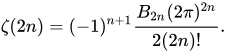
This is an example of a more general expression for evaluating the Riemann zeta function at positive even integers, in terms of the Bernoulli numbers:
-
ζ
(
2
n
)
=
(
−
1
)
n
+
1
B
2
n
(
2
π
)
2
n
2
(
2
n
)
!
.
{\displaystyle \zeta (2n)=(-1)^{n+1}{\frac {B_{2n}(2\pi )^{2n}}{2(2n)!}}.}
Physics
In aeroacoustics, Lighthill's eighth power law states that the power of the sound created by a turbulent motion, far from the turbulence, is proportional to the eighth power of the characteristic turbulent velocity.[3][4]
The ordered phase of the two-dimensional Ising model exhibits an inverse eighth power dependence of the order parameter upon the reduced temperature.[5]
The Casimir–Polder force between two molecules decays as the inverse eighth power of the distance between them.[6][7]
See also
References
- Womack, David (2015). "Beyond tetration operations: their past, present and future". Mathematics in School. 44 (1): 23–26. JSTOR 24767659.
- Quoted in Meyrignac, Jean-Charles (2001-02-14). "Computing Minimal Equal Sums Of Like Powers: Best Known Solutions". Retrieved 2019-12-18.
- Lighthill, M. J. (1952). "On sound generated aerodynamically. I. General theory". Proc. R. Soc. Lond. A. 211 (1107): 564–587. Bibcode:1952RSPSA.211..564L. doi:10.1098/rspa.1952.0060. S2CID 124316233.
- Lighthill, M. J. (1954). "On sound generated aerodynamically. II. Turbulence as a source of sound". Proc. R. Soc. Lond. A. 222 (1148): 1–32. Bibcode:1954RSPSA.222....1L. doi:10.1098/rspa.1954.0049. S2CID 123268161.
- Kardar, Mehran (2007). Statistical Physics of Fields. Cambridge University Press. p. 148. ISBN 978-0-521-87341-3. OCLC 1026157552.
- Casimir, H. B. G.; Polder, D. (1948). "The influence of retardation on the London-van der Waals forces". Physical Review. 73 (4): 360. Bibcode:1948PhRv...73..360C. doi:10.1103/PhysRev.73.360.
- Derjaguin, Boris V. (1960). "The force between molecules". Scientific American. 203 (1): 47–53. Bibcode:1960SciAm.203a..47D. doi:10.1038/scientificamerican0760-47. JSTOR 2490543.