 | |
| Names | |
|---|---|
| Preferred IUPAC name
3-Hydroxy-2-(phosphonooxy)propanoic acid | |
| Other names
2PG | |
| Identifiers | |
3D model (JSmol) |
|
| ChEBI | |
| ChemSpider |
|
| KEGG | |
PubChem CID |
|
CompTox Dashboard (EPA) |
|
| |
| |
| Properties | |
| C3H7O7P | |
| Molar mass | 186.06 g/mol |
Except where otherwise noted, data are given for materials in their standard state (at 25 °C [77 °F], 100 kPa).
| |


2-Phosphoglyceric acid (2PG), or 2-phosphoglycerate, is a glyceric acid which serves as the substrate in the ninth step of glycolysis. It is catalyzed by enolase into phosphoenolpyruvate (PEP), the penultimate step in the conversion of glucose to pyruvate.
2-phosphoglyceric acid is an intermediate that is part of the glycolysis pathway, and it is converted into phosphoenolpyruvate (PEP) by an enolase.[1] There are three types of enolase enzymes that are able to catalyze the conversion of 2-phosphoglyceric acid into PEP, which are alpha-enolase, beta-enolase, and gamma-enolase.[2] Studies have found that Alpha-enolase is the most common enolase, so it is often the specific enolase used to convert 2-phosphoglyceric acid into PEP.[2] Alpha-enolase catalyzes this conversion process by acting as a Hydrolase, which means that alpha-enolase removes a water molecule from the 2-phosphoglyceric acid in order to form PEP.[3]
In glycolysis
| 3-phospho-D-glycerate | Phosphoglyceromutase | 2-phospho-D-glycerate | Enolase | phosphoenolpyruvate | ||
 |
 |
 | ||||
| H2O | ||||||
 |
 | |||||
| H2O | ||||||
| Phosphoglyceromutase | Enolase | |||||
Compound C00197 at KEGG Pathway Database. Enzyme 5.4.2.1 at KEGG Pathway Database. Compound C00631 at KEGG Pathway Database. Enzyme 4.2.1.11 at KEGG Pathway Database. Compound C00074 at KEGG Pathway Database.
Click on genes, proteins and metabolites below to link to respective articles.[§ 1]
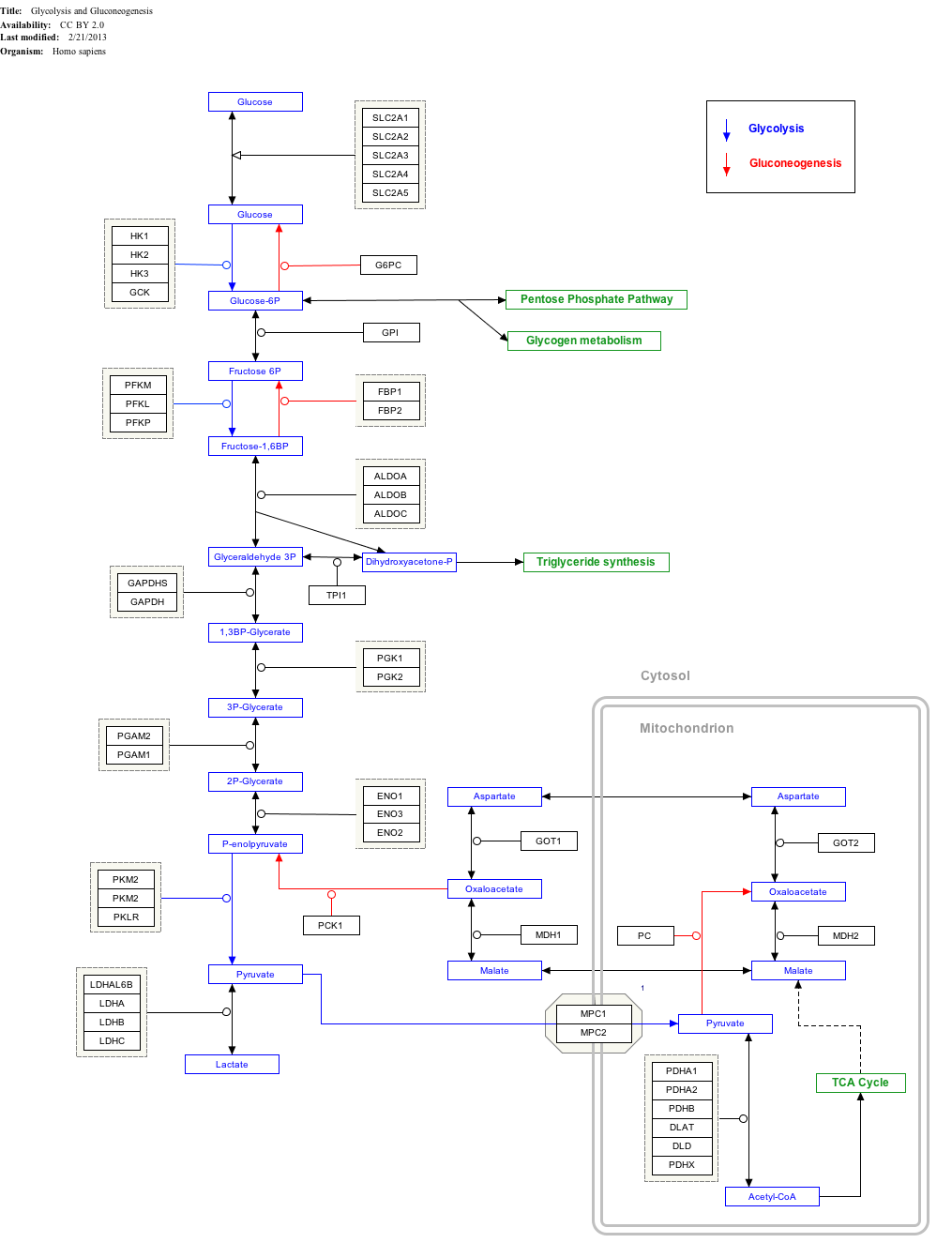

- The interactive pathway map can be edited at WikiPathways: "GlycolysisGluconeogenesis_WP534".
See also
References
- Ji, Hong; Wang, Jianfa; Guo, Jingru; Li, Yue; Lian, Shuai; Guo, Wenjin; Yang, Huanmin; Kong, Fanzhi; Zhen, Li; Guo, Li; Liu, Yanzhi (2016-03-01). "Progress in the biological function of alpha-enolase". Animal Nutrition. 2 (1): 12–17. doi:10.1016/j.aninu.2016.02.005. ISSN 2405-6545. PMC 5941012. PMID 29767008.
- Didiasova, Miroslava; Schaefer, Liliana; Wygrecka, Malgorzata (2019-04-26). "When Place Matters: Shuttling of Enolase-1 Across Cellular Compartments". Frontiers in Cell and Developmental Biology. 7 61. doi:10.3389/fcell.2019.00061. ISSN 2296-634X. PMC 6498095. PMID 31106201.
- Huang, Chen Kai; Sun, Ying; Lv, Lei; Ping, Yong (2022-03-17). "ENO1 and Cancer". Molecular Therapy - Oncolytics. 24: 288–298. doi:10.1016/j.omto.2021.12.026. ISSN 2372-7705. PMC 8987341. PMID 35434271.