
| Milü | |||||||||||||||
|---|---|---|---|---|---|---|---|---|---|---|---|---|---|---|---|
| Chinese | 密率 | ||||||||||||||
| Literal meaning | close ratio | ||||||||||||||
| |||||||||||||||
Milü (Chinese: 密率; pinyin: mìlǜ; lit. 'close ratio'), also known as Zulü (Zu's ratio), is the name given to an approximation of π (pi) found by the Chinese mathematician and astronomer Zu Chongzhi during the 5th century. Using Liu Hui's algorithm, which is based on the areas of regular polygons approximating a circle, Zu computed π as being between 3.1415926 and 3.1415927[a] and gave two rational approximations of π, 22/7 and 355/113, which were named yuelü (约率; yuēlǜ; 'approximate ratio') and milü respectively.[1]
355/113 is the best rational approximation of π with a denominator of four digits or fewer, being accurate to six decimal places. It is within 0.000009% of the value of π, or in terms of common fractions overestimates π by less than 1/3748629. The next rational number (ordered by size of denominator) that is a better rational approximation of π is 52163/16604, though it is still only correct to six decimal places. To be accurate to seven decimal places, one needs to go as far as 86953/27678. For eight, 102928/32763 is needed, and for nine, 103993/33102 is required.[2]
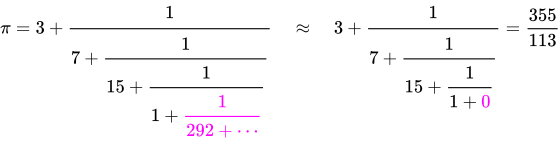
The accuracy of milü to the true value of π can be explained using the continued fraction expansion of π, the first few terms of which are [3; 7, 15, 1, 292, 1, 1, ...] (sequence A001203 in the OEIS). A property of continued fractions is that truncating the expansion of a given number at any point will give the best rational approximation of the number. To obtain milü, truncate the continued fraction expansion of π immediately before the term 292; that is, π is approximated by the finite continued fraction [3; 7, 15, 1], which is equivalent to milü. Since 292 is an unusually large term in a continued fraction expansion (corresponding to the next truncation introducing only a very small term, 1/292, to the overall fraction), this convergent will be especially close to the true value of π:[3]
-
π
=
3
+
1
7
+
1
15
+
1
1
+
1
292
+
⋯
≈
3
+
1
7
+
1
15
+
1
1
+
0
=
355
113
{\displaystyle \pi =3+{\cfrac {1}{7+{\cfrac {1}{15+{\cfrac {1}{1+{\color {magenta}{\cfrac {1}{292+\cdots }}}}}}}}}\quad \approx \quad 3+{\cfrac {1}{7+{\cfrac {1}{15+{\cfrac {1}{1+{\color {magenta}0}}}}}}}={\frac {355}{113}}}
Zu's contemporary calendarist and mathematician He Chengtian invented a fraction interpolation method called 'harmonization of the divisor of the day' (调日法; diaorifa) to increase the accuracy of approximations of π by iteratively adding the numerators and denominators of fractions. Zu's approximation of π ≈ 355/113 can be obtained with He Chengtian's method.[1]
See also
Notes
- Specifically, Zu found that if the diameter
d
{\displaystyle d}
of a circle has a length of 100 , 000 , 000 {\displaystyle 100,000,000}
, then the length of the circle's circumference C {\displaystyle C}
falls within the range 314 , 159 , 260 < C < 314 , 159 , 270 {\displaystyle 314,159,260<C<314,159,270}
. It is not known what method Zu used to calculate this result.
References
- Martzloff, Jean-Claude (2006). A History of Chinese Mathematics. Springer. p. 281. ISBN 9783540337829.
- "Fractional Approximations of Pi".
- Weisstein, Eric W. "Pi Continued Fraction". mathworld.wolfram.com. Retrieved 2017-09-03.