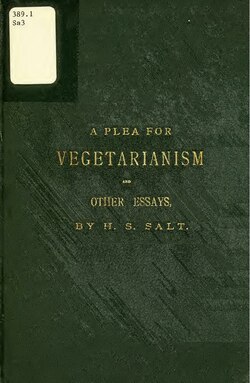
 First edition cover | |
| Author | Henry S. Salt |
|---|---|
| Language | English |
| Subject | Vegetarianism, animal rights |
| Genre | Essay collection |
| Publisher | The Vegetarian Society |
| Publication date | 1886 |
| Publication place | United Kingdom |
| Media type | Print (paperback and hardback) |
| Pages | 115 |
| OCLC | 1050804885 |
| Text | A Plea for Vegetarianism and Other Essays at Wikisource |
A Plea for Vegetarianism and Other Essays is a 1886 essay collection by the British writer and social reformer Henry S. Salt. Published by the Vegetarian Society in Manchester, it sets out ethical, economic, aesthetic, and practical arguments for vegetarianism. It was Salt's first published book.
Background

Salt was active in a number of reform causes in the late 19th century, including prison reform, education, socialism, and animal protection. He later founded the Humanitarian League in 1891. In A Plea for Vegetarianism and Other Essays, he argued that a vegetarian diet was humane, economical, and practicable, and challenged common objections to abstention from meat.[1]
A Plea for Vegetarianism and Other Essays was the first of 40 books by Salt.[1]
Publication
A Plea for Vegetarianism and Other Essays was published in 1886 by the Vegetarian Society, based at Princess Street, Manchester. The book was printed and distributed by John Heywood (Deansgate and Ridgefield, Manchester; and Paternoster Buildings, London) and F. Pitman (Paternoster Row, London). It was issued in paper covers at one shilling and in cloth at one shilling and sixpence.[2]
Summary
The volume contains ten essays:[3]
- "A Plea for Vegetarianism"
- "Morality in Diet"
- "Good Taste in Diet"
- "Some Results of Food Reform"
- "Medical Men and Food Reform"
- "Sir Henry Thompson on 'Diet'"
- "On Certain Fallacies"
- "Sport"
- "The Philosophy of Cannibalism"
- "Vegetarianism and Social Reform"
Across these essays, Salt defends vegetarianism on ethical, social, and economic grounds. He argues against the killing of animals for food, disputes the view that meat is necessary for health, and links diet to wider questions of conduct and social reform. Several essays also attack blood sports and reply to objections made by critics of vegetarianism, including Sir Henry Thompson.[3]
Legacy
Themes developed in A Plea for Vegetarianism and Other Essays appeared again in Salt's later writings, including Animals' Rights: Considered in Relation to Social Progress (1892).[4]
At a social meeting organised by the London Vegetarian Society on 20 November 1931, Gandhi said that Salt's A Plea for Vegetarianism had shown him that vegetarianism was "a moral duty" and not only a matter of custom or personal vow.[5]
See also
References
- Salt, H. S. (9 June 2025). "A Plea for Vegetarianism and Other Essays". In Miller, Ian (ed.). Food in Nineteenth-Century British History. Vol. Three: Mealtimes. Abingdon: Routledge. doi:10.4324/9781003594567. ISBN 978-1-003-59456-7.
- Salt, Henry S. (1886). A Plea for Vegetarianism and Other Essays. Manchester: The Vegetarian Society.
- Salt, Henry S. (1886). A Plea for Vegetarianism and Other Essays. Manchester: The Vegetarian Society – via Wikisource.
- Clark, Brett; Foster, John Bellamy (2000). "Henry S. Salt, Socialist Animal Rights Activist: An Introduction to Salt's 'A Lover of Animals'". Organization & Environment. 13 (4): 468–473. ISSN 1086-0266.
- Gandhi, Mohandas Karamchand (Mahatma). "The Moral Basis of Vegetarianism". SouthernCross Review. Retrieved 22 June 2025.