In commutative algebra, the mathematical study of commutative rings, adic topologies are a family of topologies on the underlying set of a module, generalizing the p-adic topologies on the integers.
Definition
Let R be a commutative ring and M an R-module. Then each ideal 𝔞 of R determines a topology on M called the 𝔞-adic topology, characterized by the pseudometric
d
(
x
,
y
)
=
2
−
sup
{
n
∣
x
−
y
∈
a
n
M
}
.
{\displaystyle d(x,y)=2^{-\sup {\{n\mid x-y\in {\mathfrak {a}}^{n}M\}}}.}


An 𝔞-adic topology is a linear topology (a topology generated by some submodules).
Properties
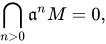
With respect to the topology, the module operations of addition and scalar multiplication are continuous, so that M becomes a topological module. However, M need not be Hausdorff; it is Hausdorff if and only if
⋂
n
>
0
a
n
M
=
0
,
{\displaystyle \bigcap _{n>0}{{\mathfrak {a}}^{n}M}=0{\text{,}}}
By Krull's intersection theorem, if R is a Noetherian ring which is an integral domain or a local ring, it holds that
⋂
n
>
0
a
n
=
0
{\displaystyle \bigcap _{n>0}{{\mathfrak {a}}^{n}}=0}

For a submodule N of M, the canonical homomorphism to M/N induces a quotient topology which coincides with the 𝔞-adic topology. The analogous result is not necessarily true for the submodule N itself: the subspace topology need not be the 𝔞-adic topology. However, the two topologies coincide when R is Noetherian and M finitely generated. This follows from the Artin–Rees lemma.[2]
Completion
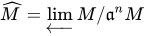
When M is Hausdorff, M can be completed as a metric space; the resulting space is denoted by
M
^
{\displaystyle {\widehat {M}}}

For example, let
R
=
k
[
x
1
,
…
,
x
n
]
{\displaystyle R=k[x_{1},\ldots ,x_{n}]}
![{\displaystyle R=k[x_{1},\ldots ,x_{n}]}](https://wikimedia.org/api/rest_v1/media/math/render/svg/bef4b57c888ca300b8994915ac191e505f39ed82)
![{\displaystyle {\hat {R}}=k[[x_{1},\ldots ,x_{n}]]}](https://wikimedia.org/api/rest_v1/media/math/render/svg/425aaa134c50b6cdd6f2d11e27b21a92601ae5b4)
Closed submodules
The 𝔞-adic closure of a submodule
N
⊆
M
{\displaystyle N\subseteq M}


R is called Zariski with respect to 𝔞 if every ideal in R is 𝔞-adically closed. There is a characterization:
- R is Zariski with respect to 𝔞 if and only if 𝔞 is contained in the Jacobson radical of R.
In particular a Noetherian local ring is Zariski with respect to the maximal ideal.[7]
References
- Singh 2011, p. 147.
- Singh 2011, p. 148.
- Singh 2011, pp. 148–151.
- Singh 2011, problem 8.16.
- Singh 2011, problem 8.4.
- Singh 2011, problem 8.8
- Atiyah & MacDonald 1969, p. 114, exercise 6.
Sources
- Singh, Balwant (2011). Basic Commutative Algebra. Singapore/Hackensack, NJ: World Scientific. ISBN 978-981-4313-61-2.
- Atiyah, M. F.; MacDonald, I. G. (1969). Introduction to Commutative Algebra. Reading, MA: Addison-Wesley.