In number theory the Agoh–Giuga conjecture on the Bernoulli numbers Bk postulates that p is a prime number if and only if
-
p
B
p
−
1
≡
−
1
(
mod
p
)
.
{\displaystyle pB_{p-1}\equiv -1{\pmod {p}}.}

It is named after Takashi Agoh and Giuseppe Giuga.
Equivalent formulation
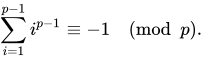
The conjecture as stated above is due to Takashi Agoh (1990); an equivalent formulation is due to Giuseppe Giuga, from 1950, to the effect that p is prime if and only if
-
1
p
−
1
+
2
p
−
1
+
⋯
+
(
p
−
1
)
p
−
1
≡
−
1
(
mod
p
)
{\displaystyle 1^{p-1}+2^{p-1}+\cdots +(p-1)^{p-1}\equiv -1{\pmod {p}}}

which may also be written as
-
∑
i
=
1
p
−
1
i
p
−
1
≡
−
1
(
mod
p
)
.
{\displaystyle \sum _{i=1}^{p-1}i^{p-1}\equiv -1{\pmod {p}}.}
It is trivial to show that p being prime is sufficient for the second equivalence to hold, since if p is prime, Fermat's little theorem states that
-
a
p
−
1
≡
1
(
mod
p
)
{\displaystyle a^{p-1}\equiv 1{\pmod {p}}}

for
a
=
1
,
2
,
…
,
p
−
1
{\displaystyle a=1,2,\dots ,p-1}


Status
The statement is still a conjecture since it has not yet been proven that if a number n is not prime (that is, n is composite), then the formula does not hold. It has been shown that a composite number n satisfies the formula if and only if it is both a Carmichael number and a Giuga number, and that if such a number exists, it has at least 13,800 digits (Borwein, Borwein, Borwein, Girgensohn 1996). Laerte Sorini, in a work of 2001 showed that a possible counterexample should be a number n greater than 1036067 which represents the limit suggested by Bedocchi for the demonstration technique specified by Giuga to his own conjecture.
Relation to Wilson's theorem
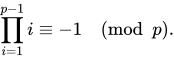
The Agoh–Giuga conjecture bears a similarity to Wilson's theorem, which has been proven to be true. Wilson's theorem states that a number p is prime if and only if
-
(
p
−
1
)
!
≡
−
1
(
mod
p
)
,
{\displaystyle (p-1)!\equiv -1{\pmod {p}},}

which may also be written as
-
∏
i
=
1
p
−
1
i
≡
−
1
(
mod
p
)
.
{\displaystyle \prod _{i=1}^{p-1}i\equiv -1{\pmod {p}}.}
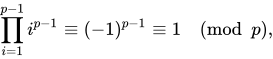
For an odd prime p we have
-
∏
i
=
1
p
−
1
i
p
−
1
≡
(
−
1
)
p
−
1
≡
1
(
mod
p
)
,
{\displaystyle \prod _{i=1}^{p-1}i^{p-1}\equiv (-1)^{p-1}\equiv 1{\pmod {p}},}
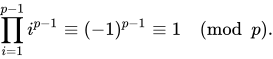
and for p=2 we have
-
∏
i
=
1
p
−
1
i
p
−
1
≡
(
−
1
)
p
−
1
≡
1
(
mod
p
)
.
{\displaystyle \prod _{i=1}^{p-1}i^{p-1}\equiv (-1)^{p-1}\equiv 1{\pmod {p}}.}
So, the truth of the Agoh–Giuga conjecture combined with Wilson's theorem would give: a number p is prime if and only if
-
∑
i
=
1
p
−
1
i
p
−
1
≡
−
1
(
mod
p
)
{\displaystyle \sum _{i=1}^{p-1}i^{p-1}\equiv -1{\pmod {p}}}
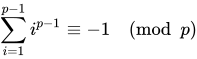
and
-
∏
i
=
1
p
−
1
i
p
−
1
≡
1
(
mod
p
)
.
{\displaystyle \prod _{i=1}^{p-1}i^{p-1}\equiv 1{\pmod {p}}.}

See also
References
- Giuga, Giuseppe (1951). "Su una presumibile proprietà caratteristica dei numeri primi". Ist.Lombardo Sci. Lett., Rend., Cl. Sci. Mat. Natur. (in Italian). 83: 511–518. ISSN 0375-9164. Zbl 0045.01801.
- Agoh, Takashi (1995). "On Giuga's conjecture". Manuscripta Mathematica. 87 (4): 501–510. doi:10.1007/bf02570490. Zbl 0845.11004.
- Borwein, D.; Borwein, J. M.; Borwein, P. B.; Girgensohn, R. (1996). "Giuga's Conjecture on Primality" (PDF). American Mathematical Monthly. 103 (1): 40–50. CiteSeerX 10.1.1.586.1424. doi:10.2307/2975213. JSTOR 2975213. Zbl 0860.11003. Archived from the original (PDF) on 2005-05-31. Retrieved 2005-05-29.
- Sorini, Laerte (2001). "Un Metodo Euristico per la Soluzione della Congettura di Giuga". Quaderni di Economia, Matematica e Statistica, DESP, Università di Urbino Carlo Bo (in Italian). 68. ISSN 1720-9668.