Alexander's trick, also known as the Alexander trick, is a basic result in geometric topology, named after J. W. Alexander.
Statement
Two homeomorphisms of the n-dimensional ball
D
n
{\displaystyle D^{n}}


More generally, two homeomorphisms of
D
n
{\displaystyle D^{n}}
Proof
Base case: every homeomorphism which fixes the boundary is isotopic to the identity relative to the boundary.
If
f
:
D
n
→
D
n
{\displaystyle f\colon D^{n}\to D^{n}}


-
J
(
x
,
t
)
=
{
t
f
(
x
/
t
)
,
if
0
≤
‖
x
‖
<
t
,
x
,
if
t
≤
‖
x
‖
≤
1.
{\displaystyle J(x,t)={\begin{cases}tf(x/t),&{\text{if }}0\leq \|x\|<t,\\x,&{\text{if }}t\leq \|x\|\leq 1.\end{cases}}}

Visually, the homeomorphism is 'straightened out' from the boundary, 'squeezing'
f
{\displaystyle f}


The subtlety is that at
t
=
0
{\displaystyle t=0}

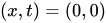
General case: isotopic on boundary implies isotopic
If
f
,
g
:
D
n
→
D
n
{\displaystyle f,g\colon D^{n}\to D^{n}}



Radial extension
Some authors use the term Alexander trick for the statement that every homeomorphism of
S
n
−
1
{\displaystyle S^{n-1}}
However, this is much easier to prove than the result discussed above: it is called radial extension (or coning) and is also true piecewise-linearly, but not smoothly.
Concretely, let
f
:
S
n
−
1
→
S
n
−
1
{\displaystyle f\colon S^{n-1}\to S^{n-1}}

-
F
:
D
n
→
D
n
with
F
(
r
x
)
=
r
f
(
x
)
for all
r
∈
[
0
,
1
]
and
x
∈
S
n
−
1
{\displaystyle F\colon D^{n}\to D^{n}{\text{ with }}F(rx)=rf(x){\text{ for all }}r\in [0,1]{\text{ and }}x\in S^{n-1}}
defines a homeomorphism of the ball.
Exotic spheres
The failure of smooth radial extension and the success of PL radial extension yield exotic spheres via twisted spheres.
See also
References
- Hansen, Vagn Lundsgaard (1989). Braids and coverings: selected topics. London Mathematical Society Student Texts. Vol. 18. Cambridge: Cambridge University Press. doi:10.1017/CBO9780511613098. ISBN 0-521-38757-4. MR 1247697.
- Alexander, J. W. (1923). "On the deformation of an n-cell". Proceedings of the National Academy of Sciences of the United States of America. 9 (12): 406–407. Bibcode:1923PNAS....9..406A. doi:10.1073/pnas.9.12.406. PMC 1085470. PMID 16586918.