A solution in radicals or algebraic solution is an expression of a solution of a polynomial equation that is algebraic, that is, relies only on addition, subtraction, multiplication, division, raising to integer powers, and extraction of nth roots (square roots, cube roots, etc.).
A well-known example is the quadratic formula
-
x
=
−
b
±
b
2
−
4
a
c
2
a
,
{\displaystyle x={\frac {-b\pm {\sqrt {b^{2}-4ac\ }}}{2a}},}
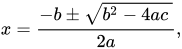
which expresses the solutions of the quadratic equation
-
a
x
2
+
b
x
+
c
=
0.
{\displaystyle ax^{2}+bx+c=0.}

There exist algebraic solutions for cubic equations[1] and quartic equations,[2] which are more complicated than the quadratic formula. The Abel–Ruffini theorem,[3]: 211 and, more generally Galois theory, state that some quintic equations, such as
-
x
5
−
x
+
1
=
0
,
{\displaystyle x^{5}-x+1=0,}

do not have any algebraic solution. The same is true for every higher degree. However, for any degree there are some polynomial equations that have algebraic solutions; for example, the equation
x
10
=
2
{\displaystyle x^{10}=2}

![{\displaystyle x=\pm {\sqrt[{10}]{2}}.}](https://wikimedia.org/api/rest_v1/media/math/render/svg/685464ac5a9ee481b1eaea4e3077295eaa876fc2)
![{\displaystyle x=\pm r{\sqrt[{10}]{2}},}](https://wikimedia.org/api/rest_v1/media/math/render/svg/e280ec5745504f0316e7edcf240579cb60cd9202)
Évariste Galois introduced a criterion allowing one to decide which equations are solvable in radicals. See Radical extension for the precise formulation of his result.
See also
References
- Nickalls, R. W. D., "A new approach to solving the cubic: Cardano's solution revealed," Mathematical Gazette 77, November 1993, 354-359.
- Carpenter, William, "On the solution of the real quartic," Mathematics Magazine 39, 1966, 28-30.
- Jacobson, Nathan (2009), Basic Algebra 1 (2nd ed.), Dover, ISBN 978-0-486-47189-1