The Bochner–Riesz mean is a summability method often used in harmonic analysis when considering convergence of Fourier series and Fourier integrals. It was introduced by Salomon Bochner as a modification of the Riesz mean.
Definition
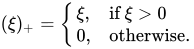
Define
-
(
ξ
)
+
=
{
ξ
,
if
ξ
>
0
0
,
otherwise
.
{\displaystyle (\xi )_{+}={\begin{cases}\xi ,&{\mbox{if }}\xi >0\\0,&{\mbox{otherwise}}.\end{cases}}}
Let
f
{\displaystyle f}


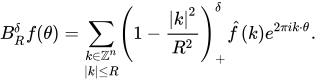
-
B
R
δ
f
(
θ
)
=
∑
k
∈
Z
n
|
k
|
≤
R
(
1
−
|
k
|
2
R
2
)
+
δ
f
^
(
k
)
e
2
π
i
k
⋅
θ
.
{\displaystyle B_{R}^{\delta }f(\theta )={\underset {|k|\leq R}{\sum _{k\in \mathbb {Z} ^{n}}}}\left(1-{\frac {|k|^{2}}{R^{2}}}\right)_{+}^{\delta }{\hat {f}}(k)e^{2\pi ik\cdot \theta }.}
Analogously, for a function
f
{\displaystyle f}


-
S
R
δ
f
(
x
)
=
∫
|
ξ
|
≤
R
(
1
−
|
ξ
|
2
R
2
)
+
δ
f
^
(
ξ
)
e
2
π
i
x
⋅
ξ
d
ξ
.
{\displaystyle S_{R}^{\delta }f(x)=\int _{|\xi |\leq R}\left(1-{\frac {|\xi |^{2}}{R^{2}}}\right)_{+}^{\delta }{\hat {f}}(\xi )e^{2\pi ix\cdot \xi }\,d\xi .}

Application to convolution operators
For
δ
>
0
{\displaystyle \delta >0}


In higher dimensions, the convolution kernels become "worse behaved": specifically, for
-
δ
≤
n
−
1
2
{\displaystyle \delta \leq {\tfrac {n-1}{2}}}

the kernel is no longer integrable. Here, establishing almost everywhere convergence becomes correspondingly more difficult.
Bochner–Riesz conjecture
Another question is that of for which
δ
{\displaystyle \delta }


By a transference result, the
R
n
{\displaystyle \mathbb {R} ^{n}}


For
n
=
2
{\displaystyle n=2}


Define
δ
(
p
)
{\displaystyle \delta (p)}

-
max
(
n
|
1
/
p
−
1
/
2
|
−
1
/
2
,
0
)
{\displaystyle \max(n|1/p-1/2|-1/2,0)}
.
Then the Bochner–Riesz conjecture states that
-
δ
>
δ
(
p
)
{\displaystyle \delta >\delta (p)}

is the necessary and sufficient condition for a
L
p
{\displaystyle L^{p}}
References
- Fefferman, Charles (1971). "The multiplier problem for the ball". Annals of Mathematics. 94 (2): 330–336. doi:10.2307/1970864. JSTOR 1970864.
- Sogge, C. D. (2008). "Lectures on eigenfunctions of the Laplacian". Topics in Mathematical Analysis. By Ciatti, Paolo; Gonzalez, Eduardo; Lanza de Cristoforis, Massimo; Leonardi, Gian Paolo. World Scientific. p. 347. ISBN 9789812811066.
Further reading
- Lu, Shanzhen (2013). Bochner-Riesz Means on Euclidean Spaces (First ed.). World Scientific. ISBN 978-981-4458-76-4.
- Grafakos, Loukas (2008). Classical Fourier Analysis (Second ed.). Berlin: Springer. ISBN 978-0-387-09431-1.
- Grafakos, Loukas (2009). Modern Fourier Analysis (Second ed.). Berlin: Springer. ISBN 978-0-387-09433-5.
- Stein, Elias M. & Murphy, Timothy S. (1993). Harmonic Analysis: Real-variable Methods, Orthogonality, and Oscillatory Integrals. Princeton: Princeton University Press. ISBN 0-691-03216-5.