Bochner theorem

☆ Save On Wikipedia ↗

In mathematics, Bochner's theorem (named for Salomon Bochner) characterizes the Fourier-Stieltjes transform of a positive finite Borel measure on the real line.[1] More generally in harmonic analysis, Bochner's theorem asserts that under Fourier transform a continuous positive-definite function on a locally compact abelian group corresponds to a finite positive measure on the Pontryagin dual group. The case of sequences was first established by Gustav Herglotz[2][3]

The theorem for locally compact abelian groups

Bochner's theorem for a locally compact abelian group G {\displaystyle G} {\displaystyle G}, with dual group G ^ {\displaystyle {\widehat {G}}} {\displaystyle {\widehat {G}}}, says the following:[4]

Theorem For any normalized continuous positive-definite function f : G → C {\displaystyle f:G\to \mathbb {C} } {\displaystyle f:G\to \mathbb {C} } (normalization here means that f {\displaystyle f} {\displaystyle f} is 1 at the unit of G {\displaystyle G} {\displaystyle G}), there exists a unique probability measure μ {\displaystyle \mu } {\displaystyle \mu } on G ^ {\displaystyle {\widehat {G}}} {\displaystyle {\widehat {G}}} such that

f ( g ) = ∫ G ^ ξ ( g ) d μ ( ξ ) , {\displaystyle f(g)=\int _{\widehat {G}}\xi (g)\,d\mu (\xi ),} {\displaystyle f(g)=\int _{\widehat {G}}\xi (g)\,d\mu (\xi ),}
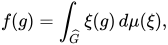
i.e. f {\displaystyle f} {\displaystyle f} is the Fourier transform of a unique probability measure μ {\displaystyle \mu } {\displaystyle \mu } on G ^ {\displaystyle {\widehat {G}}} {\displaystyle {\widehat {G}}}. Conversely, the Fourier transform of a probability measure on G ^ {\displaystyle {\widehat {G}}} {\displaystyle {\widehat {G}}} is necessarily a normalized continuous positive-definite function f {\displaystyle f} {\displaystyle f} on G {\displaystyle G} {\displaystyle G}. This is in fact a one-to-one correspondence.

The Gelfand–Fourier transform is an isomorphism between the group C*-algebra C ∗ ( G ) {\displaystyle C^{*}(G)} {\displaystyle C^{*}(G)} and C 0 ( G ^ ) {\displaystyle C_{0}({\widehat {G}})} {\displaystyle C_{0}({\widehat {G}})}. The theorem is essentially the dual statement for states of the two abelian C*-algebras.

The proof of the theorem passes through vector states on strongly continuous unitary representations of G {\displaystyle G} {\displaystyle G} (the proof in fact shows that every normalized continuous positive-definite function must be of this form).

Given a normalized continuous positive-definite function f {\displaystyle f} {\displaystyle f} on G {\displaystyle G} {\displaystyle G}, one can construct a strongly continuous unitary representation of G {\displaystyle G} {\displaystyle G} in a natural way: Let F 0 ( G ) {\displaystyle F_{0}(G)} {\displaystyle F_{0}(G)} be the family of complex-valued functions on G {\displaystyle G} {\displaystyle G} with finite support, i.e. h ( g ) = 0 {\displaystyle h(g)=0} {\displaystyle h(g)=0} for all but finitely many g {\displaystyle g} {\displaystyle g}. The positive-definite kernel K ( g 1 , g 2 ) = f ( g 1 − g 2 ) {\displaystyle K(g_{1},g_{2})=f(g_{1}-g_{2})} {\displaystyle K(g_{1},g_{2})=f(g_{1}-g_{2})} induces a (possibly degenerate) inner product on F 0 ( G ) {\displaystyle F_{0}(G)} {\displaystyle F_{0}(G)}. Quotienting out degeneracy and taking the completion gives a Hilbert space

( H , ⟨ ⋅ , ⋅ ⟩ f ) , {\displaystyle ({\mathcal {H}},\langle \cdot ,\cdot \rangle _{f}),} {\displaystyle ({\mathcal {H}},\langle \cdot ,\cdot \rangle _{f}),}

whose typical element is an equivalence class [ h ] {\displaystyle [h]} {\displaystyle [h]}. For a fixed g {\displaystyle g} {\displaystyle g} in G {\displaystyle G} {\displaystyle G}, the "shift operator" U g {\displaystyle U_{g}} {\displaystyle U_{g}} defined by ( U g h ) ( g ′ ) = h ( g ′ − g ) {\displaystyle (U_{g}h)(g')=h(g'-g)} {\displaystyle (U_{g}h)(g')=h(g'-g)}, for a representative of [ h ] {\displaystyle [h]} {\displaystyle [h]}, is unitary. So the map

g ↦ U g {\displaystyle g\mapsto U_{g}} {\displaystyle g\mapsto U_{g}}

is a unitary representations of G {\displaystyle G} {\displaystyle G} on ( H , ⟨ ⋅ , ⋅ ⟩ f ) {\displaystyle ({\mathcal {H}},\langle \cdot ,\cdot \rangle _{f})} {\displaystyle ({\mathcal {H}},\langle \cdot ,\cdot \rangle _{f})}. By continuity of f {\displaystyle f} {\displaystyle f}, it is weakly continuous, therefore strongly continuous. By construction, we have

⟨ U g [ e ] , [ e ] ⟩ f = f ( g ) , {\displaystyle \langle U_{g}[e],[e]\rangle _{f}=f(g),} {\displaystyle \langle U_{g}[e],[e]\rangle _{f}=f(g),}

where [ e ] {\displaystyle [e]} {\displaystyle [e]} is the class of the function that is 1 on the identity of G {\displaystyle G} {\displaystyle G} and zero elsewhere. But by Gelfand–Fourier isomorphism, the vector state ⟨ ⋅ [ e ] , [ e ] ⟩ f {\displaystyle \langle \cdot [e],[e]\rangle _{f}} {\displaystyle \langle \cdot [e],[e]\rangle _{f}} on C ∗ ( G ) {\displaystyle C^{*}(G)} {\displaystyle C^{*}(G)} is the pullback of a state on C 0 ( G ^ ) {\displaystyle C_{0}({\widehat {G}})} {\displaystyle C_{0}({\widehat {G}})}, which is necessarily integration against a probability measure μ {\displaystyle \mu } {\displaystyle \mu }. Chasing through the isomorphisms then gives

⟨ U g [ e ] , [ e ] ⟩ f = ∫ G ^ ξ ( g ) d μ ( ξ ) . {\displaystyle \langle U_{g}[e],[e]\rangle _{f}=\int _{\widehat {G}}\xi (g)\,d\mu (\xi ).} {\displaystyle \langle U_{g}[e],[e]\rangle _{f}=\int _{\widehat {G}}\xi (g)\,d\mu (\xi ).}

On the other hand, given a probability measure μ {\displaystyle \mu } {\displaystyle \mu } on G ^ {\displaystyle {\widehat {G}}} {\displaystyle {\widehat {G}}}, the function

f ( g ) = ∫ G ^ ξ ( g ) d μ ( ξ ) {\displaystyle f(g)=\int _{\widehat {G}}\xi (g)\,d\mu (\xi )} {\displaystyle f(g)=\int _{\widehat {G}}\xi (g)\,d\mu (\xi )}
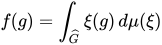
is a normalized continuous positive-definite function. Continuity of f {\displaystyle f} {\displaystyle f} follows from the dominated convergence theorem. For positive-definiteness, take a nondegenerate representation of C 0 ( G ^ ) {\displaystyle C_{0}({\widehat {G}})} {\displaystyle C_{0}({\widehat {G}})}. This extends uniquely to a representation of its multiplier algebra C b ( G ^ ) {\displaystyle C_{b}({\widehat {G}})} {\displaystyle C_{b}({\widehat {G}})} and therefore a strongly continuous unitary representation U g {\displaystyle U_{g}} {\displaystyle U_{g}}. As above we have f {\displaystyle f} {\displaystyle f} given by some vector state on U g {\displaystyle U_{g}} {\displaystyle U_{g}}

f ( g ) = ⟨ U g v , v ⟩ , {\displaystyle f(g)=\langle U_{g}v,v\rangle ,} {\displaystyle f(g)=\langle U_{g}v,v\rangle ,}

therefore positive-definite.

The two constructions are mutual inverses.

Special cases

Bochner's theorem in the special case of the discrete group Z {\displaystyle \mathbb {Z} } {\displaystyle \mathbb {Z} } is often referred to as Herglotz's theorem and says that a function f {\displaystyle f} {\displaystyle f} on Z {\displaystyle \mathbb {Z} } {\displaystyle \mathbb {Z} } with f ( 0 ) = 1 {\displaystyle f(0)=1} {\displaystyle f(0)=1} is positive-definite if and only if there exists a probability measure μ {\displaystyle \mu } {\displaystyle \mu } on the circle T {\displaystyle \mathbb {T} } {\displaystyle \mathbb {T} } such that f ( k ) = ∫ T e − 2 π i k x d μ ( x ) , {\displaystyle f(k)=\int _{\mathbb {T} }e^{-2\pi ikx}\,d\mu (x),} {\displaystyle f(k)=\int _{\mathbb {T} }e^{-2\pi ikx}\,d\mu (x),} are the coefficients of a Fourier-Stieltjes series.[5][6]

Similarly, a continuous function f : R d → C {\displaystyle f:\mathbb {R} ^{d}\to \mathbb {C} } {\displaystyle f:\mathbb {R} ^{d}\to \mathbb {C} } with f ( 0 ) = 1 {\displaystyle f(0)=1} {\displaystyle f(0)=1} is positive-definite if and only if there exists a probability measure μ {\displaystyle \mu } {\displaystyle \mu } on R d {\displaystyle \mathbb {R} ^{d}} {\displaystyle \mathbb {R} ^{d}} such that

f ( t ) = ∫ R d e − 2 π i ξ ⋅ t d μ ( ξ ) . {\displaystyle f(t)=\int _{\mathbb {R} ^{d}}e^{-2\pi i\xi \cdot t}\,d\mu (\xi ).} {\displaystyle f(t)=\int _{\mathbb {R} ^{d}}e^{-2\pi i\xi \cdot t}\,d\mu (\xi ).}

Here, f {\displaystyle f} {\displaystyle f} is positive definite if for any finite set of points α 1 , ⋯ , α N ∈ R d {\displaystyle \alpha _{1},\cdots ,\alpha _{N}\in \mathbb {R} ^{d}} {\displaystyle \alpha _{1},\cdots ,\alpha _{N}\in \mathbb {R} ^{d}}, and any complex numbers ρ 1 , ⋯ , ρ N ∈ C {\displaystyle \rho _{1},\cdots ,\rho _{N}\in \mathbb {C} } {\displaystyle \rho _{1},\cdots ,\rho _{N}\in \mathbb {C} }, there holds

∑ p , q = 1 N f ( α p − α q ) ρ p ρ ¯ q ⩾ 0. {\displaystyle \sum _{p,q=1}^{N}f(\alpha _{p}-\alpha _{q})\rho _{p}{\bar {\rho }}_{q}\geqslant 0.} {\displaystyle \sum _{p,q=1}^{N}f(\alpha _{p}-\alpha _{q})\rho _{p}{\bar {\rho }}_{q}\geqslant 0.}

Applications

In statistics, Bochner's theorem can be used to describe the serial correlation of certain type of time series. A sequence of random variables { f n } {\displaystyle \{f_{n}\}} {\displaystyle \{f_{n}\}} of mean 0 is a (wide-sense) stationary time series if the covariance

Cov ⁡ ( f n , f m ) {\displaystyle \operatorname {Cov} (f_{n},f_{m})} {\displaystyle \operatorname {Cov} (f_{n},f_{m})}

only depends on n − m {\displaystyle n-m} {\displaystyle n-m}. The function

g ( n − m ) = Cov ⁡ ( f n , f m ) {\displaystyle g(n-m)=\operatorname {Cov} (f_{n},f_{m})} {\displaystyle g(n-m)=\operatorname {Cov} (f_{n},f_{m})}

is called the autocovariance function of the time series. By the mean zero assumption,

g ( n − m ) = ⟨ f n , f m ⟩ , {\displaystyle g(n-m)=\langle f_{n},f_{m}\rangle ,} {\displaystyle g(n-m)=\langle f_{n},f_{m}\rangle ,}

where ⟨ ⋅ , ⋅ ⟩ {\displaystyle \langle \cdot ,\cdot \rangle } {\displaystyle \langle \cdot ,\cdot \rangle } denotes the inner product on the Hilbert space of random variables with finite second moments. It is then immediate that g {\displaystyle g} {\displaystyle g} is a positive-definite function on the integers Z {\displaystyle \mathbb {Z} } {\displaystyle \mathbb {Z} }. By Bochner's theorem, there exists a unique positive measure μ {\displaystyle \mu } {\displaystyle \mu } on [ 0 , 1 ] {\displaystyle [0,1]} {\displaystyle [0,1]} such that

g ( k ) = ∫ e − 2 π i k x d μ ( x ) . {\displaystyle g(k)=\int e^{-2\pi ikx}\,d\mu (x).} {\displaystyle g(k)=\int e^{-2\pi ikx}\,d\mu (x).}
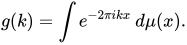
This measure μ {\displaystyle \mu } {\displaystyle \mu } is called the spectral measure of the time series. It yields information about the "seasonal trends" of the series.

For example, let z {\displaystyle z} {\displaystyle z} be an m {\displaystyle m} {\displaystyle m}-th root of unity (with the current identification, this is 1 / m ∈ [ 0 , 1 ] {\displaystyle 1/m\in [0,1]} {\displaystyle 1/m\in [0,1]}) and f {\displaystyle f} {\displaystyle f} be a random variable of mean 0 and variance 1. Consider the time series { z n f } {\displaystyle \{z^{n}f\}} {\displaystyle \{z^{n}f\}}. The autocovariance function is

g ( k ) = z k . {\displaystyle g(k)=z^{k}.} {\displaystyle g(k)=z^{k}.}

Evidently, the corresponding spectral measure is the Dirac point mass centered at z {\displaystyle z} {\displaystyle z}. This is related to the fact that the time series repeats itself every m {\displaystyle m} {\displaystyle m} periods.

When g {\displaystyle g} {\displaystyle g} has sufficiently fast decay, the measure μ {\displaystyle \mu } {\displaystyle \mu } is absolutely continuous with respect to the Lebesgue measure, and its Radon–Nikodym derivative f {\displaystyle f} {\displaystyle f} is called the spectral density of the time series. When g {\displaystyle g} {\displaystyle g} lies in ℓ 1 ( Z ) {\displaystyle \ell ^{1}(\mathbb {Z} )} {\displaystyle \ell ^{1}(\mathbb {Z} )}, f {\displaystyle f} {\displaystyle f} is the Fourier transform of g {\displaystyle g} {\displaystyle g}.

See also

Notes

  1. Katznelson 2004, p. 170.
  2. William Feller, Introduction to probability theory and its applications, volume 2, Wiley, p. 634
  3. Rudin 1990, p. 19.
  4. Reiter & Stegeman 2000, p. 149.
  5. Maruyama 2017, p. 130.
  6. Helson 2010, p. 40.

References