Carleman's inequality is an inequality in mathematics, named after Torsten Carleman, who proved it in 1923[1] and used it to prove the Denjoy–Carleman theorem on quasi-analytic classes.[2][3]
Statement
Let
a
1
,
a
2
,
a
3
,
…
{\displaystyle a_{1},a_{2},a_{3},\dots }

-
∑
n
=
1
∞
(
a
1
a
2
⋯
a
n
)
1
/
n
≤
e
∑
n
=
1
∞
a
n
.
{\displaystyle \sum _{n=1}^{\infty }\left(a_{1}a_{2}\cdots a_{n}\right)^{1/n}\leq \mathrm {e} \sum _{n=1}^{\infty }a_{n}.}
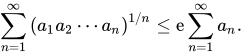
The constant
e
{\displaystyle \mathrm {e} }

Integral version
Carleman's inequality has an integral version, which states that
-
∫
0
∞
exp
{
1
x
∫
0
x
ln
f
(
t
)
d
t
}
d
x
≤
e
∫
0
∞
f
(
x
)
d
x
{\displaystyle \int _{0}^{\infty }\exp \left\{{\frac {1}{x}}\int _{0}^{x}\ln f(t)\,\mathrm {d} t\right\}\,\mathrm {d} x\leq \mathrm {e} \int _{0}^{\infty }f(x)\,\mathrm {d} x}

for any f ≥ 0.
Carleson's inequality
A generalisation, due to Lennart Carleson, states the following:[4]
for any convex function g with g(0) = 0, and for any -1 < p < ∞,
-
∫
0
∞
x
p
e
−
g
(
x
)
/
x
d
x
≤
e
p
+
1
∫
0
∞
x
p
e
−
g
′
(
x
)
d
x
.
{\displaystyle \int _{0}^{\infty }x^{p}\mathrm {e} ^{-g(x)/x}\,\mathrm {d} x\leq \mathrm {e} ^{p+1}\int _{0}^{\infty }x^{p}\mathrm {e} ^{-g'(x)}\,\mathrm {d} x.}

Carleman's inequality follows from the case p = 0.
Proof
Direct proof
An elementary proof is sketched below. From the inequality of arithmetic and geometric means applied to the numbers
1
⋅
a
1
,
2
⋅
a
2
,
…
,
n
⋅
a
n
{\displaystyle 1\cdot a_{1},2\cdot a_{2},\dots ,n\cdot a_{n}}

-
M
G
(
a
1
,
…
,
a
n
)
=
M
G
(
1
a
1
,
2
a
2
,
…
,
n
a
n
)
(
n
!
)
−
1
/
n
≤
M
A
(
1
a
1
,
2
a
2
,
…
,
n
a
n
)
(
n
!
)
−
1
/
n
{\displaystyle \mathrm {MG} (a_{1},\dots ,a_{n})=\mathrm {MG} (1a_{1},2a_{2},\dots ,na_{n})(n!)^{-1/n}\leq \mathrm {MA} (1a_{1},2a_{2},\dots ,na_{n})(n!)^{-1/n}}

where MG stands for geometric mean, and MA — for arithmetic mean. The Stirling-type inequality
n
!
≥
2
π
n
n
n
e
−
n
{\displaystyle n!\geq {\sqrt {2\pi n}}\,n^{n}\mathrm {e} ^{-n}}


-
(
n
!
)
−
1
/
n
≤
e
n
+
1
{\displaystyle (n!)^{-1/n}\leq {\frac {\mathrm {e} }{n+1}}}
for all n ≥ 1. {\displaystyle n\geq 1.}

Therefore,
-
M
G
(
a
1
,
…
,
a
n
)
≤
e
n
(
n
+
1
)
∑
1
≤
k
≤
n
k
a
k
,
{\displaystyle MG(a_{1},\dots ,a_{n})\leq {\frac {\mathrm {e} }{n(n+1)}}\,\sum _{1\leq k\leq n}ka_{k}\,,}

whence
-
∑
n
≥
1
M
G
(
a
1
,
…
,
a
n
)
≤
e
∑
k
≥
1
(
∑
n
≥
k
1
n
(
n
+
1
)
)
k
a
k
=
e
∑
k
≥
1
a
k
,
{\displaystyle \sum _{n\geq 1}MG(a_{1},\dots ,a_{n})\leq \,\mathrm {e} \,\sum _{k\geq 1}{\bigg (}\sum _{n\geq k}{\frac {1}{n(n+1)}}{\bigg )}\,ka_{k}=\,\mathrm {e} \,\sum _{k\geq 1}\,a_{k}\,,}

proving the inequality. Moreover, the inequality of arithmetic and geometric means of
n
{\displaystyle n}


By Hardy’s inequality
One can also prove Carleman's inequality by starting with Hardy's inequality[5]: §334
-
∑
n
=
1
∞
(
a
1
+
a
2
+
⋯
+
a
n
n
)
p
≤
(
p
p
−
1
)
p
∑
n
=
1
∞
a
n
p
{\displaystyle \sum _{n=1}^{\infty }\left({\frac {a_{1}+a_{2}+\cdots +a_{n}}{n}}\right)^{p}\leq \left({\frac {p}{p-1}}\right)^{p}\sum _{n=1}^{\infty }a_{n}^{p}}

for the non-negative numbers
a
1
{\displaystyle a_{1}}


Versions for specific sequences
Christian Axler and Mehdi Hassani investigated Carleman's inequality for the specific cases of
a
i
=
p
i
{\displaystyle a_{i}=p_{i}}


Notes
- T. Carleman, Sur les fonctions quasi-analytiques, Conférences faites au cinquième congres des mathématiciens Scandinaves, Helsinki (1923), 181-196.
- Duncan, John; McGregor, Colin M. (2003). "Carleman's inequality". Amer. Math. Monthly. 110 (5): 424–431. doi:10.2307/3647829. MR 2040885.
- Pečarić, Josip; Stolarsky, Kenneth B. (2001). "Carleman's inequality: history and new generalizations". Aequationes Mathematicae. 61 (1–2): 49–62. doi:10.1007/s000100050160. MR 1820809.
- Carleson, L. (1954). "A proof of an inequality of Carleman" (PDF). Proc. Amer. Math. Soc. 5: 932–933. doi:10.1090/s0002-9939-1954-0065601-3.
- Hardy, G. H.; Littlewood, J.E.; Pólya, G. (1952). Inequalities (Second ed.). Cambridge, UK.
{{cite book}}: CS1 maint: location missing publisher (link) - Christian Axler, Medhi Hassani. "Carleman's Inequality over prime numbers" (PDF). Integers. 21, Article A53. Retrieved 13 November 2022.
References
- Hardy, G. H.; Littlewood J.E.; Pólya, G. (1952). Inequalities, 2nd ed. Cambridge University Press. ISBN 0-521-35880-9.
{{cite book}}: ISBN / Date incompatibility (help) - Rassias, Thermistocles M., ed. (2000). Survey on classical inequalities. Kluwer Academic. ISBN 0-7923-6483-X.
- Hörmander, Lars (1990). The analysis of linear partial differential operators I: distribution theory and Fourier analysis, 2nd ed. Springer. ISBN 3-540-52343-X.
External links
- "Carleman inequality", Encyclopedia of Mathematics, EMS Press, 2001 [1994]