A centered (or centred) triangular number is a centered figurate number that represents an equilateral triangle with a dot in the center and all its other dots surrounding the center in successive equilateral triangular layers.
This is also the number of points of a hexagonal lattice with nearest-neighbor coupling whose distance from a given point
is less than or equal to
n
{\displaystyle n}

The following image shows the building of the centered triangular numbers by using the associated figures: at each step, the previous triangle (shown in red) is surrounded by a triangular layer of new dots (in blue).


Properties
- The gnomon of the n-th centered triangular number, corresponding to the (n + 1)-th triangular layer, is:
-
C
3
,
n
+
1
−
C
3
,
n
=
3
(
n
+
1
)
.
{\displaystyle C_{3,n+1}-C_{3,n}=3(n+1).}
-
C
3
,
n
+
1
−
C
3
,
n
=
3
(
n
+
1
)
.
{\displaystyle C_{3,n+1}-C_{3,n}=3(n+1).}

- The n-th centered triangular number, corresponding to n layers plus the center, is given by the formula:
-
C
3
,
n
=
1
+
3
n
(
n
+
1
)
2
=
3
n
2
+
3
n
+
2
2
.
{\displaystyle C_{3,n}=1+3{\frac {n(n+1)}{2}}={\frac {3n^{2}+3n+2}{2}}.}
-
C
3
,
n
=
1
+
3
n
(
n
+
1
)
2
=
3
n
2
+
3
n
+
2
2
.
{\displaystyle C_{3,n}=1+3{\frac {n(n+1)}{2}}={\frac {3n^{2}+3n+2}{2}}.}

- Each centered triangular number has a remainder of 1 when divided by 3, and the quotient (if positive) is the previous regular triangular number.
- Each centered triangular number from 10 onwards is the sum of three consecutive regular triangular numbers.
- For n > 2, the sum of the first n centered triangular numbers is the magic constant for an n by n normal magic square.
Relationship with centered square numbers
The centered triangular numbers can be expressed in terms of the centered square numbers:
-
C
3
,
n
=
3
C
4
,
n
+
1
4
,
{\displaystyle C_{3,n}={\frac {3C_{4,n}+1}{4}},}
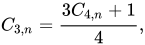
where
-
C
4
,
n
=
n
2
+
(
n
+
1
)
2
.
{\displaystyle C_{4,n}=n^{2}+(n+1)^{2}.}

Lists of centered triangular numbers
The first centered triangular numbers (C3,n < 3000) are:
- 1, 4, 10, 19, 31, 46, 64, 85, 109, 136, 166, 199, 235, 274, 316, 361, 409, 460, 514, 571, 631, 694, 760, 829, 901, 976, 1054, 1135, 1219, 1306, 1396, 1489, 1585, 1684, 1786, 1891, 1999, 2110, 2224, 2341, 2461, 2584, 2710, 2839, 2971, … (sequence A005448 in the OEIS).
The first simultaneously triangular and centered triangular numbers (C3,n = TN < 109) are:
The generating function
If the centered triangular numbers are treated as the coefficients of
the McLaurin series of a function, that function converges for all
|
x
|
<
1
{\displaystyle |x|<1}

-
1
+
4
x
+
10
x
2
+
19
x
3
+
31
x
4
+
.
.
.
=
1
−
x
3
(
1
−
x
)
4
=
x
2
+
x
+
1
(
1
−
x
)
3
.
{\displaystyle 1+4x+10x^{2}+19x^{3}+31x^{4}+~...={\frac {1-x^{3}}{(1-x)^{4}}}={\frac {x^{2}+x+1}{(1-x)^{3}}}~.}

References
- Lancelot Hogben: Mathematics for the Million (1936), republished by W. W. Norton & Company (September 1993), ISBN 978-0-393-31071-9
- Weisstein, Eric W. "Centered Triangular Number". MathWorld.