

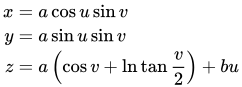
In geometry, Dini's surface is a surface with constant negative curvature that can be created by twisting a pseudosphere.[1] It is named after Ulisse Dini[2] and described by the following parametric equations:[3]
-
x
=
a
cos
u
sin
v
y
=
a
sin
u
sin
v
z
=
a
(
cos
v
+
ln
tan
v
2
)
+
b
u
{\displaystyle {\begin{aligned}x&=a\cos u\sin v\\y&=a\sin u\sin v\\z&=a\left(\cos v+\ln \tan {\frac {v}{2}}\right)+bu\end{aligned}}}

Another description is a generalized helicoid constructed from the tractrix.[4]
See also
References
- "Wolfram Mathworld: Dini's Surface". Retrieved 2009-11-12.
- J J O'Connor and E F Robertson (2000). "Ulisse Dini Biography". School of Mathematics and Statistics, University of St Andrews, Scotland. Archived from the original on 2012-06-09. Retrieved 2016-04-12.
- "Knol: Dini's Surface (geometry)". Archived from the original on 2011-07-23. Retrieved 2009-11-12.
- Rogers and Schief (2002). Bäcklund and Darboux transformations: geometry and modern applications in Soliton Theory. Cambridge University Press. pp. 35–36.