In mathematics, the dual bundle is an operation on vector bundles extending the operation of duality for vector spaces.
Definition
The dual bundle of a vector bundle
π
:
E
→
X
{\displaystyle \pi :E\to X}
is the vector bundle
π
∗
:
E
∗
→
X
{\displaystyle \pi ^{*}:E^{*}\to X}
whose fibers are the dual spaces to the fibers of
E
{\displaystyle E}
.
Equivalently,
E
∗
{\displaystyle E^{*}}
can be defined as the Hom bundle
H
o
m
(
E
,
R
×
X
)
,
{\displaystyle \mathrm {Hom} (E,\mathbb {R} \times X),}
that is, the vector bundle of morphisms from
E
{\displaystyle E}
to the trivial line bundle
R
×
X
→
X
.
{\displaystyle \mathbb {R} \times X\to X.}
Constructions and examples
Given a local trivialization of
E
{\displaystyle E}
with transition functions
t
i
j
,
{\displaystyle t_{ij},}
a local trivialization of
E
∗
{\displaystyle E^{*}}
is given by the same open cover of
X
{\displaystyle X}
with transition functions
t
i
j
∗
=
(
t
i
j
T
)
−
1
{\displaystyle t_{ij}^{*}=(t_{ij}^{T})^{-1}}
(the inverse of the transpose). The dual bundle
E
∗
{\displaystyle E^{*}}
is then constructed using the fiber bundle construction theorem. As particular cases:
- The dual bundle of an associated bundle is the bundle associated to the dual representation of the structure group.
- The dual bundle of the tangent bundle of a differentiable manifold is its cotangent bundle.
Properties
If the base space
X
{\displaystyle X}
is paracompact and Hausdorff then a real, finite-rank vector bundle
E
{\displaystyle E}
and its dual
E
∗
{\displaystyle E^{*}}
are isomorphic as vector bundles. However, just as for vector spaces, there is no natural choice of isomorphism unless
E
{\displaystyle E}
is equipped with an inner product.
This is not true in the case of complex vector bundles: for example, the tautological line bundle over the Riemann sphere is not isomorphic to its dual. The dual
E
∗
{\displaystyle E^{*}}
of a complex vector bundle
E
{\displaystyle E}
is indeed isomorphic to the conjugate bundle
E
¯
,
{\displaystyle {\overline {E}},}
but the choice of isomorphism is non-canonical unless
E
{\displaystyle E}
is equipped with a hermitian product.
The Hom bundle
H
o
m
(
E
1
,
E
2
)
{\displaystyle \mathrm {Hom} (E_{1},E_{2})}
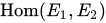
of two vector bundles is canonically isomorphic to the tensor product bundle
E
1
∗
⊗
E
2
.
{\displaystyle E_{1}^{*}\otimes E_{2}.}
Given a morphism
f
:
E
1
→
E
2
{\displaystyle f:E_{1}\to E_{2}}
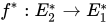
of vector bundles over the same space, there is a morphism
f
∗
:
E
2
∗
→
E
1
∗
{\displaystyle f^{*}:E_{2}^{*}\to E_{1}^{*}}
between their dual bundles (in the converse order), defined fibrewise as the transpose of each linear map
f
x
:
(
E
1
)
x
→
(
E
2
)
x
.
{\displaystyle f_{x}:(E_{1})_{x}\to (E_{2})_{x}.}
Accordingly, the dual bundle operation defines a contravariant functor from the category of vector bundles and their morphisms to itself.
References
- 今野, 宏 (2013). 微分幾何学. 〈現代数学への入門〉 (in Japanese). 東京: 東京大学出版会. ISBN 9784130629713.