
In geometry, the elliptic coordinate system is a two-dimensional orthogonal coordinate system in which the coordinate lines are confocal ellipses and hyperbolae. The two foci
F
1
{\displaystyle F_{1}}


Basic definition
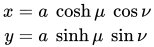
The most common definition of elliptic coordinates
(
μ
,
ν
)
{\displaystyle (\mu ,\nu )}

-
x
=
a
cosh
μ
cos
ν
y
=
a
sinh
μ
sin
ν
{\displaystyle {\begin{aligned}x&=a\ \cosh \mu \ \cos \nu \\y&=a\ \sinh \mu \ \sin \nu \end{aligned}}}
where
μ
{\displaystyle \mu }

![{\displaystyle \nu \in [0,2\pi ].}](https://wikimedia.org/api/rest_v1/media/math/render/svg/ad13894fea18f0bc355ad1eca69f2378bef70659)
On the complex plane, an equivalent relationship is
-
x
+
i
y
=
a
cosh
(
μ
+
i
ν
)
{\displaystyle x+iy=a\ \cosh(\mu +i\nu )}

These definitions correspond to ellipses and hyperbolae. The trigonometric identity
-
x
2
a
2
cosh
2
μ
+
y
2
a
2
sinh
2
μ
=
cos
2
ν
+
sin
2
ν
=
1
{\displaystyle {\frac {x^{2}}{a^{2}\cosh ^{2}\mu }}+{\frac {y^{2}}{a^{2}\sinh ^{2}\mu }}=\cos ^{2}\nu +\sin ^{2}\nu =1}

shows that curves of constant
μ
{\displaystyle \mu }
-
x
2
a
2
cos
2
ν
−
y
2
a
2
sin
2
ν
=
cosh
2
μ
−
sinh
2
μ
=
1
{\displaystyle {\frac {x^{2}}{a^{2}\cos ^{2}\nu }}-{\frac {y^{2}}{a^{2}\sin ^{2}\nu }}=\cosh ^{2}\mu -\sinh ^{2}\mu =1}

shows that curves of constant
ν
{\displaystyle \nu }

Scale factors
In an orthogonal coordinate system the lengths of the basis vectors are known as scale factors. The scale factors for the elliptic coordinates
(
μ
,
ν
)
{\displaystyle (\mu ,\nu )}
-
h
μ
=
h
ν
=
a
sinh
2
μ
+
sin
2
ν
=
a
cosh
2
μ
−
cos
2
ν
.
{\displaystyle h_{\mu }=h_{\nu }=a{\sqrt {\sinh ^{2}\mu +\sin ^{2}\nu }}=a{\sqrt {\cosh ^{2}\mu -\cos ^{2}\nu }}.}

Using the double argument identities for hyperbolic functions and trigonometric functions, the scale factors can be equivalently expressed as
-
h
μ
=
h
ν
=
a
1
2
(
cosh
2
μ
−
cos
2
ν
)
.
{\displaystyle h_{\mu }=h_{\nu }=a{\sqrt {{\frac {1}{2}}(\cosh 2\mu -\cos 2\nu )}}.}

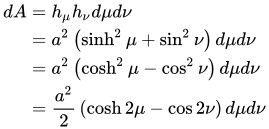
Consequently, an infinitesimal element of area equals
-
d
A
=
h
μ
h
ν
d
μ
d
ν
=
a
2
(
sinh
2
μ
+
sin
2
ν
)
d
μ
d
ν
=
a
2
(
cosh
2
μ
−
cos
2
ν
)
d
μ
d
ν
=
a
2
2
(
cosh
2
μ
−
cos
2
ν
)
d
μ
d
ν
{\displaystyle {\begin{aligned}dA&=h_{\mu }h_{\nu }d\mu d\nu \\&=a^{2}\left(\sinh ^{2}\mu +\sin ^{2}\nu \right)d\mu d\nu \\&=a^{2}\left(\cosh ^{2}\mu -\cos ^{2}\nu \right)d\mu d\nu \\&={\frac {a^{2}}{2}}\left(\cosh 2\mu -\cos 2\nu \right)d\mu d\nu \end{aligned}}}
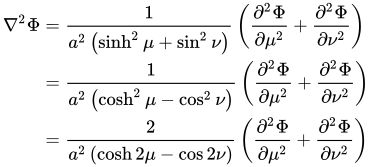
and the Laplacian reads
-
∇
2
Φ
=
1
a
2
(
sinh
2
μ
+
sin
2
ν
)
(
∂
2
Φ
∂
μ
2
+
∂
2
Φ
∂
ν
2
)
=
1
a
2
(
cosh
2
μ
−
cos
2
ν
)
(
∂
2
Φ
∂
μ
2
+
∂
2
Φ
∂
ν
2
)
=
2
a
2
(
cosh
2
μ
−
cos
2
ν
)
(
∂
2
Φ
∂
μ
2
+
∂
2
Φ
∂
ν
2
)
{\displaystyle {\begin{aligned}\nabla ^{2}\Phi &={\frac {1}{a^{2}\left(\sinh ^{2}\mu +\sin ^{2}\nu \right)}}\left({\frac {\partial ^{2}\Phi }{\partial \mu ^{2}}}+{\frac {\partial ^{2}\Phi }{\partial \nu ^{2}}}\right)\\&={\frac {1}{a^{2}\left(\cosh ^{2}\mu -\cos ^{2}\nu \right)}}\left({\frac {\partial ^{2}\Phi }{\partial \mu ^{2}}}+{\frac {\partial ^{2}\Phi }{\partial \nu ^{2}}}\right)\\&={\frac {2}{a^{2}\left(\cosh 2\mu -\cos 2\nu \right)}}\left({\frac {\partial ^{2}\Phi }{\partial \mu ^{2}}}+{\frac {\partial ^{2}\Phi }{\partial \nu ^{2}}}\right)\end{aligned}}}
Other differential operators such as
∇
⋅
F
{\displaystyle \nabla \cdot \mathbf {F} }


Alternative definition
An alternative and geometrically intuitive set of elliptic coordinates
(
σ
,
τ
)
{\displaystyle (\sigma ,\tau )}


The coordinates
(
σ
,
τ
)
{\displaystyle (\sigma ,\tau )}


A drawback of these coordinates is that the points with Cartesian coordinates (x,y) and (x,-y) have the same coordinates
(
σ
,
τ
)
{\displaystyle (\sigma ,\tau )}
-
x
=
a
σ
τ
{\displaystyle x=a\left.\sigma \right.\tau }

-
y
2
=
a
2
(
σ
2
−
1
)
(
1
−
τ
2
)
.
{\displaystyle y^{2}=a^{2}\left(\sigma ^{2}-1\right)\left(1-\tau ^{2}\right).}

Alternative scale factors
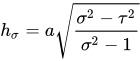
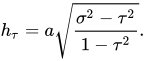
The scale factors for the alternative elliptic coordinates
(
σ
,
τ
)
{\displaystyle (\sigma ,\tau )}
-
h
σ
=
a
σ
2
−
τ
2
σ
2
−
1
{\displaystyle h_{\sigma }=a{\sqrt {\frac {\sigma ^{2}-\tau ^{2}}{\sigma ^{2}-1}}}}
-
h
τ
=
a
σ
2
−
τ
2
1
−
τ
2
.
{\displaystyle h_{\tau }=a{\sqrt {\frac {\sigma ^{2}-\tau ^{2}}{1-\tau ^{2}}}}.}
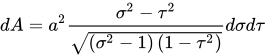
Hence, the infinitesimal area element becomes
-
d
A
=
a
2
σ
2
−
τ
2
(
σ
2
−
1
)
(
1
−
τ
2
)
d
σ
d
τ
{\displaystyle dA=a^{2}{\frac {\sigma ^{2}-\tau ^{2}}{\sqrt {\left(\sigma ^{2}-1\right)\left(1-\tau ^{2}\right)}}}d\sigma d\tau }
and the Laplacian equals
-
∇
2
Φ
=
1
a
2
(
σ
2
−
τ
2
)
[
σ
2
−
1
∂
∂
σ
(
σ
2
−
1
∂
Φ
∂
σ
)
+
1
−
τ
2
∂
∂
τ
(
1
−
τ
2
∂
Φ
∂
τ
)
]
.
{\displaystyle \nabla ^{2}\Phi ={\frac {1}{a^{2}\left(\sigma ^{2}-\tau ^{2}\right)}}\left[{\sqrt {\sigma ^{2}-1}}{\frac {\partial }{\partial \sigma }}\left({\sqrt {\sigma ^{2}-1}}{\frac {\partial \Phi }{\partial \sigma }}\right)+{\sqrt {1-\tau ^{2}}}{\frac {\partial }{\partial \tau }}\left({\sqrt {1-\tau ^{2}}}{\frac {\partial \Phi }{\partial \tau }}\right)\right].}
![{\displaystyle \nabla ^{2}\Phi ={\frac {1}{a^{2}\left(\sigma ^{2}-\tau ^{2}\right)}}\left[{\sqrt {\sigma ^{2}-1}}{\frac {\partial }{\partial \sigma }}\left({\sqrt {\sigma ^{2}-1}}{\frac {\partial \Phi }{\partial \sigma }}\right)+{\sqrt {1-\tau ^{2}}}{\frac {\partial }{\partial \tau }}\left({\sqrt {1-\tau ^{2}}}{\frac {\partial \Phi }{\partial \tau }}\right)\right].}](https://wikimedia.org/api/rest_v1/media/math/render/svg/387a412b798ac56009b9b3afe86bff2995fc2ba2)
Other differential operators such as
∇
⋅
F
{\displaystyle \nabla \cdot \mathbf {F} }
Extrapolation to higher dimensions
Elliptic coordinates form the basis for several sets of three-dimensional orthogonal coordinates:
- The elliptic cylindrical coordinates are produced by projecting in the
z
{\displaystyle z}
-direction.
- The prolate spheroidal coordinates are produced by rotating the elliptic coordinates about the
x
{\displaystyle x}
-axis, i.e., the axis separating the foci.
- Ellipsoidal coordinates are a formal extension of elliptic coordinates into 3-dimensions, which is based on confocal ellipsoids, hyperboloids of one and two sheets.
Note that (ellipsoidal) Geographic coordinate system is a different concept from above.
Applications
The classic applications of elliptic coordinates are in solving partial differential equations, e.g., Laplace's equation or the Helmholtz equation, for which elliptic coordinates are a natural description of a system thus allowing a separation of variables in the partial differential equations. Some traditional examples are solving systems such as electrons orbiting a molecule or planetary orbits that have an elliptical shape.
The geometric properties of elliptic coordinates can also be useful. A typical example might involve
an integration over all pairs of vectors
p
{\displaystyle \mathbf {p} }


See also
References
- "Elliptic coordinates", Encyclopedia of Mathematics, EMS Press, 2001 [1994]
- Korn GA and Korn TM. (1961) Mathematical Handbook for Scientists and Engineers, McGraw-Hill.
- Weisstein, Eric W. "Elliptic Cylindrical Coordinates." From MathWorld — A Wolfram Web Resource. http://mathworld.wolfram.com/EllipticCylindricalCoordinates.html