In type theory, a typing environment (or typing context) represents the association between variable names and data types.
More formally, an environment
Γ
{\displaystyle \Gamma }


The judgement
-
Γ
⊢
e
:
τ
{\displaystyle \Gamma \vdash e:\tau }

is read as "
e
{\displaystyle e}

For each function body type checks:
-
Γ
=
{
(
f
,
τ
1
×
.
.
.
×
τ
n
→
τ
0
)
|
(
f
,
x
s
,
(
τ
1
,
.
.
.
,
τ
n
)
,
t
f
,
τ
0
)
∈
e
}
{\displaystyle \Gamma =\{(f,\tau _{1}\times ...\times \tau _{n}\to \tau _{0})|(f,xs,(\tau _{1},...,\tau _{n}),t_{f},\tau _{0})\in e\}}

Typing Rules Example:
Γ
⊢
b
:
B
o
o
l
,
Γ
⊢
t
1
:
τ
,
Γ
⊢
t
2
:
τ
Γ
⊢
(
if
(
b
)
t
1
else
t
2
)
:
τ
{\displaystyle {\begin{array}{c}\Gamma \vdash b:Bool,\Gamma \vdash t_{1}:\tau ,\Gamma \vdash t_{2}:\tau \\\hline \Gamma \vdash ({\text{if}}(b)t_{1}{\text{else}}t_{2}):\tau \\\end{array}}}
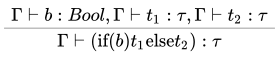
In statically typed programming languages, these environments are used and maintained by typing rules to type check a given program or expression.[1]
See also
References
- "Simply Typed λ-calculus" (PDF).