In combinatorics, the Eulerian number
A
(
n
,
k
)
{\textstyle A(n,k)}


Leonhard Euler investigated them and associated polynomials in his 1755 book Institutiones calculi differentialis.[1][2]

Other notations for
A
(
n
,
k
)
{\textstyle A(n,k)}


Definition

The Eulerian polynomials
A
n
(
t
)
{\displaystyle A_{n}(t)}

-
∑
n
=
0
∞
A
n
(
t
)
x
n
n
!
=
t
−
1
t
−
e
(
t
−
1
)
x
=
(
1
−
e
(
t
−
1
)
x
−
1
t
−
1
)
−
1
.
{\displaystyle \sum _{n=0}^{\infty }A_{n}(t)\,{\frac {x^{n}}{n!}}={\frac {t-1}{t-e^{(t-1)\,x}}}=\left(1-{\frac {e^{(t-1)x}-1}{t-1}}\right)^{-1}.}

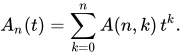
The Eulerian numbers
A
(
n
,
k
)
{\displaystyle A(n,k)}

-
A
n
(
t
)
=
∑
k
=
0
n
A
(
n
,
k
)
t
k
.
{\displaystyle A_{n}(t)=\sum _{k=0}^{n}A(n,k)\,t^{k}.}
An explicit formula for
A
(
n
,
k
)
{\textstyle A(n,k)}
-
A
(
n
,
k
)
=
∑
i
=
0
k
(
−
1
)
i
(
n
+
1
i
)
(
k
+
1
−
i
)
n
.
{\displaystyle A(n,k)=\sum _{i=0}^{k}(-1)^{i}{\binom {n+1}{i}}(k+1-i)^{n}.}

Basic properties
- For fixed
n
{\textstyle n}
. Indeed, as ( n 0 ) = 1 {\displaystyle {\tbinom {n}{0}}=1}
for all n {\displaystyle n}
, A ( n , 0 ) = 1 {\textstyle A(n,0)=1}
. This formally includes the empty collection of numbers, n = 0 {\textstyle n=0}
. And so A 0 ( t ) = A 1 ( t ) = 1 {\textstyle A_{0}(t)=A_{1}(t)=1}
.
- For
k
=
1
{\textstyle k=1}
the explicit formula implies A ( n , 1 ) = 2 n − ( n + 1 ) {\textstyle A(n,1)=2^{n}-(n+1)}
, a sequence in n {\displaystyle n}
.
- Fully reversing a permutation with
k
{\textstyle k}
ascents. Therefore A ( n , k ) = A ( n , n − k − 1 ) {\textstyle A(n,k)=A(n,n-k-1)}
. So there is also a single permutation which has n − 1 {\textstyle n-1}
ascents, namely the rising permutation ( 1 , 2 , … , n ) {\textstyle (1,2,\ldots ,n)}
. So also A ( n , n − 1 ) {\textstyle A(n,n-1)}
equals 1 {\displaystyle 1}
.
- Since a permutation of the numbers
1
{\displaystyle 1}
ascents must have n − 1 − k {\displaystyle n-1-k}
descents, the symmetry A ( n , k ) = A ( n , n − k − 1 ) {\textstyle A(n,k)=A(n,n-k-1)}
- For
k
≥
n
>
0
{\textstyle k\geq n>0}
, the values are formally zero, meaning many sums over k {\textstyle k}
.
A tabulation of the numbers in a triangular array is called the Euler triangle or Euler's triangle. It shares some common characteristics with Pascal's triangle. Values of
A
(
n
,
k
)
{\textstyle A(n,k)}

- kn
0 1 2 3 4 5 6 7 8 0 1 1 1 2 1 1 3 1 4 1 4 1 11 11 1 5 1 26 66 26 1 6 1 57 302 302 57 1 7 1 120 1191 2416 1191 120 1 8 1 247 4293 15619 15619 4293 247 1 9 1 502 14608 88234 156190 88234 14608 502 1
Computation
For larger values of
n
{\textstyle n}
-
A
(
n
,
k
)
=
(
n
−
k
)
A
(
n
−
1
,
k
−
1
)
+
(
k
+
1
)
A
(
n
−
1
,
k
)
.
{\displaystyle A(n,k)=(n-k)A(n-1,k-1)+(k+1)A(n-1,k).}

This formula can be motivated from the combinatorial definition and thus serves as a natural starting point for the theory.
For small values of
n
{\textstyle n}
n k Permutations A(n, k) 1 0 (1) A(1,0) = 1 2 0 (2, 1) A(2,0) = 1 1 (1, 2) A(2,1) = 1 3 0 (3, 2, 1) A(3,0) = 1 1 (1, 3, 2), (2, 1, 3), (2, 3, 1) and (3, 1, 2) A(3,1) = 4 2 (1, 2, 3) A(3,2) = 1
Applying the recurrence to one example, we may find
-
A
(
4
,
1
)
=
(
4
−
1
)
A
(
3
,
0
)
+
(
1
+
1
)
A
(
3
,
1
)
=
3
⋅
1
+
2
⋅
4
=
11.
{\displaystyle A(4,1)=(4-1)\,A(3,0)+(1+1)\,A(3,1)=3\cdot 1+2\cdot 4=11.}

Likewise, the Eulerian polynomials can be computed by the recurrence
-
A
0
(
t
)
=
1
,
{\displaystyle A_{0}(t)=1,}
-
A
n
(
t
)
=
A
n
−
1
′
(
t
)
⋅
t
(
1
−
t
)
+
A
n
−
1
(
t
)
⋅
(
1
+
(
n
−
1
)
t
)
,
for
n
>
1.
{\displaystyle A_{n}(t)=A_{n-1}'(t)\cdot t\,(1-t)+A_{n-1}(t)\cdot (1+(n-1)\,t),{\text{ for }}n>1.}


The second formula can be cast into an inductive form,
-
A
n
(
t
)
=
∑
k
=
0
n
−
1
(
n
k
)
A
k
(
t
)
⋅
(
t
−
1
)
n
−
1
−
k
,
for
n
>
1.
{\displaystyle A_{n}(t)=\sum _{k=0}^{n-1}{\binom {n}{k}}A_{k}(t)\cdot (t-1)^{n-1-k},{\text{ for }}n>1.}

Identities
For any set partition of a finite set into disjoint subsets, the sum of the cardinalities of the parts equals the cardinality of the whole set. Since there are
n
!
{\displaystyle n!}


![{\displaystyle [0,n]}](https://wikimedia.org/api/rest_v1/media/math/render/svg/dcc2257be9f01b9d99b472f230da52da8aab84a8)
-
∑
k
=
0
n
−
1
A
(
n
,
k
)
f
(
k
)
=
n
!
∫
0
1
⋯
∫
0
1
f
(
⌊
x
1
+
⋯
+
x
n
⌋
)
d
x
1
⋯
d
x
n
.
{\displaystyle \sum _{k=0}^{n-1}A(n,k)\,f(k)=n!\int _{0}^{1}\cdots \int _{0}^{1}f\left(\left\lfloor x_{1}+\cdots +x_{n}\right\rfloor \right)dx_{1}\cdots dx_{n}.}

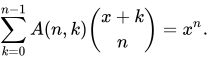
Worpitzky's identity expresses
x
n
{\textstyle x^{n}}

-
∑
k
=
0
n
−
1
A
(
n
,
k
)
(
x
+
k
n
)
=
x
n
.
{\displaystyle \sum _{k=0}^{n-1}A(n,k){\binom {x+k}{n}}=x^{n}.}
From this, it follows that
-
∑
k
=
1
m
k
n
=
∑
k
=
0
n
−
1
A
(
n
,
k
)
(
m
+
k
+
1
n
+
1
)
.
{\displaystyle \sum _{k=1}^{m}k^{n}=\sum _{k=0}^{n-1}A(n,k){\binom {m+k+1}{n+1}}.}
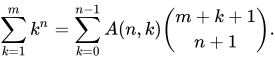
This identity is named after Julius Worpitzky, who discovered it in the 1880s;[6] it had been originally discovered somewhat earlier, by Li Shanlan in his 1867 work Duò Jī Bǐ Lèi.[7][8]
Eulerian numbers appear as the coefficients of the polylogarithm for negative integer inputs:
Li
−
n
(
z
)
=
1
(
1
−
z
)
n
+
1
∑
k
=
0
n
−
1
A
(
n
,
k
)
z
n
−
k
(
n
=
1
,
2
,
3
,
…
)
.
{\displaystyle \operatorname {Li} _{-n}(z)={1 \over (1-z)^{n+1}}\sum _{k=0}^{n-1}A(n,k)z^{n-k}\qquad (n=1,2,3,\ldots ).}

Formulas involving alternating sums
The alternating sum of the Eulerian numbers for a fixed value of
n
{\textstyle n}

-
∑
k
=
0
n
−
1
(
−
1
)
k
A
(
n
,
k
)
=
2
n
+
1
(
2
n
+
1
−
1
)
B
n
+
1
n
+
1
,
for
n
>
0.
{\displaystyle \sum _{k=0}^{n-1}(-1)^{k}A(n,k)=2^{n+1}(2^{n+1}-1){\frac {B_{n+1}}{n+1}},{\text{ for }}n>0.}

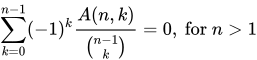
Furthermore,
-
∑
k
=
0
n
−
1
(
−
1
)
k
A
(
n
,
k
)
(
n
−
1
k
)
=
0
,
for
n
>
1
{\displaystyle \sum _{k=0}^{n-1}(-1)^{k}{\frac {A(n,k)}{\binom {n-1}{k}}}=0,{\text{ for }}n>1}
and
-
∑
k
=
0
n
−
1
(
−
1
)
k
A
(
n
,
k
)
(
n
k
)
=
(
n
+
1
)
B
n
,
for
n
>
1
{\displaystyle \sum _{k=0}^{n-1}(-1)^{k}{\frac {A(n,k)}{\binom {n}{k}}}=(n+1)B_{n},{\text{ for }}n>1}

Formulas involving the polynomials
The symmetry property implies:
-
A
n
(
t
)
=
t
n
−
1
A
n
(
t
−
1
)
{\displaystyle A_{n}(t)=t^{n-1}A_{n}(t^{-1})}

The Eulerian numbers are involved in the generating function for the sequence of nth powers:
-
∑
i
=
1
∞
i
n
x
i
=
1
(
1
−
x
)
n
+
1
∑
k
=
0
n
A
(
n
,
k
)
x
k
+
1
=
x
(
1
−
x
)
n
+
1
A
n
(
x
)
{\displaystyle \sum _{i=1}^{\infty }i^{n}x^{i}={\frac {1}{(1-x)^{n+1}}}\sum _{k=0}^{n}A(n,k)\,x^{k+1}={\frac {x}{(1-x)^{n+1}}}A_{n}(x)}

An explicit expression for Eulerian polynomials is[9]
A
n
(
t
)
=
∑
k
=
0
n
{
n
k
}
k
!
(
t
−
1
)
n
−
k
{\displaystyle A_{n}(t)=\sum _{k=0}^{n}\left\{{n \atop k}\right\}k!(t-1)^{n-k}}
where
{
n
k
}
{\textstyle \left\{{n \atop k}\right\}}

Geometric interpretations
The Eulerian numbers have two important geometric interpretations involving convex polytopes.
First of all, the identity
-
∑
i
=
0
∞
(
i
+
1
)
n
x
i
=
1
(
1
−
x
)
n
+
1
∑
k
=
0
n
A
(
n
,
k
)
x
k
{\displaystyle \sum _{i=0}^{\infty }(i+1)^{n}x^{i}={\frac {1}{(1-x)^{n+1}}}\sum _{k=0}^{n}A(n,k)\,x^{k}}

implies that the Eulerian numbers form the
h
∗
{\displaystyle h^{\ast }}


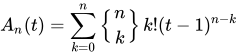
Secondly, the identity
A
n
(
t
)
=
∑
k
=
0
n
{
n
k
}
k
!
(
t
−
1
)
n
−
k
{\displaystyle A_{n}(t)=\sum _{k=0}^{n}\left\{{n \atop k}\right\}k!(t-1)^{n-k}}


Type B Eulerian numbers
The hyperoctahedral group of order
n
{\displaystyle n}





Given an element
π
{\displaystyle \pi }



-
B
(
n
,
k
)
=
∑
i
=
1
k
(
−
1
)
k
−
i
(
n
k
−
i
)
(
2
i
−
1
)
n
−
1
.
{\displaystyle B(n,k)=\sum _{i=1}^{k}(-1)^{k-i}{\binom {n}{k-i}}(2i-1)^{n-1}.}

The table of
B
(
n
,
k
)
{\displaystyle B(n,k)}
- kn
0 1 2 3 4 5 0 1 1 1 1 2 1 6 1 3 1 23 23 1 4 1 76 230 76 1 5 1 237 1682 1682 237 1
The corresponding polynomials
M
n
(
x
)
=
∑
k
=
0
n
B
(
n
,
k
)
x
k
{\displaystyle M_{n}(x)=\sum _{k=0}^{n}B(n,k)x^{k}}

The Type B Eulerian numbers and polynomials satisfy many similar identities, and have many similar properties, as the Type A, i.e., usual, Eulerian numbers and polynomials. For example, for any
n
≥
1
{\displaystyle n\geq 1}

-
∑
i
=
0
∞
(
2
i
+
1
)
n
x
i
=
M
n
(
x
)
(
1
−
x
)
n
+
1
.
{\displaystyle \sum _{i=0}^{\infty }(2i+1)^{n}x^{i}={\frac {M_{n}(x)}{(1-x)^{n+1}}}.}

And the Type B Eulerian numbers give the h-vector of the simple polytope dual to the Type B permutohedron.
In fact, one can define Eulerian numbers for any finite Coxeter group with analogous properties.[13]
Eulerian numbers of the second order
The permutations of the multiset
{
1
,
1
,
2
,
2
,
…
,
n
,
n
}
{\textstyle \{1,1,2,2,\ldots ,n,n\}}


The Eulerian number of the second order, denoted
⟨
⟨
n
m
⟩
⟩
{\textstyle \left\langle \!\left\langle {n \atop m}\right\rangle \!\right\rangle }

- 332211,
- 221133, 221331, 223311, 233211, 113322, 133221, 331122, 331221,
- 112233, 122133, 112332, 123321, 133122, 122331.
The Eulerian numbers of the second order satisfy the recurrence relation, that follows directly from the above definition:
-
⟨
⟨
n
k
⟩
⟩
=
(
2
n
−
k
−
1
)
⟨
⟨
n
−
1
k
−
1
⟩
⟩
+
(
k
+
1
)
⟨
⟨
n
−
1
k
⟩
⟩
,
{\displaystyle \left\langle \!\!\left\langle {n \atop k}\right\rangle \!\!\right\rangle =(2n-k-1)\left\langle \!\!\left\langle {n-1 \atop k-1}\right\rangle \!\!\right\rangle +(k+1)\left\langle \!\!\left\langle {n-1 \atop k}\right\rangle \!\!\right\rangle ,}

with initial condition for n = 0, expressed in Iverson bracket notation:
-
⟨
⟨
0
k
⟩
⟩
=
[
k
=
0
]
.
{\displaystyle \left\langle \!\!\left\langle {0 \atop k}\right\rangle \!\!\right\rangle =[k=0].}
![{\displaystyle \left\langle \!\!\left\langle {0 \atop k}\right\rangle \!\!\right\rangle =[k=0].}](https://wikimedia.org/api/rest_v1/media/math/render/svg/6cda001a9301196dab5512d11ab97ce842dae3cd)
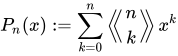
Correspondingly, the Eulerian polynomial of second order, here denoted Pn (no standard notation exists for them) are
-
P
n
(
x
)
:=
∑
k
=
0
n
⟨
⟨
n
k
⟩
⟩
x
k
{\displaystyle P_{n}(x):=\sum _{k=0}^{n}\left\langle \!\!\left\langle {n \atop k}\right\rangle \!\!\right\rangle x^{k}}
and the above recurrence relations are translated into a recurrence relation for the sequence Pn(x):
-
P
n
+
1
(
x
)
=
(
2
n
x
+
1
)
P
n
(
x
)
−
x
(
x
−
1
)
P
n
′
(
x
)
{\displaystyle P_{n+1}(x)=(2nx+1)P_{n}(x)-x(x-1)P_{n}^{\prime }(x)}

with initial condition
P
0
(
x
)
=
1
{\displaystyle P_{0}(x)=1}

-
(
x
−
1
)
−
2
n
−
2
P
n
+
1
(
x
)
=
(
x
(
1
−
x
)
−
2
n
−
1
P
n
(
x
)
)
′
{\displaystyle (x-1)^{-2n-2}P_{n+1}(x)=\left(x\,(1-x)^{-2n-1}P_{n}(x)\right)^{\prime }}

so that the rational function
-
u
n
(
x
)
:=
(
x
−
1
)
−
2
n
P
n
(
x
)
{\displaystyle u_{n}(x):=(x-1)^{-2n}P_{n}(x)}

satisfies a simple autonomous recurrence:
-
u
n
+
1
=
(
x
1
−
x
u
n
)
′
,
u
0
=
1
{\displaystyle u_{n+1}=\left({\frac {x}{1-x}}u_{n}\right)^{\prime },\quad u_{0}=1}
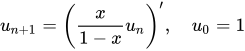
Whence one obtains the Eulerian polynomials of second order as
P
n
(
x
)
=
(
1
−
x
)
2
n
u
n
(
x
)
{\textstyle P_{n}(x)=(1-x)^{2n}u_{n}(x)}

The Eulerian polynomials of the second order satisfy an identity analogous to the identity
-
∑
i
=
1
∞
i
n
x
i
=
x
A
n
(
x
)
(
1
−
x
)
n
+
1
{\displaystyle \sum _{i=1}^{\infty }i^{n}x^{i}={\frac {xA_{n}(x)}{(1-x)^{n+1}}}}

satisfied by the usual Eulerian polynomials. Specifically, as proved by Gessel and Stanley,[14] they satisfy the identity
-
∑
m
=
0
∞
{
n
+
m
m
}
x
m
=
x
P
n
(
x
)
(
1
−
x
)
2
n
+
1
{\displaystyle \sum _{m=0}^{\infty }\left\{{n+m \atop m}\right\}x^{m}={\frac {xP_{n}(x)}{(1-x)^{2n+1}}}}

where again the
{
n
k
}
{\displaystyle \left\{{n \atop k}\right\}}

The following table displays the first few second-order Eulerian numbers:
- kn
0 1 2 3 4 5 6 7 8 0 1 1 1 2 1 2 3 1 8 6 4 1 22 58 24 5 1 52 328 444 120 6 1 114 1452 4400 3708 720 7 1 240 5610 32120 58140 33984 5040 8 1 494 19950 195800 644020 785304 341136 40320 9 1 1004 67260 1062500 5765500 12440064 11026296 3733920 362880
The sum of the n-th row, which is also the value
P
n
(
1
)
{\textstyle P_{n}(1)}

Indexing the second-order Eulerian numbers comes in three flavors:
References
- Eulerus, Leonardus [Leonhard Euler] (1755). Institutiones calculi differentialis cum eius usu in analysi finitorum ac doctrina serierum [Foundations of differential calculus, with applications to finite analysis and series]. Academia imperialis scientiarum Petropolitana; Berolini: Officina Michaelis.
- Carlitz, L. (1959). "Eulerian Numbers and polynomials". Math. Mag. 32 (5): 247–260. doi:10.2307/3029225. JSTOR 3029225.
- Comtet, Louis (1974). Advanced Combinatorics: The Art of Finite and Infinite Expansions (PDF). Dordrecht: Springer Netherlands. ISBN 978-94-010-2198-2.
- Gould, H. W. (1978). "Evaluation of sums of convolved powers using Stirling and Eulerian Numbers". Fib. Quart. 16 (6): 488–497. doi:10.1080/00150517.1978.12430271.
- Desarmenien, Jacques; Foata, Dominique (1992). "The signed Eulerian numbers". Discrete Math. 99 (1–3): 49–58. doi:10.1016/0012-365X(92)90364-L.
- Lesieur, Leonce; Nicolas, Jean-Louis (1992). "On the Eulerian Numbers M=max (A(n,k))". Europ. J. Combinat. 13 (5): 379–399. doi:10.1016/S0195-6698(05)80018-6.
- Butzer, P. L.; Hauss, M. (1993). "Eulerian numbers with fractional order parameters". Aequationes Mathematicae. 46 (1–2): 119–142. doi:10.1007/bf01834003. S2CID 121868847.
- Koutras, M.V. (1994). "Eulerian numbers associated with sequences of polynomials". Fib. Quart. 32 (1): 44–57. doi:10.1080/00150517.1994.12429255.
- Graham, Ronald; Knuth, Donald; Patashnik, Oren (1994). Concrete Mathematics: A Foundation for Computer Science (2nd ed.). Addison-Wesley. pp. 267–272.
- Hsu, Leetsch C.; Jau-Shyong Shiue, Peter (1999). "On certain summation problems and generalizations of Eulerian polynomials and numbers". Discrete Math. 204 (1–3): 237–247. doi:10.1016/S0012-365X(98)00379-3.
- Boyadzhiev, Khristo N. (2007). "Apostol-Bernoulli functions, derivative polynomials and Eulerian polynomials". arXiv:0710.1124 [math.CA].
- Petersen, T. Kyle (2015). Eulerian Numbers. Birkhäuser Advanced Texts Basler Lehrbücher. Birkhäuser. doi:10.1007/978-1-4939-3091-3_1. ISBN 978-1-4939-3090-6.
Citations
- Euler, Leonhard (1755-01-01). "Institutiones calculi differentialis cum eius usu in analysi finitorum ac doctrina serierum, volume 1". Academiae Imperialis Scientiarum Petropolitanae: 1–880.
- Euler, Leonhard; Aycock, Alexander (2019-05-24), Institutiones calculi differentialis cum eius usu in analysi finitorum ac doctrina serierum, arXiv, doi:10.48550/arXiv.1905.10438, arXiv:1905.10438, retrieved 2026-04-21
- Comtet (1974), p. 243.
- Comtet (1974), p. 51.
- Graham, Knuth & Patashnik (1994), Exercise 6.65.
- Worpitzky, J. (1883). "Studien über die Bernoullischen und Eulerschen Zahlen". Journal für die reine und angewandte Mathematik. 94: 203–232.
- Petersen (2015), p. 14.
- Knuth, Donald Ervin (1997). The art of computer programming (3rd ed.). Reading, Mass: Addison-Wesley. p. 36. ISBN 978-0-201-89683-1.
- Qi, Feng; Guo, Bai-Ni (2017-08-01). "Explicit formulas and recurrence relations for higher order Eulerian polynomials". Indagationes Mathematicae. 28 (4): 884–891. doi:10.1016/j.indag.2017.06.010. ISSN 0019-3577.
- Chow, Chak-On; Gessel, Ira M. (March 2007). "On the descent numbers and major indices for the hyperoctahedral group". Advances in Applied Mathematics. 38 (3): 275–301. doi:10.1016/j.aam.2006.07.003.
- Sloane, N. J. A. (ed.). "Sequence A060187 (Triangle read by rows: Eulerian numbers of type B)". The On-Line Encyclopedia of Integer Sequences. OEIS Foundation.
- Schoenberg, I. J. (1972). "Cardinal Interpolation and Spline Functions IV. The Exponential Euler Splines". Linear Operators and Approximation / Lineare Operatoren und Approximation: 382–404. doi:10.1007/978-3-0348-7283-6_34. ISBN 978-3-0348-7285-0.
- Petersen (2015), Part III.
- Gessel, Ira; Stanley, Richard P (1 January 1978). "Stirling polynomials". Journal of Combinatorial Theory, Series A. 24 (1): 24–33. doi:10.1016/0097-3165(78)90042-0.
External links
- Eulerian Polynomials at OEIS Wiki.
- "Eulerian Numbers". MathPages.com.
- Weisstein, Eric W. "Eulerian Number". MathWorld.
- Weisstein, Eric W. "Euler's Number Triangle". MathWorld.
- Weisstein, Eric W. "Worpitzky's Identity". MathWorld.
- Weisstein, Eric W. "Second-Order Eulerian Triangle". MathWorld.
- Euler-matrix (generalized rowindexes, divergent summation)