In mathematics, Fatou's lemma establishes an inequality relating the Lebesgue integral of the limit inferior of a sequence of functions to the limit inferior of integrals of these functions. The lemma is named after Pierre Fatou.
Fatou's lemma can be used to prove the Fatou–Lebesgue theorem and Lebesgue's dominated convergence theorem.
Standard statement
In what follows,
B
R
¯
≥
0
{\displaystyle \operatorname {\mathcal {B}} _{{\bar {\mathbb {R} }}_{\geq 0}}}


![{\displaystyle [0,+\infty ]}](https://wikimedia.org/api/rest_v1/media/math/render/svg/f32245981f739c86ea8f68ce89b1ad6807428d35)
Theorem—Fatou's lemma. Given a measure space
(
Ω
,
F
,
μ
)
{\displaystyle (\Omega ,{\mathcal {F}},\mu )}


![{\displaystyle f_{n}:X\to [0,+\infty ]}](https://wikimedia.org/api/rest_v1/media/math/render/svg/6c40303a8eaaeaa98d29ac2ac62dc40c14dd2f35)
![{\displaystyle f:X\to [0,+\infty ]}](https://wikimedia.org/api/rest_v1/media/math/render/svg/b309700f0faa34eb53e04f4cc81440cb0c97f753)



-
∫
X
f
d
μ
≤
lim inf
n
→
∞
∫
X
f
n
d
μ
,
{\displaystyle \int _{X}f\,d\mu \leq \liminf _{n\to \infty }\int _{X}f_{n}\,d\mu ,}

where the integrals and the limit inferior may be infinite.
Fatou's lemma remains true if its assumptions hold
μ
{\displaystyle \mu }


Proof
Fatou's lemma does not require the monotone convergence theorem, but the latter can be used to provide a quick and natural proof. A proof directly from the definitions of integrals is given further below.
Via the Monotone Convergence Theorem
let
g
n
(
x
)
=
inf
k
≥
n
f
k
(
x
)
{\displaystyle \textstyle g_{n}(x)=\inf _{k\geq n}f_{k}(x)}

- the sequence
{
g
n
(
x
)
}
n
{\displaystyle \{g_{n}(x)\}_{n}}
is pointwise non-decreasing at any x and
-
g
n
≤
f
n
{\displaystyle g_{n}\leq f_{n}}
, ∀ n ∈ N {\displaystyle \forall n\in \mathbb {N} }
.
Since
-
f
(
x
)
=
lim inf
n
→
∞
f
n
(
x
)
=
sup
n
inf
k
≥
n
f
k
(
x
)
=
sup
n
g
n
(
x
)
{\displaystyle f(x)=\liminf _{n\to \infty }f_{n}(x)=\sup _{n}\inf _{k\geq n}f_{k}(x)=\sup _{n}g_{n}(x)}
,
and infima and suprema of measurable functions are measurable we see that
f
{\displaystyle f}
By the Monotone Convergence Theorem and property (1), the sup and integral may be interchanged:
-
∫
X
f
d
μ
=
∫
X
sup
n
g
n
d
μ
=
sup
n
∫
X
g
n
d
μ
=
lim inf
n
→
∞
∫
X
g
n
d
μ
≤
lim inf
n
→
∞
∫
X
f
n
d
μ
,
{\displaystyle {\begin{aligned}\int _{X}f\,d\mu &=\int _{X}\sup _{n}g_{n}\,d\mu \\&=\sup _{n}\int _{X}g_{n}\,d\mu \\&=\liminf _{n\to \infty }\int _{X}g_{n}\,d\mu \\&\leq \liminf _{n\to \infty }\int _{X}f_{n}\,d\mu ,\end{aligned}}}

where the last step used property (2).
From "first principles"
To demonstrate that the monotone convergence theorem is not "hidden", the proof below does not use any properties of Lebesgue integral except those established here and the fact that the functions
f
{\displaystyle f}

Denote by
SF
(
f
)
{\displaystyle \operatorname {SF} (f)}


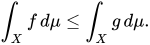
Monotonicity—
- If
f
≤
g
{\displaystyle f\leq g}
everywhere on X , {\displaystyle X,}
then
-
∫
X
f
d
μ
≤
∫
X
g
d
μ
.
{\displaystyle \int _{X}f\,d\mu \leq \int _{X}g\,d\mu .}
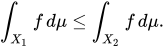
- If
X
1
,
X
2
∈
F
{\displaystyle X_{1},X_{2}\in {\mathcal {F}}}
and X 1 ⊆ X 2 , {\displaystyle X_{1}\subseteq X_{2},}
then
-
∫
X
1
f
d
μ
≤
∫
X
2
f
d
μ
.
{\displaystyle \int _{X_{1}}f\,d\mu \leq \int _{X_{2}}f\,d\mu .}
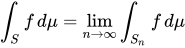
- If f is nonnegative and
S
=
∪
i
=
1
∞
S
i
{\displaystyle S=\cup _{i=1}^{\infty }S_{i}}
, where S 1 ⊆ … ⊆ S i ⊆ … ⊆ S {\displaystyle S_{1}\subseteq \ldots \subseteq S_{i}\subseteq \ldots \subseteq S}
is a non-decreasing chain of μ {\displaystyle \mu }
-
∫
S
f
d
μ
=
lim
n
→
∞
∫
S
n
f
d
μ
{\displaystyle \int _{S}{f\,d\mu }=\lim _{n\to \infty }{\int _{S_{n}}{f\,d\mu }}}
1. Since
f
≤
g
,
{\displaystyle f\leq g,}

-
SF
(
f
)
⊆
SF
(
g
)
.
{\displaystyle \operatorname {SF} (f)\subseteq \operatorname {SF} (g).}

By definition of Lebesgue integral and the properties of supremum,
-
∫
X
f
d
μ
=
sup
s
∈
S
F
(
f
)
∫
X
s
d
μ
≤
sup
s
∈
S
F
(
g
)
∫
X
s
d
μ
=
∫
X
g
d
μ
.
{\displaystyle \int _{X}f\,d\mu =\sup _{s\in {\rm {SF}}(f)}\int _{X}s\,d\mu \leq \sup _{s\in {\rm {SF}}(g)}\int _{X}s\,d\mu =\int _{X}g\,d\mu .}

2. Let
1
X
1
{\displaystyle {\mathbf {1} }_{X_{1}}}


-
∫
X
2
f
⋅
1
X
1
d
μ
=
∫
X
1
f
d
μ
{\displaystyle \int _{X_{2}}f\cdot {\mathbf {1} }_{X_{1}}\,d\mu =\int _{X_{1}}f\,d\mu }

if we notice that, for every
s
∈
S
F
(
f
⋅
1
X
1
)
,
{\displaystyle s\in {\rm {SF}}(f\cdot {\mathbf {1} }_{X_{1}}),}



-
∫
X
1
f
d
μ
=
∫
X
2
f
⋅
1
X
1
d
μ
≤
∫
X
2
f
d
μ
.
{\displaystyle \int _{X_{1}}f\,d\mu =\int _{X_{2}}f\cdot {\mathbf {1} }_{X_{1}}\,d\mu \leq \int _{X_{2}}f\,d\mu .}

3. First note that the claim holds if f is the indicator function of a set, by monotonicity of measures. By linearity, this also immediately implies the claim for simple functions.
Since any simple function supported on Sn is simple and supported on X, we must have
-
∫
X
f
d
μ
≥
lim
n
→
∞
∫
S
n
f
d
μ
{\displaystyle \int _{X}{f\,d\mu }\geq \lim _{n\to \infty }{\int _{S_{n}}{f\,d\mu }}}
.
For the reverse, suppose g ∈ SF(f) with
∫
X
f
d
μ
−
ϵ
≤
∫
X
g
d
μ
{\displaystyle \textstyle \int _{X}{f\,d\mu }-\epsilon \leq \int _{X}{g\,d\mu }}

-
∫
X
f
d
μ
−
ϵ
≤
∫
X
g
d
μ
=
lim
n
→
∞
∫
S
n
g
d
μ
≤
lim
n
→
∞
∫
S
n
f
d
μ
{\displaystyle \int _{X}{f\,d\mu }-\epsilon \leq \int _{X}{g\,d\mu }=\lim _{n\to \infty }{\int _{S_{n}}{g\,d\mu }}\leq \lim _{n\to \infty }{\int _{S_{n}}{f\,d\mu }}}

Now we turn to the main theorem
Step 1—
g
n
=
g
n
(
x
)
{\displaystyle g_{n}=g_{n}(x)}


Recall the closed intervals generate the Borel σ-algebra. Thus it suffices to show, for every
t
∈
[
−
∞
,
+
∞
]
{\displaystyle t\in [-\infty ,+\infty ]}
![{\displaystyle t\in [-\infty ,+\infty ]}](https://wikimedia.org/api/rest_v1/media/math/render/svg/e3ecb7e01f03b4a97e90c4658defa8da09a8a400)
![{\displaystyle g_{n}^{-1}([t,+\infty ])\in {\mathcal {F}}}](https://wikimedia.org/api/rest_v1/media/math/render/svg/3fa12d5227d3f7f98c569765cf21832cb9d131f4)
-
g
n
−
1
(
[
t
,
+
∞
]
)
=
{
x
∈
X
∣
g
n
(
x
)
≥
t
}
=
{
x
∈
X
|
inf
k
≥
n
f
k
(
x
)
≥
t
}
=
⋂
k
≥
n
{
x
∈
X
∣
f
k
(
x
)
≥
t
}
=
⋂
k
≥
n
f
k
−
1
(
[
t
,
+
∞
]
)
{\displaystyle {\begin{aligned}g_{n}^{-1}([t,+\infty ])&=\left\{x\in X\mid g_{n}(x)\geq t\right\}\\[3pt]&=\left\{x\in X\;\left|\;\inf _{k\,\geq \,n}f_{k}(x)\geq t\right.\right\}\\[3pt]&=\bigcap _{k\,\geq \,n}\left\{x\in X\mid f_{k}(x)\geq t\right\}\\[3pt]&=\bigcap _{k\,\geq \,n}f_{k}^{-1}([t,+\infty ])\end{aligned}}}
![{\displaystyle {\begin{aligned}g_{n}^{-1}([t,+\infty ])&=\left\{x\in X\mid g_{n}(x)\geq t\right\}\\[3pt]&=\left\{x\in X\;\left|\;\inf _{k\,\geq \,n}f_{k}(x)\geq t\right.\right\}\\[3pt]&=\bigcap _{k\,\geq \,n}\left\{x\in X\mid f_{k}(x)\geq t\right\}\\[3pt]&=\bigcap _{k\,\geq \,n}f_{k}^{-1}([t,+\infty ])\end{aligned}}}](https://wikimedia.org/api/rest_v1/media/math/render/svg/9c4629e8eef562fad7dbba39d6bff54ca975e36f)
Every set on the right-hand side is from
F
{\displaystyle {\mathcal {F}}}

Similarly, it is enough to verify that
f
−
1
(
[
0
,
t
]
)
∈
F
{\displaystyle f^{-1}([0,t])\in {\mathcal {F}}}
![{\displaystyle f^{-1}([0,t])\in {\mathcal {F}}}](https://wikimedia.org/api/rest_v1/media/math/render/svg/4becf44fee8803d73df9006cd9f79d2efbc1380f)

-
f
−
1
(
[
0
,
t
]
)
=
⋂
n
g
n
−
1
(
[
0
,
t
]
)
∈
F
{\displaystyle f^{-1}([0,t])=\bigcap _{n}g_{n}^{-1}([0,t])\in {\mathcal {F}}}
.
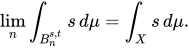
Step 2—Given a simple function
s
∈
SF
(
f
)
{\displaystyle s\in \operatorname {SF} (f)}


-
B
k
s
,
t
=
{
x
∈
X
∣
t
⋅
s
(
x
)
≤
g
k
(
x
)
}
⊆
X
.
{\displaystyle B_{k}^{s,t}=\{x\in X\mid t\cdot s(x)\leq g_{k}(x)\}\subseteq X.}

Then
B
k
s
,
t
∈
F
{\displaystyle B_{k}^{s,t}\in {\mathcal {F}}}


Step 2a. To prove the first claim, write s as a weighted sum of indicator functions of disjoint sets:
-
s
=
∑
i
=
1
m
c
i
⋅
1
A
i
{\displaystyle s=\sum _{i=1}^{m}c_{i}\cdot \mathbf {1} _{A_{i}}}
.
Then
-
B
k
s
,
t
=
⋃
i
=
1
m
(
g
k
−
1
(
[
t
⋅
c
i
,
+
∞
]
)
∩
A
i
)
{\displaystyle B_{k}^{s,t}=\bigcup _{i=1}^{m}{\Bigl (}g_{k}^{-1}{\Bigl (}[t\cdot c_{i},+\infty ]{\Bigr )}\cap A_{i}{\Bigr )}}
.
Since the pre-image
g
k
−
1
(
[
t
⋅
c
i
,
+
∞
]
)
{\displaystyle g_{k}^{-1}{\Bigl (}[t\cdot c_{i},+\infty ]{\Bigr )}}
![{\displaystyle g_{k}^{-1}{\Bigl (}[t\cdot c_{i},+\infty ]{\Bigr )}}](https://wikimedia.org/api/rest_v1/media/math/render/svg/af0c488bdbc5e5de021cfcd6d87e335e44d9e2b2)
![{\displaystyle [t\cdot c_{i},+\infty ]}](https://wikimedia.org/api/rest_v1/media/math/render/svg/64f66a9f9fcbf06a37f52a85145ee31464958d0c)

Step 2b. To prove the second claim, note that, for each
k
{\displaystyle k}


Step 2c. To prove the third claim, suppose for contradiction there exists
-
x
0
∈
X
∖
⋃
k
B
k
s
,
t
=
⋂
k
(
X
∖
B
k
s
,
t
)
{\displaystyle x_{0}\in X\setminus \bigcup _{k}B_{k}^{s,t}=\bigcap _{k}(X\setminus B_{k}^{s,t})}

Then
0
≤
g
k
(
x
0
)
<
t
⋅
s
(
x
0
)
<
s
(
x
0
)
{\displaystyle 0\leq g_{k}(x_{0})<t\cdot s(x_{0})<s(x_{0})}


-
f
(
x
0
)
≤
t
⋅
s
(
x
0
)
<
s
(
x
0
)
.
{\displaystyle f(x_{0})\leq t\cdot s(x_{0})<s(x_{0}).}

This contradicts our initial assumption that
s
≤
f
{\displaystyle s\leq f}

Step 3—From step 2 and monotonicity,
-
lim
n
∫
B
n
s
,
t
s
d
μ
=
∫
X
s
d
μ
.
{\displaystyle \lim _{n}\int _{B_{n}^{s,t}}s\,d\mu =\int _{X}s\,d\mu .}
Step 4—For every
s
∈
SF
(
f
)
{\displaystyle s\in \operatorname {SF} (f)}
-
∫
X
s
d
μ
≤
lim
k
∫
X
g
k
d
μ
{\displaystyle \int _{X}s\,d\mu \leq \lim _{k}\int _{X}g_{k}\,d\mu }
.
Indeed, using the definition of
B
k
s
,
t
{\displaystyle B_{k}^{s,t}}

-
∀
k
≥
1
∫
B
k
s
,
t
t
⋅
s
d
μ
≤
∫
B
k
s
,
t
g
k
d
μ
≤
∫
X
g
k
d
μ
{\displaystyle \forall k\geq 1\qquad \int _{B_{k}^{s,t}}t\cdot s\,d\mu \leq \int _{B_{k}^{s,t}}g_{k}\,d\mu \leq \int _{X}g_{k}\,d\mu }
.
In accordance with Step 4, as
k
→
∞
{\displaystyle k\to \infty }
-
t
∫
X
s
d
μ
≤
lim
k
∫
X
g
k
d
μ
{\displaystyle t\int _{X}s\,d\mu \leq \lim _{k}\int _{X}g_{k}\,d\mu }
.
Taking the limit as
t
↑
1
{\displaystyle t\uparrow 1}

-
∫
X
s
d
μ
≤
lim
k
∫
X
g
k
d
μ
{\displaystyle \int _{X}s\,d\mu \leq \lim _{k}\int _{X}g_{k}\,d\mu }
as required.
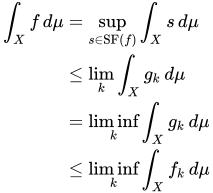
Step 5—To complete the proof, we apply the definition of Lebesgue integral to the inequality established in Step 4 and take into account that
g
n
≤
f
n
{\displaystyle g_{n}\leq f_{n}}
-
∫
X
f
d
μ
=
sup
s
∈
SF
(
f
)
∫
X
s
d
μ
≤
lim
k
∫
X
g
k
d
μ
=
lim inf
k
∫
X
g
k
d
μ
≤
lim inf
k
∫
X
f
k
d
μ
{\displaystyle {\begin{aligned}\int _{X}f\,d\mu &=\sup _{s\in \operatorname {SF} (f)}\int _{X}s\,d\mu \\&\leq \lim _{k}\int _{X}g_{k}\,d\mu \\&=\liminf _{k}\int _{X}g_{k}\,d\mu \\&\leq \liminf _{k}\int _{X}f_{k}\,d\mu \end{aligned}}}
The proof is complete.
Examples for strict inequality
Equip the space
S
{\displaystyle S}

- Example for a probability space: Let
S
=
[
0
,
1
]
{\displaystyle S=[0,1]}
denote the unit interval. For every natural number n {\displaystyle n}
define
-
f
n
(
x
)
=
{
n
for
x
∈
(
0
,
1
/
n
)
,
0
otherwise.
{\displaystyle f_{n}(x)={\begin{cases}n&{\text{for }}x\in (0,1/n),\\0&{\text{otherwise.}}\end{cases}}}
-
f
n
(
x
)
=
{
n
for
x
∈
(
0
,
1
/
n
)
,
0
otherwise.
{\displaystyle f_{n}(x)={\begin{cases}n&{\text{for }}x\in (0,1/n),\\0&{\text{otherwise.}}\end{cases}}}

- Example with uniform convergence: Let
S
{\displaystyle S}
-
f
n
(
x
)
=
{
1
n
for
x
∈
[
0
,
n
]
,
0
otherwise.
{\displaystyle f_{n}(x)={\begin{cases}{\frac {1}{n}}&{\text{for }}x\in [0,n],\\0&{\text{otherwise.}}\end{cases}}}
-
f
n
(
x
)
=
{
1
n
for
x
∈
[
0
,
n
]
,
0
otherwise.
{\displaystyle f_{n}(x)={\begin{cases}{\frac {1}{n}}&{\text{for }}x\in [0,n],\\0&{\text{otherwise.}}\end{cases}}}
![{\displaystyle f_{n}(x)={\begin{cases}{\frac {1}{n}}&{\text{for }}x\in [0,n],\\0&{\text{otherwise.}}\end{cases}}}](https://wikimedia.org/api/rest_v1/media/math/render/svg/bf508e0cccac351160fdf49494d4f3711f15edfe)
These sequences
(
f
n
)
n
∈
N
{\displaystyle (f_{n})_{n\in \mathbb {N} }}


The role of non-negativity
A suitable assumption concerning the negative parts of the sequence f1, f2, . . . of functions is necessary for Fatou's lemma, as the following example shows. Let S denote the half line [0,∞) with the Borel σ-algebra and the Lebesgue measure. For every natural number n define
-
f
n
(
x
)
=
{
−
1
n
for
x
∈
[
n
,
2
n
]
,
0
otherwise.
{\displaystyle f_{n}(x)={\begin{cases}-{\frac {1}{n}}&{\text{for }}x\in [n,2n],\\0&{\text{otherwise.}}\end{cases}}}
![{\displaystyle f_{n}(x)={\begin{cases}-{\frac {1}{n}}&{\text{for }}x\in [n,2n],\\0&{\text{otherwise.}}\end{cases}}}](https://wikimedia.org/api/rest_v1/media/math/render/svg/032ca178360ef3bcbb8ef9ee885942640791cad1)
This sequence converges uniformly on S to the zero function and the limit, 0, is reached in a finite number of steps: for every x ≥ 0, if n > x, then fn(x) = 0. However, every function fn has integral −1. Contrary to Fatou's lemma, this value is strictly less than the integral of the limit (0).
As discussed in § Extensions and variations of Fatou's lemma below, the problem is that there is no uniform integrable bound on the sequence from below, while 0 is the uniform bound from above.
Reverse Fatou lemma
Let f1, f2, . . . be a sequence of extended real-valued measurable functions defined on a measure space (S,Σ,μ). If there exists a non-negative integrable function g on S such that fn ≤ g for all n, then
-
lim sup
n
→
∞
∫
S
f
n
d
μ
≤
∫
S
lim sup
n
→
∞
f
n
d
μ
.
{\displaystyle \limsup _{n\to \infty }\int _{S}f_{n}\,d\mu \leq \int _{S}\limsup _{n\to \infty }f_{n}\,d\mu .}

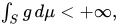
Note: Here g integrable means that g is measurable and that
∫
S
g
d
μ
<
∞
{\displaystyle \textstyle \int _{S}g\,d\mu <\infty }

Sketch of proof
We apply linearity of Lebesgue integral and Fatou's lemma to the sequence
g
−
f
n
.
{\displaystyle g-f_{n}.}

Extensions and variations of Fatou's lemma
Integrable lower bound
Let
f
1
,
f
2
,
…
{\displaystyle f_{1},f_{2},\ldots }


-
∫
S
lim inf
n
→
∞
f
n
d
μ
≤
lim inf
n
→
∞
∫
S
f
n
d
μ
.
{\displaystyle \int _{S}\liminf _{n\to \infty }f_{n}\,d\mu \leq \liminf _{n\to \infty }\int _{S}f_{n}\,d\mu .}

Proof
Apply Fatou's lemma to the non-negative sequence given by
f
n
+
g
{\displaystyle f_{n}+g}

Pointwise convergence
If in the previous setting the sequence
f
1
,
f
2
,
…
{\displaystyle f_{1},f_{2},\ldots }
-
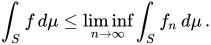
∫
S
f
d
μ
≤
lim inf
n
→
∞
∫
S
f
n
d
μ
.
{\displaystyle \int _{S}f\,d\mu \leq \liminf _{n\to \infty }\int _{S}f_{n}\,d\mu \,.}
Proof
Note that
f
{\displaystyle f}
Convergence in measure
The last assertion also holds, if the sequence
f
1
,
f
2
,
…
{\displaystyle f_{1},f_{2},\ldots }
Proof
There exists a subsequence such that
-
lim
k
→
∞
∫
S
f
n
k
d
μ
=
lim inf
n
→
∞
∫
S
f
n
d
μ
.
{\displaystyle \lim _{k\to \infty }\int _{S}f_{n_{k}}\,d\mu =\liminf _{n\to \infty }\int _{S}f_{n}\,d\mu .}

Since this subsequence also converges in measure to
f
{\displaystyle f}
Fatou's Lemma with Converging Measures
Measures with setwise convergence
In all of the above statements of Fatou's Lemma, the integration was carried out with respect to a single fixed measure
μ
{\displaystyle \mu }


-
∀
E
∈
F
:
μ
n
(
E
)
→
μ
(
E
)
{\displaystyle \forall E\in {\mathcal {F}}\colon \;\mu _{n}(E)\to \mu (E)}
.
Then, with
f
n
{\displaystyle f_{n}}
-
∫
S
f
d
μ
≤
lim inf
n
→
∞
∫
S
f
n
d
μ
n
.
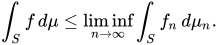
{\displaystyle \int _{S}f\,d\mu \leq \liminf _{n\to \infty }\int _{S}f_{n}\,d\mu _{n}.}
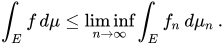
Proof We will prove something a bit stronger here. Namely, we will allow f n {\displaystyle f_{n}} of S {\displaystyle S}
-
∫
E
f
d
μ
≤
lim inf
n
→
∞
∫
E
f
n
d
μ
n
.
{\displaystyle \int _{E}f\,d\mu \leq \liminf _{n\to \infty }\int _{E}f_{n}\,d\mu _{n}\,.}
-
K
=
{
x
∈
E
|
f
n
(
x
)
→
f
(
x
)
}
{\displaystyle K=\{x\in E|f_{n}(x)\rightarrow f(x)\}}
.
-
∫
E
f
d
μ
=
∫
E
−
K
f
d
μ
,
∫
E
f
n
d
μ
=
∫
E
−
K
f
n
d
μ
∀
n
∈
N
.
{\displaystyle \int _{E}f\,d\mu =\int _{E-K}f\,d\mu ,~~~\int _{E}f_{n}\,d\mu =\int _{E-K}f_{n}\,d\mu ~\forall n\in \mathbb {N} .}
we may assume that f n {\displaystyle f_{n}}
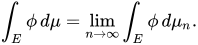
we have
-
∫
E
ϕ
d
μ
=
lim
n
→
∞
∫
E
ϕ
d
μ
n
.
{\displaystyle \int _{E}\phi \,d\mu =\lim _{n\to \infty }\int _{E}\phi \,d\mu _{n}.}
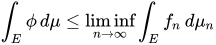
-
∫
E
ϕ
d
μ
≤
lim inf
n
→
∞
∫
E
f
n
d
μ
n
{\displaystyle \int _{E}\phi \,d\mu \leq \liminf _{n\rightarrow \infty }\int _{E}f_{n}\,d\mu _{n}}
-
A
=
{
x
∈
E
|
ϕ
(
x
)
>
a
}
{\displaystyle A=\{x\in E|\phi (x)>a\}}
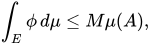
. We must have that μ ( A ) {\displaystyle \mu (A)}
is infinite since
-
∫
E
ϕ
d
μ
≤
M
μ
(
A
)
,
{\displaystyle \int _{E}\phi \,d\mu \leq M\mu (A),}
-
A
n
=
{
x
∈
E
|
f
k
(
x
)
>
a
∀
k
≥
n
}
.
{\displaystyle A_{n}=\{x\in E|f_{k}(x)>a~\forall k\geq n\}.}
-
A
⊆
⋃
n
A
n
⇒
μ
(
⋃
n
A
n
)
=
∞
.
{\displaystyle A\subseteq \bigcup _{n}A_{n}\Rightarrow \mu (\bigcup _{n}A_{n})=\infty .}
is a nested increasing sequence of functions and hence, by the continuity from below μ {\displaystyle \mu }
-
lim
n
→
∞
μ
(
A
n
)
=
∞
.
{\displaystyle \lim _{n\rightarrow \infty }\mu (A_{n})=\infty .}
.
-
lim
n
→
∞
μ
n
(
A
n
)
=
μ
(
A
n
)
=
∞
.
{\displaystyle \lim _{n\to \infty }\mu _{n}(A_{n})=\mu (A_{n})=\infty .}
.
-
∫
E
f
n
d
μ
n
≥
a
μ
n
(
A
n
)
⇒
lim inf
n
→
∞
∫
E
f
n
d
μ
n
=
∞
=
∫
E
ϕ
d
μ
,
{\displaystyle \int _{E}f_{n}\,d\mu _{n}\geq a\mu _{n}(A_{n})\Rightarrow \liminf _{n\to \infty }\int _{E}f_{n}\,d\mu _{n}=\infty =\int _{E}\phi \,d\mu ,}
. We must have that μ ( A ) {\displaystyle \mu (A)}
the maximum value of ϕ {\displaystyle \phi }
Define
-
A
n
=
{
x
∈
E
|
f
k
(
x
)
>
(
1
−
ϵ
)
ϕ
(
x
)
∀
k
≥
n
}
.
{\displaystyle A_{n}=\{x\in E|f_{k}(x)>(1-\epsilon )\phi (x)~\forall k\geq n\}.}
. Thus, A − A n {\displaystyle A-A_{n}}
is a decreasing sequence of sets with empty intersection. Since A {\displaystyle A}
-
lim
n
→
∞
μ
(
A
−
A
n
)
=
0.
{\displaystyle \lim _{n\rightarrow \infty }\mu (A-A_{n})=0.}
-
μ
(
A
−
A
k
)
<
ϵ
,
∀
k
≥
n
.
{\displaystyle \mu (A-A_{k})<\epsilon ,~\forall k\geq n.}
-
lim
n
→
∞
μ
n
(
A
−
A
k
)
=
μ
(
A
−
A
k
)
,
{\displaystyle \lim _{n\to \infty }\mu _{n}(A-A_{k})=\mu (A-A_{k}),}
-
μ
k
(
A
−
A
k
)
<
ϵ
,
∀
k
≥
N
.
{\displaystyle \mu _{k}(A-A_{k})<\epsilon ,~\forall k\geq N.}
-
∫
E
f
k
d
μ
k
≥
∫
A
k
f
k
d
μ
k
≥
(
1
−
ϵ
)
∫
A
k
ϕ
d
μ
k
.
{\displaystyle \int _{E}f_{k}\,d\mu _{k}\geq \int _{A_{k}}f_{k}\,d\mu _{k}\geq (1-\epsilon )\int _{A_{k}}\phi \,d\mu _{k}.}
-
∫
E
ϕ
d
μ
k
=
∫
A
ϕ
d
μ
k
=
∫
A
k
ϕ
d
μ
k
+
∫
A
−
A
k
ϕ
d
μ
k
.
{\displaystyle \int _{E}\phi \,d\mu _{k}=\int _{A}\phi \,d\mu _{k}=\int _{A_{k}}\phi \,d\mu _{k}+\int _{A-A_{k}}\phi \,d\mu _{k}.}
-
(
1
−
ϵ
)
∫
A
k
ϕ
d
μ
k
≥
(
1
−
ϵ
)
∫
E
ϕ
d
μ
k
−
∫
A
−
A
k
ϕ
d
μ
k
.
{\displaystyle (1-\epsilon )\int _{A_{k}}\phi \,d\mu _{k}\geq (1-\epsilon )\int _{E}\phi \,d\mu _{k}-\int _{A-A_{k}}\phi \,d\mu _{k}.}
-
∫
E
f
k
d
μ
k
≥
(
1
−
ϵ
)
∫
E
ϕ
d
μ
k
−
∫
A
−
A
k
ϕ
d
μ
k
≥
∫
E
ϕ
d
μ
k
−
ϵ
(
∫
E
ϕ
d
μ
k
+
M
)
.
{\displaystyle \int _{E}f_{k}\,d\mu _{k}\geq (1-\epsilon )\int _{E}\phi \,d\mu _{k}-\int _{A-A_{k}}\phi \,d\mu _{k}\geq \int _{E}\phi \,d\mu _{k}-\epsilon \left(\int _{E}\phi \,d\mu _{k}+M\right).}
to 0 and taking the liminf in n {\displaystyle n}
-
lim inf
n
→
∞
∫
E
f
n
d
μ
k
≥
∫
E
ϕ
d
μ
,
{\displaystyle \liminf _{n\rightarrow \infty }\int _{E}f_{n}\,d\mu _{k}\geq \int _{E}\phi \,d\mu ,}
-
∫
E
f
d
μ
≤
lim inf
n
→
∞
∫
E
f
n
d
μ
n
.
{\displaystyle \int _{E}f\,d\mu \leq \liminf _{n\to \infty }\int _{E}f_{n}\,d\mu _{n}\,.}
















Asymptotically uniform integrable functions
The following results use the notion asymptotically uniform integrable (a.u.i). A sequence
{
f
n
}
n
∈
N
{\displaystyle \{f_{n}\}_{n\in \mathbb {N} }}


lim
K
→
+
∞
lim sup
n
→
∞
∫
M
|
f
n
(
s
)
|
I
{
s
∈
M
:
|
f
n
(
s
)
|
≥
K
}
μ
n
(
d
s
)
=
0
.
{\displaystyle \lim _{K\rightarrow +\infty }\limsup _{n\rightarrow \infty }\int _{M}|f_{n}(s)|\mathbf {I} \{s\in M:|f_{n}(s)|\geq K\}\mu _{n}(ds)=0\,.}

Weakly converging measures
A sequence of measures
{
μ
n
}
n
∈
N
{\displaystyle \{\mu _{n}\}_{n\in \mathbb {N} }}
∫
M
f
(
s
)
μ
n
(
d
s
)
→
∫
M
f
(
s
)
μ
(
d
s
)
as
n
→
∞
.
{\displaystyle \int _{M}f(s)\mu _{n}(ds)\rightarrow \int _{M}f(s)\mu (ds)\quad {\text{as }}n\rightarrow \infty \,.}

Theorem[1]—Denote
f
n
−
(
s
)
=
−
min
{
f
n
(
s
)
,
0
}
{\displaystyle f_{n}^{-}(s)=-\min\{f_{n}(s),0\}}


-
∫
M
lim inf
n
→
∞
,
s
′
→
s
f
n
(
s
′
)
μ
(
d
s
)
≤
lim inf
n
→
∞
∫
M
f
n
(
s
)
μ
n
(
d
s
)
.
{\displaystyle \int _{M}\liminf _{n\rightarrow \infty ,s'\rightarrow s}f_{n}(s')\mu (ds)\leq \liminf _{n\rightarrow \infty }\int _{M}f_{n}(s)\mu _{n}(ds)\,.}

Measures with convergence in total variation
A sequence of finite measures
{
μ
n
}
n
∈
N
{\displaystyle \{\mu _{n}\}_{n\in \mathbb {N} }}
sup
{
|
∫
M
f
(
s
)
μ
n
(
d
s
)
−
∫
M
f
(
s
)
μ
(
d
s
)
|
:
f
:
M
↦
[
−
1
,
1
]
is measurable
}
→
0
as
n
→
∞
.
{\displaystyle \sup \left\{\left|\int _{M}f(s)\mu _{n}(ds)-\int _{M}f(s)\mu (ds)\right|:\,f:M\mapsto [-1,1]{\text{ is measurable}}\right\}\rightarrow 0\quad {\text{as }}n\rightarrow \infty \,.}
![{\displaystyle \sup \left\{\left|\int _{M}f(s)\mu _{n}(ds)-\int _{M}f(s)\mu (ds)\right|:\,f:M\mapsto [-1,1]{\text{ is measurable}}\right\}\rightarrow 0\quad {\text{as }}n\rightarrow \infty \,.}](https://wikimedia.org/api/rest_v1/media/math/render/svg/a3afd0554b323ae301564a2899c75841e57f8ec2)
Theorem[2]—Let
M
{\displaystyle M}


-
lim inf
n
→
∞
inf
C
∈
Σ
(
∫
C
f
n
(
s
)
μ
n
(
d
s
)
−
∫
C
f
(
s
)
μ
(
d
s
)
)
≥
0
,
{\displaystyle \liminf _{n\rightarrow \infty }\inf _{C\in \Sigma }\left(\int _{C}f_{n}(s)\mu _{n}(ds)-\int _{C}f(s)\mu (ds)\right)\geq 0\,,}

if and only if the following two statements hold:
- (i) for each
ε
>
0
{\displaystyle \varepsilon >0}
, μ ( { s ∈ M : f n ( s ) ≤ f ( s ) − ε } ) → 0 {\displaystyle \mu (\{s\in M:f_{n}(s)\leq f(s)-\varepsilon \})\to 0}
as n → ∞ {\displaystyle n\to \infty }
, and, therefore, there exists a subsequence { f n k } k ∈ N ⊂ { f n } n ∈ N {\displaystyle \{f_{n_{k}}\}_{k\in \mathbb {N} }\subset \{f_{n}\}_{n\in \mathbb {N} }}
such that f ( s ) ≤ lim inf k → ∞ f n k ( s ) {\displaystyle f(s)\leq \liminf _{k\to \infty }f_{n_{k}}(s)}
for μ {\displaystyle \mu }
;
- (ii)
{
f
n
−
}
n
∈
N
{\displaystyle \{f_{n}^{-}\}_{n\in \mathbb {N} }}
Fatou's lemma for conditional expectations
In probability theory, by a change of notation, the above versions of Fatou's lemma are applicable to sequences of random variables X1, X2, . . . defined on a probability space
(
Ω
,
F
,
P
)
{\displaystyle \scriptstyle (\Omega ,\,{\mathcal {F}},\,\mathbb {P} )}

Standard version
Let X1, X2, . . . be a sequence of non-negative random variables on a probability space
(
Ω
,
F
,
P
)
{\displaystyle \scriptstyle (\Omega ,{\mathcal {F}},\mathbb {P} )}


-
E
[
lim inf
n
→
∞
X
n
|
G
]
≤
lim inf
n
→
∞
E
[
X
n
|
G
]
{\displaystyle \mathbb {E} {\Bigl [}\liminf _{n\to \infty }X_{n}\,{\Big |}\,{\mathcal {G}}{\Bigr ]}\leq \liminf _{n\to \infty }\,\mathbb {E} [X_{n}|{\mathcal {G}}]}
almost surely.
Note: Conditional expectation for non-negative random variables is always well defined, finite expectation is not needed.
Proof
Besides a change of notation, the proof is very similar to the one for the standard version of Fatou's lemma above, however the monotone convergence theorem for conditional expectations has to be applied.
Let X denote the limit inferior of the Xn. For every natural number k define pointwise the random variable
-
Y
k
=
inf
n
≥
k
X
n
.
{\displaystyle Y_{k}=\inf _{n\geq k}X_{n}.}
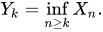
Then the sequence Y1, Y2, . . . is increasing and converges pointwise to X. For k ≤ n, we have Yk ≤ Xn, so that
-
E
[
Y
k
|
G
]
≤
E
[
X
n
|
G
]
{\displaystyle \mathbb {E} [Y_{k}|{\mathcal {G}}]\leq \mathbb {E} [X_{n}|{\mathcal {G}}]}
almost surely
by the monotonicity of conditional expectation, hence
-
E
[
Y
k
|
G
]
≤
inf
n
≥
k
E
[
X
n
|
G
]
{\displaystyle \mathbb {E} [Y_{k}|{\mathcal {G}}]\leq \inf _{n\geq k}\mathbb {E} [X_{n}|{\mathcal {G}}]}
almost surely,
because the countable union of the exceptional sets of probability zero is again a null set. Using the definition of X, its representation as pointwise limit of the Yk, the monotone convergence theorem for conditional expectations, the last inequality, and the definition of the limit inferior, it follows that almost surely
-
E
[
lim inf
n
→
∞
X
n
|
G
]
=
E
[
X
|
G
]
=
E
[
lim
k
→
∞
Y
k
|
G
]
=
lim
k
→
∞
E
[
Y
k
|
G
]
≤
lim
k
→
∞
inf
n
≥
k
E
[
X
n
|
G
]
=
lim inf
n
→
∞
E
[
X
n
|
G
]
.
{\displaystyle {\begin{aligned}\mathbb {E} {\Bigl [}\liminf _{n\to \infty }X_{n}\,{\Big |}\,{\mathcal {G}}{\Bigr ]}&=\mathbb {E} [X|{\mathcal {G}}]=\mathbb {E} {\Bigl [}\lim _{k\to \infty }Y_{k}\,{\Big |}\,{\mathcal {G}}{\Bigr ]}=\lim _{k\to \infty }\mathbb {E} [Y_{k}|{\mathcal {G}}]\\&\leq \lim _{k\to \infty }\inf _{n\geq k}\mathbb {E} [X_{n}|{\mathcal {G}}]=\liminf _{n\to \infty }\,\mathbb {E} [X_{n}|{\mathcal {G}}].\end{aligned}}}
![{\displaystyle {\begin{aligned}\mathbb {E} {\Bigl [}\liminf _{n\to \infty }X_{n}\,{\Big |}\,{\mathcal {G}}{\Bigr ]}&=\mathbb {E} [X|{\mathcal {G}}]=\mathbb {E} {\Bigl [}\lim _{k\to \infty }Y_{k}\,{\Big |}\,{\mathcal {G}}{\Bigr ]}=\lim _{k\to \infty }\mathbb {E} [Y_{k}|{\mathcal {G}}]\\&\leq \lim _{k\to \infty }\inf _{n\geq k}\mathbb {E} [X_{n}|{\mathcal {G}}]=\liminf _{n\to \infty }\,\mathbb {E} [X_{n}|{\mathcal {G}}].\end{aligned}}}](https://wikimedia.org/api/rest_v1/media/math/render/svg/13169cd09a4372a20eb250f3d617c3623bfacabc)
Extension to uniformly integrable negative parts
Let X1, X2, . . . be a sequence of random variables on a probability space
(
Ω
,
F
,
P
)
{\displaystyle \scriptstyle (\Omega ,{\mathcal {F}},\mathbb {P} )}
-
X
n
−
:=
max
{
−
X
n
,
0
}
,
n
∈
N
,
{\displaystyle X_{n}^{-}:=\max\{-X_{n},0\},\qquad n\in {\mathbb {N} },}

are uniformly integrable with respect to the conditional expectation, in the sense that, for ε > 0 there exists a c > 0 such that
-
E
[
X
n
−
1
{
X
n
−
>
c
}
|
G
]
<
ε
,
for all
n
∈
N
,
almost surely
{\displaystyle \mathbb {E} {\bigl [}X_{n}^{-}1_{\{X_{n}^{-}>c\}}\,|\,{\mathcal {G}}{\bigr ]}<\varepsilon ,\qquad {\text{for all }}n\in \mathbb {N} ,\,{\text{almost surely}}}
,
then
-
E
[
lim inf
n
→
∞
X
n
|
G
]
≤
lim inf
n
→
∞
E
[
X
n
|
G
]
{\displaystyle \mathbb {E} {\Bigl [}\liminf _{n\to \infty }X_{n}\,{\Big |}\,{\mathcal {G}}{\Bigr ]}\leq \liminf _{n\to \infty }\,\mathbb {E} [X_{n}|{\mathcal {G}}]}
Note: On the set where
-
X
:=
lim inf
n
→
∞
X
n
{\displaystyle X:=\liminf _{n\to \infty }X_{n}}

satisfies
-
E
[
max
{
X
,
0
}
|
G
]
=
∞
,
{\displaystyle \mathbb {E} [\max\{X,0\}\,|\,{\mathcal {G}}]=\infty ,}
![{\displaystyle \mathbb {E} [\max\{X,0\}\,|\,{\mathcal {G}}]=\infty ,}](https://wikimedia.org/api/rest_v1/media/math/render/svg/11b354af5729d85d5b7f584bac0edc000ed0f6e6)
the left-hand side of the inequality is considered to be plus infinity. The conditional expectation of the limit inferior might not be well defined on this set, because the conditional expectation of the negative part might also be plus infinity.
Proof
Let ε > 0. Due to uniform integrability with respect to the conditional expectation, there exists a c > 0 such that
-
E
[
X
n
−
1
{
X
n
−
>
c
}
|
G
]
<
ε
for all
n
∈
N
,
almost surely
.
{\displaystyle \mathbb {E} {\bigl [}X_{n}^{-}1_{\{X_{n}^{-}>c\}}\,|\,{\mathcal {G}}{\bigr ]}<\varepsilon \qquad {\text{for all }}n\in \mathbb {N} ,\,{\text{almost surely}}.}
![{\displaystyle \mathbb {E} {\bigl [}X_{n}^{-}1_{\{X_{n}^{-}>c\}}\,|\,{\mathcal {G}}{\bigr ]}<\varepsilon \qquad {\text{for all }}n\in \mathbb {N} ,\,{\text{almost surely}}.}](https://wikimedia.org/api/rest_v1/media/math/render/svg/8ca3bf9b4f2b18c99ab5fb278b2fa046d649f839)
Since
-
X
+
c
≤
lim inf
n
→
∞
(
X
n
+
c
)
+
,
{\displaystyle X+c\leq \liminf _{n\to \infty }(X_{n}+c)^{+},}

where x+ := max{x,0} denotes the positive part of a real x, monotonicity of conditional expectation (or the above convention) and the standard version of Fatou's lemma for conditional expectations imply
-
E
[
X
|
G
]
+
c
≤
E
[
lim inf
n
→
∞
(
X
n
+
c
)
+
|
G
]
≤
lim inf
n
→
∞
E
[
(
X
n
+
c
)
+
|
G
]
{\displaystyle \mathbb {E} [X\,|\,{\mathcal {G}}]+c\leq \mathbb {E} {\Bigl [}\liminf _{n\to \infty }(X_{n}+c)^{+}\,{\Big |}\,{\mathcal {G}}{\Bigr ]}\leq \liminf _{n\to \infty }\mathbb {E} [(X_{n}+c)^{+}\,|\,{\mathcal {G}}]}
almost surely.
Since
-
(
X
n
+
c
)
+
=
(
X
n
+
c
)
+
(
X
n
+
c
)
−
≤
X
n
+
c
+
X
n
−
1
{
X
n
−
>
c
}
,
{\displaystyle (X_{n}+c)^{+}=(X_{n}+c)+(X_{n}+c)^{-}\leq X_{n}+c+X_{n}^{-}1_{\{X_{n}^{-}>c\}},}

we have
-
E
[
(
X
n
+
c
)
+
|
G
]
≤
E
[
X
n
|
G
]
+
c
+
ε
{\displaystyle \mathbb {E} [(X_{n}+c)^{+}\,|\,{\mathcal {G}}]\leq \mathbb {E} [X_{n}\,|\,{\mathcal {G}}]+c+\varepsilon }
almost surely,
hence
-
E
[
X
|
G
]
≤
lim inf
n
→
∞
E
[
X
n
|
G
]
+
ε
{\displaystyle \mathbb {E} [X\,|\,{\mathcal {G}}]\leq \liminf _{n\to \infty }\mathbb {E} [X_{n}\,|\,{\mathcal {G}}]+\varepsilon }
almost surely.
This implies the assertion.
References
- Feinberg, E. A.; Kasyanov, P. O.; Liang, Y. (2020). "Fatou's Lemma for Weakly Converging Measures under the Uniform Integrability Condition". Theory of Probability & Its Applications. 64 (4): 615–630. arXiv:1807.07931. doi:10.1137/S0040585X97T989738. ISSN 0040-585X.
- Feinberg; Kasyanov; Zgurovsky (2016). "Uniform Fatou's lemma". Journal of Mathematical Analysis and Applications. 444: 550–567.
- Carothers, N. L. (2000). Real Analysis. New York: Cambridge University Press. pp. 321–22. ISBN 0-521-49756-6.
- Royden, H. L. (1988). Real Analysis (3rd ed.). London: Collier Macmillan. ISBN 0-02-404151-3.
- Weir, Alan J. (1973). "The Convergence Theorems". Lebesgue Integration and Measure. Cambridge: Cambridge University Press. pp. 93–118. ISBN 0-521-08728-7.