In mathematics, a filtered algebra is a generalization of the notion of a graded algebra. Examples appear in many branches of mathematics, especially in homological algebra and representation theory.
A filtered algebra over the field
k
{\displaystyle k}




-
A
=
⋃
i
∈
N
F
i
{\displaystyle A=\bigcup _{i\in \mathbb {N} }F_{i}}

and that is compatible with the multiplication in the following sense:
-
∀
m
,
n
∈
N
,
F
m
⋅
F
n
⊆
F
n
+
m
.
{\displaystyle \forall m,n\in \mathbb {N} ,\quad F_{m}\cdot F_{n}\subseteq F_{n+m}.}

Associated graded algebra
In general, there is the following construction that produces a graded algebra out of a filtered algebra.
If
A
{\displaystyle A}

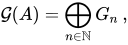
- As a vector space
-
G
(
A
)
=
⨁
n
∈
N
G
n
,
{\displaystyle {\mathcal {G}}(A)=\bigoplus _{n\in \mathbb {N} }G_{n}\,,}
where,
-
G
0
=
F
0
,
{\displaystyle G_{0}=F_{0},}
and
-
∀
n
>
0
,
G
n
=
F
n
/
F
n
−
1
,
{\displaystyle \forall n>0,\ G_{n}=F_{n}/F_{n-1}\,,}
-
G
(
A
)
=
⨁
n
∈
N
G
n
,
{\displaystyle {\mathcal {G}}(A)=\bigoplus _{n\in \mathbb {N} }G_{n}\,,}
- the multiplication is defined by
-
(
x
+
F
n
−
1
)
(
y
+
F
m
−
1
)
=
x
⋅
y
+
F
n
+
m
−
1
{\displaystyle (x+F_{n-1})(y+F_{m-1})=x\cdot y+F_{n+m-1}}
for all x ∈ F n {\displaystyle x\in F_{n}}
and y ∈ F m {\displaystyle y\in F_{m}}
. (More precisely, the multiplication map G ( A ) × G ( A ) → G ( A ) {\displaystyle {\mathcal {G}}(A)\times {\mathcal {G}}(A)\to {\mathcal {G}}(A)}
is combined from the maps
-
(
F
n
/
F
n
−
1
)
×
(
F
m
/
F
m
−
1
)
→
F
n
+
m
/
F
n
+
m
−
1
,
(
x
+
F
n
−
1
,
y
+
F
m
−
1
)
↦
x
⋅
y
+
F
n
+
m
−
1
{\displaystyle (F_{n}/F_{n-1})\times (F_{m}/F_{m-1})\to F_{n+m}/F_{n+m-1},\ \ \ \ \ \left(x+F_{n-1},y+F_{m-1}\right)\mapsto x\cdot y+F_{n+m-1}}
and m ≥ 0 {\displaystyle m\geq 0}
.)
-
(
x
+
F
n
−
1
)
(
y
+
F
m
−
1
)
=
x
⋅
y
+
F
n
+
m
−
1
{\displaystyle (x+F_{n-1})(y+F_{m-1})=x\cdot y+F_{n+m-1}}



The multiplication is well-defined and endows
G
(
A
)
{\displaystyle {\mathcal {G}}(A)}


As algebras
A
{\displaystyle A}


Examples
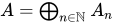
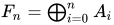
Any graded algebra graded by
N
{\displaystyle \mathbb {N} }

An example of a filtered algebra is the Clifford algebra
Cliff
(
V
,
q
)
{\displaystyle \operatorname {Cliff} (V,q)}


The symmetric algebra on the dual of an affine space is a filtered algebra of polynomials; on a vector space, one instead obtains a graded algebra.
The universal enveloping algebra of a Lie algebra
g
{\displaystyle {\mathfrak {g}}}


Scalar differential operators on a manifold
M
{\displaystyle M}



The group algebra of a group with a length function is a filtered algebra.
See also
References
- Abe, Eiichi (1980). Hopf Algebras. Cambridge: Cambridge University Press. ISBN 0-521-22240-0.
This article incorporates material from Filtered algebra on PlanetMath, which is licensed under the Creative Commons Attribution/Share-Alike License.