In mathematics, a finite von Neumann algebra is a von Neumann algebra in which every isometry is a unitary. In other words, for an operator V in a finite von Neumann algebra if
V
∗
V
=
I
{\displaystyle V^{*}V=I}


Properties
Let
M
{\displaystyle {\mathcal {M}}}


-
τ
(
A
B
)
=
τ
(
B
A
)
,
A
,
B
∈
M
{\displaystyle \tau (AB)=\tau (BA),A,B\in {\mathcal {M}}}
,
- if
A
≥
0
{\displaystyle A\geq 0}
and τ ( A ) = 0 {\displaystyle \tau (A)=0}
then A = 0 {\displaystyle A=0}
,
-
τ
(
C
)
=
C
{\displaystyle \tau (C)=C}
for C ∈ Z {\displaystyle C\in {\mathcal {Z}}}
,
-
τ
(
C
A
)
=
C
τ
(
A
)
{\displaystyle \tau (CA)=C\tau (A)}
for A ∈ M {\displaystyle A\in {\mathcal {M}}}
and C ∈ Z {\displaystyle C\in {\mathcal {Z}}}
Examples
Finite-dimensional von Neumann algebras
The finite-dimensional von Neumann algebras can be characterized using Wedderburn's theory of semisimple algebras. Let Cn × n be the n × n matrices with complex entries. A von Neumann algebra M is a self adjoint subalgebra in Cn × n such that M contains the identity operator I in Cn × n.
Every such M as defined above is a semisimple algebra, i.e. it contains no nilpotent ideals. Suppose M ≠ 0 lies in a nilpotent ideal of M. Since M* ∈ M by assumption, we have M*M, a positive semidefinite matrix, lies in that nilpotent ideal. This implies (M*M)k = 0 for some k. So M*M = 0, i.e. M = 0.
The center of a von Neumann algebra M will be denoted by Z(M). Since M is self-adjoint, Z(M) is itself a (commutative) von Neumann algebra. A von Neumann algebra N is called a factor if Z(N) is one-dimensional, that is, Z(N) consists of multiples of the identity I.
Theorem Every finite-dimensional von Neumann algebra M is a direct sum of m factors, where m is the dimension of Z(M).
Proof: By Wedderburn's theory of semisimple algebras, Z(M) contains a finite orthogonal set of idempotents (projections) {Pi} such that PiPj = 0 for i ≠ j, Σ Pi = I, and
-
Z
(
M
)
=
⨁
i
Z
(
M
)
P
i
{\displaystyle Z(\mathbf {M} )=\bigoplus _{i}Z(\mathbf {M} )P_{i}}
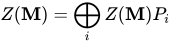
where each Z(M)Pi is a commutative simple algebra. Every complex simple algebras is isomorphic to the full matrix algebra Ck × k for some k. But Z(M)Pi is commutative, therefore one-dimensional.
The projections Pi "diagonalizes" M in a natural way. For M ∈ M, M can be uniquely decomposed into M = Σ MPi. Therefore,
-
M
=
⨁
i
M
P
i
.
{\displaystyle {\mathbf {M} }=\bigoplus _{i}{\mathbf {M} }P_{i}.}
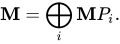
One can see that Z(MPi) = Z(M)Pi. So Z(MPi) is one-dimensional and each MPi is a factor. This proves the claim.
For general von Neumann algebras, the direct sum is replaced by the direct integral. The above is a special case of the central decomposition of von Neumann algebras.
Abelian von Neumann algebras
Abelian von Neumann algebras are all isomorphic to a multiplication algebra
L
∞
(
X
)
{\displaystyle L^{\infty }(X)}


Type
I
I
1
{\displaystyle II_{1}}
 factors
References
- Kadison, R. V.; Ringrose, J. R. (1997). Fundamentals of the Theory of Operator Algebras, Vol. II : Advanced Theory. AMS. p. 676. ISBN 978-0821808207.
- Sinclair, A. M.; Smith, R. R. (2008). Finite von Neumann Algebras and Masas. Cambridge University Press. p. 410. ISBN 978-0521719193.