In mathematics, the Fredholm alternative, named after Ivar Fredholm, is one of Fredholm's theorems and is a result in Fredholm theory. It may be expressed in several ways, as a theorem of linear algebra, a theorem of integral equations, or as a theorem on Fredholm operators. Part of the result states that a non-zero complex number in the spectrum of a compact operator is an eigenvalue.
Linear algebra
If
V
{\displaystyle V}
is a
n
{\displaystyle n}
-dimensional vector space, with
n
{\displaystyle n}
finite, and
T
:
V
→
V
{\displaystyle T:V\to V}
is a linear transformation, then exactly one of the following holds:
- For each vector
v
{\displaystyle v}
in V {\displaystyle V}
there is a vector u {\displaystyle u}
in V {\displaystyle V}
so that T ( u ) = v {\displaystyle T(u)=v}
. In other words: T {\displaystyle T}
is surjective (and so also bijective, since V {\displaystyle V}
is finite-dimensional).
-
dim
(
ker
(
T
)
)
>
0.
{\displaystyle \dim(\ker(T))>0.}

A more elementary formulation, in terms of matrices, is as follows. Given an
m
×
n
{\displaystyle m\times n}
matrix
A
{\displaystyle A}
and a
m
×
1
{\displaystyle m\times 1}
column vector
b
{\displaystyle \mathbf {b} }
, exactly one of the following must hold:
- Either:
A
x
=
b
{\displaystyle A\mathbf {x} =\mathbf {b} }
has a solution x {\displaystyle \mathbf {x} }
- Or:
A
T
y
=
0
{\displaystyle A^{T}\mathbf {y} =0}
has a solution y {\displaystyle \mathbf {y} }
with y T b ≠ 0 {\displaystyle \mathbf {y} ^{T}\mathbf {b} \neq 0}
.
In other words,
A
x
=
b
{\displaystyle A\mathbf {x} =\mathbf {b} }
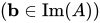
has a solution
(
b
∈
Im
(
A
)
)
{\displaystyle (\mathbf {b} \in \operatorname {Im} (A))}
if and only if for any
y
{\displaystyle \mathbf {y} }
such that
A
T
y
=
0
{\displaystyle A^{T}\mathbf {y} =0}
, it follows that
y
T
b
=
0
{\displaystyle \mathbf {y} ^{T}\mathbf {b} =0}
(
i
.
e
.
,
b
∈
ker
(
A
T
)
⊥
)
{\displaystyle (i.e.,\mathbf {b} \in \ker(A^{T})^{\bot })}
.
Integral equations
Let
K
(
x
,
y
)
{\displaystyle K(x,y)}
be an integral kernel, and consider the homogeneous equation, the Fredholm integral equation,
-
λ
φ
(
x
)
−
∫
a
b
K
(
x
,
y
)
φ
(
y
)
d
y
=
0
{\displaystyle \lambda \varphi (x)-\int _{a}^{b}K(x,y)\varphi (y)\,dy=0}
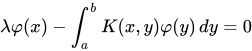
and the inhomogeneous equation
-
λ
φ
(
x
)
−
∫
a
b
K
(
x
,
y
)
φ
(
y
)
d
y
=
f
(
x
)
.
{\displaystyle \lambda \varphi (x)-\int _{a}^{b}K(x,y)\varphi (y)\,dy=f(x).}
The Fredholm alternative is the statement that, for every non-zero fixed complex number
λ
∈
C
,
{\displaystyle \lambda \in \mathbb {C} ,}
either the first equation has a non-trivial solution, or the second equation has a solution for all
f
(
x
)
{\displaystyle f(x)}
.
A sufficient condition for this statement to be true is for
K
(
x
,
y
)
{\displaystyle K(x,y)}
to be square integrable on the rectangle
[
a
,
b
]
×
[
a
,
b
]
{\displaystyle [a,b]\times [a,b]}
(where a and/or b may be minus or plus infinity). The integral operator defined by such a K is called a Hilbert–Schmidt integral operator.
Functional analysis
Results about Fredholm operators generalize these results to complete normed vector spaces of infinite dimensions; that is, Banach spaces.
The integral equation can be reformulated in terms of operator notation as follows. Write (somewhat informally)
T
=
λ
−
K
{\displaystyle T=\lambda -K}
to mean
T
(
x
,
y
)
=
λ
δ
(
x
−
y
)
−
K
(
x
,
y
)
{\displaystyle T(x,y)=\lambda \;\delta (x-y)-K(x,y)}
with
δ
(
x
−
y
)
{\displaystyle \delta (x-y)}
the Dirac delta function, considered as a distribution, or generalized function, in two variables.
Then by convolution,
T
{\displaystyle T}
induces a linear operator acting on a Banach space
V
{\displaystyle V}
of functions
φ
(
x
)
{\displaystyle \varphi (x)}
V
→
V
{\displaystyle V\to V}
given by
φ
↦
ψ
{\displaystyle \varphi \mapsto \psi }
with
ψ
{\displaystyle \psi }
given by
ψ
(
x
)
=
∫
a
b
T
(
x
,
y
)
φ
(
y
)
d
y
=
λ
φ
(
x
)
−
∫
a
b
K
(
x
,
y
)
φ
(
y
)
d
y
.
{\displaystyle \psi (x)=\int _{a}^{b}T(x,y)\varphi (y)\,dy=\lambda \;\varphi (x)-\int _{a}^{b}K(x,y)\varphi (y)\,dy.}
In this language, the Fredholm alternative for integral equations is seen to be analogous to the Fredholm alternative for finite-dimensional linear algebra.
The operator
K
{\displaystyle K}
given by convolution with an
L
2
{\displaystyle L^{2}}
kernel, as above, is known as a Hilbert–Schmidt integral operator.
Such operators are always compact. More generally, the Fredholm alternative is valid when
K
{\displaystyle K}
is any compact operator. The Fredholm alternative may be restated in the following form: a nonzero
λ
{\displaystyle \lambda }
either is an eigenvalue of
K
,
{\displaystyle K,}
or lies in the domain of the resolvent
R
(
λ
;
K
)
=
(
K
−
λ
Id
)
−
1
.
{\displaystyle R(\lambda ;K)=(K-\lambda \operatorname {Id} )^{-1}.}
Elliptic partial differential equations
The Fredholm alternative can be applied to solving linear elliptic boundary value problems. The basic result is: if the equation and the appropriate Banach spaces have been set up correctly, then either
- (1) The homogeneous equation has a nontrivial solution, or
- (2) The inhomogeneous equation can be solved uniquely for each choice of data.
The argument goes as follows. A typical simple-to-understand elliptic operator
L
{\displaystyle L}
would be the Laplacian plus some lower order terms. Combined with suitable boundary conditions and expressed on a suitable Banach space
X
{\displaystyle X}
(which encodes both the boundary conditions and the desired regularity of the solution),
L
{\displaystyle L}
becomes an unbounded operator from
X
{\displaystyle X}
to itself, and one attempts to solve
-
L
u
=
f
,
u
∈
dom
(
L
)
⊆
X
,
{\displaystyle Lu=f,\qquad u\in \operatorname {dom} (L)\subseteq X,}

where
f
∈
X
{\displaystyle f\in X}
is some function serving as data for which we want a solution. The Fredholm alternative, together with the theory of elliptic equations, will enable us to organize the solutions of this equation.
A concrete example would be an elliptic boundary-value problem like
-
(
∗
)
L
u
:=
−
Δ
u
+
h
(
x
)
u
=
f
in
Ω
,
{\displaystyle (*)\qquad Lu:=-\Delta u+h(x)u=f\qquad {\text{in }}\Omega ,}
supplemented with the boundary condition
-
(
∗
∗
)
u
=
0
on
∂
Ω
,
{\displaystyle (**)\qquad u=0\qquad {\text{on }}\partial \Omega ,}

where
Ω
⊆
R
n
{\displaystyle \Omega \subseteq \mathbf {R} ^{n}}
is a bounded open set with smooth boundary and
h
{\displaystyle h}
is a fixed coefficient function (a potential, in the case of a Schrödinger operator). The function
f
∈
X
{\displaystyle f\in X}
is the variable data for which we wish to solve the equation. Here one would take
X
{\displaystyle X}
to be the space
L
2
(
Ω
)
{\displaystyle L^{2}(\Omega )}
of all square-integrable functions on
Ω
{\displaystyle \Omega }
, and
dom
(
L
)
{\displaystyle \operatorname {dom} (L)}
is then the Sobolev space
W
2
,
2
(
Ω
)
∩
W
0
1
,
2
(
Ω
)
{\displaystyle W^{2,2}(\Omega )\cap W_{0}^{1,2}(\Omega )}
, which amounts to the set of all square-integrable functions on
Ω
{\displaystyle \Omega }
whose weak first and second derivatives exist and are square-integrable, and which satisfy a zero boundary condition on
∂
Ω
{\displaystyle \partial \Omega }
.
If
X
{\displaystyle X}
has been selected correctly (as it has in this example), then for
μ
0
≫
0
{\displaystyle \mu _{0}\gg 0}
the operator
L
+
μ
0
{\displaystyle L+\mu _{0}}
is positive, and then employing elliptic estimates, one can prove that
L
+
μ
0
:
dom
(
L
)
→
X
{\displaystyle L+\mu _{0}:\operatorname {dom} (L)\to X}
is a bijection, and its inverse is a compact, everywhere-defined operator
K
{\displaystyle K}
from
X
{\displaystyle X}
to
X
{\displaystyle X}
, with image equal to
dom
(
L
)
{\displaystyle \operatorname {dom} (L)}
. We fix one such
μ
0
{\displaystyle \mu _{0}}
, but its value is not important as it is only a tool.
We may then transform the Fredholm alternative, stated above for compact operators, into a statement about the solvability of the boundary-value problem (*)–(**). The Fredholm alternative, as stated above, asserts:
- For each
λ
∈
R
{\displaystyle \lambda \in \mathbf {R} }
, either λ {\displaystyle \lambda }
is an eigenvalue of K {\displaystyle K}
, or the operator K − λ {\displaystyle K-\lambda }
is bijective from X {\displaystyle X}
to itself.
Let us explore the two alternatives as they play out for the boundary-value problem. Suppose
λ
≠
0
{\displaystyle \lambda \neq 0}
. Then either
(A)
λ
{\displaystyle \lambda }
is an eigenvalue of
K
{\displaystyle K}
⇔
{\displaystyle \Leftrightarrow }
there is a solution
h
∈
dom
(
L
)
{\displaystyle h\in \operatorname {dom} (L)}
of
(
L
+
μ
0
)
h
=
λ
−
1
h
{\displaystyle (L+\mu _{0})h=\lambda ^{-1}h}
⇔
{\displaystyle \Leftrightarrow }
−
μ
0
+
λ
−
1
{\displaystyle -\mu _{0}+\lambda ^{-1}}
is an eigenvalue of
L
{\displaystyle L}
.
(B) The operator
K
−
λ
:
X
→
X
{\displaystyle K-\lambda :X\to X}
is a bijection
⇔
{\displaystyle \Leftrightarrow }
(
K
−
λ
)
(
L
+
μ
0
)
=
Id
−
λ
(
L
+
μ
0
)
:
dom
(
L
)
→
X
{\displaystyle (K-\lambda )(L+\mu _{0})=\operatorname {Id} -\lambda (L+\mu _{0}):\operatorname {dom} (L)\to X}
is a bijection
⇔
{\displaystyle \Leftrightarrow }
L
+
μ
0
−
λ
−
1
:
dom
(
L
)
→
X
{\displaystyle L+\mu _{0}-\lambda ^{-1}:\operatorname {dom} (L)\to X}
is a bijection.
Replacing
−
μ
0
+
λ
−
1
{\displaystyle -\mu _{0}+\lambda ^{-1}}
by
λ
{\displaystyle \lambda }
, and treating the case
λ
=
−
μ
0
{\displaystyle \lambda =-\mu _{0}}
separately, this yields the following Fredholm alternative for an elliptic boundary-value problem:
- For each
λ
∈
R
{\displaystyle \lambda \in \mathbf {R} }
, either the homogeneous equation ( L − λ ) u = 0 {\displaystyle (L-\lambda )u=0}
has a nontrivial solution, or the inhomogeneous equation ( L − λ ) u = f {\displaystyle (L-\lambda )u=f}
possesses a unique solution u ∈ dom ( L ) {\displaystyle u\in \operatorname {dom} (L)}
for each given datum f ∈ X {\displaystyle f\in X}
.
The latter function
u
{\displaystyle u}
solves the boundary-value problem (*)–(**) introduced above. This is the dichotomy that was claimed in (1)–(2) above. By the spectral theorem for compact operators, one also obtains that the set of
λ
{\displaystyle \lambda }
for which the solvability fails is a discrete subset of
R
{\displaystyle \mathbf {R} }
(the eigenvalues of
L
{\displaystyle L}
). The eigenvalues’ associated eigenfunctions can be thought of as "resonances" that block the solvability of the equation.
See also
References
- Fredholm, E. I. (1903). "Sur une classe d'equations fonctionnelles". Acta Math. 27: 365–390. doi:10.1007/bf02421317.
- A. G. Ramm, "A Simple Proof of the Fredholm Alternative and a Characterization of the Fredholm Operators", American Mathematical Monthly, 108 (2001) p. 855.
- Khvedelidze, B.V. (2001) [1994], "Fredholm theorems", Encyclopedia of Mathematics, EMS Press
- "Fredholm alternative", Encyclopedia of Mathematics, EMS Press, 2001 [1994]

