In mathematics, the Fuglede−Kadison determinant of an invertible operator in a finite factor is a positive real number associated with it. It defines a multiplicative homomorphism from the set of invertible operators to the set of positive real numbers. The Fuglede−Kadison determinant of an operator
A
{\displaystyle A}


For a matrix
A
{\displaystyle A}


Definition
Let
M
{\displaystyle {\mathcal {M}}}


-
Δ
(
X
)
:=
exp
τ
(
log
(
X
∗
X
)
1
/
2
)
,
{\displaystyle \Delta (X):=\exp \tau (\log(X^{*}X)^{1/2}),}

(cf. Relation between determinant and trace via eigenvalues). The number
Δ
(
X
)
{\displaystyle \Delta (X)}

Properties
-
Δ
(
X
Y
)
=
Δ
(
X
)
Δ
(
Y
)
{\displaystyle \Delta (XY)=\Delta (X)\Delta (Y)}
for invertible operators X , Y ∈ M {\displaystyle X,Y\in {\mathcal {M}}}
,
-
Δ
(
exp
A
)
=
|
exp
τ
(
A
)
|
=
exp
ℜ
τ
(
A
)
{\displaystyle \Delta (\exp A)=\left|\exp \tau (A)\right|=\exp \Re \tau (A)}
for A ∈ M . {\displaystyle A\in {\mathcal {M}}.}
-
Δ
{\displaystyle \Delta }
is norm-continuous on G L 1 ( M ) {\displaystyle GL_{1}({\mathcal {M}})}
, the set of invertible operators in M , {\displaystyle {\mathcal {M}},}
-
Δ
(
X
)
{\displaystyle \Delta (X)}


Extensions to singular operators
There are many possible extensions of the Fuglede−Kadison determinant to singular operators in
M
{\displaystyle {\mathcal {M}}}
Algebraic extension
The algebraic extension of
Δ
{\displaystyle \Delta }
Analytic extension
For an operator
A
{\displaystyle A}
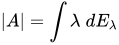


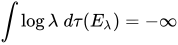
-
lim
ε
→
0
Δ
(
H
+
ε
I
)
=
Δ
(
H
)
{\displaystyle \lim _{\varepsilon \rightarrow 0}\Delta (H+\varepsilon I)=\Delta (H)}
for H ≥ 0. {\displaystyle H\geq 0.}

Generalizations
Although originally the Fuglede−Kadison determinant was defined for operators in finite factors, it carries over to the case of operators in von Neumann algebras with a tracial state (
τ
{\displaystyle \tau }

References
- Fuglede, Bent; Kadison, Richard (1952), "Determinant theory in finite factors", Ann. Math., Series 2, 55 (3): 520–530, doi:10.2307/1969645, JSTOR 1969645.