In single-variable differential calculus, the fundamental increment lemma is an immediate consequence of the definition of the derivative
f
′
(
a
)
{\textstyle f'(a)}


-
f
′
(
a
)
=
lim
h
→
0
f
(
a
+
h
)
−
f
(
a
)
h
.
{\displaystyle f'(a)=\lim _{h\to 0}{\frac {f(a+h)-f(a)}{h}}.}
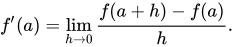
The lemma asserts that the existence of this derivative implies the existence of a function
φ
{\displaystyle \varphi }

-
lim
h
→
0
φ
(
h
)
=
0
and
f
(
a
+
h
)
=
f
(
a
)
+
f
′
(
a
)
h
+
φ
(
h
)
h
{\displaystyle \lim _{h\to 0}\varphi (h)=0\qquad {\text{and}}\qquad f(a+h)=f(a)+f'(a)h+\varphi (h)h}

for sufficiently small but non-zero
h
{\textstyle h}

-
φ
(
h
)
=
f
(
a
+
h
)
−
f
(
a
)
h
−
f
′
(
a
)
{\displaystyle \varphi (h)={\frac {f(a+h)-f(a)}{h}}-f'(a)}

and verify this
φ
{\displaystyle \varphi }
The lemma says, at least when
h
{\displaystyle h}

-
f
(
a
+
h
)
−
f
(
a
)
h
{\displaystyle {\frac {f(a+h)-f(a)}{h}}}
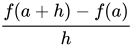
can be written as the derivative f' plus an error term
φ
(
h
)
{\displaystyle \varphi (h)}


That is, one has
-
f
(
a
+
h
)
−
f
(
a
)
h
=
f
′
(
a
)
+
φ
(
h
)
.
{\displaystyle {\frac {f(a+h)-f(a)}{h}}=f'(a)+\varphi (h).}

Differentiability in higher dimensions
In that the existence of
φ
{\displaystyle \varphi }


-
M
:
R
n
→
R
{\displaystyle M:\mathbb {R} ^{n}\to \mathbb {R} }

and a function
-
Φ
:
D
→
R
,
D
⊆
R
n
∖
{
0
}
,
{\displaystyle \Phi :D\to \mathbb {R} ,\qquad D\subseteq \mathbb {R} ^{n}\smallsetminus \{\mathbf {0} \},}

such that
-
lim
h
→
0
Φ
(
h
)
=
0
and
f
(
a
+
h
)
−
f
(
a
)
=
M
(
h
)
+
Φ
(
h
)
⋅
‖
h
‖
{\displaystyle \lim _{\mathbf {h} \to 0}\Phi (\mathbf {h} )=0\qquad {\text{and}}\qquad f(\mathbf {a} +\mathbf {h} )-f(\mathbf {a} )=M(\mathbf {h} )+\Phi (\mathbf {h} )\cdot \Vert \mathbf {h} \Vert }

for non-zero h sufficiently close to 0. In this case, M is the unique derivative (or total derivative, to distinguish from the directional and partial derivatives) of f at a. Notably, M is given by the Jacobian matrix of f evaluated at a.
We can write the above equation in terms of the partial derivatives
∂
f
∂
x
i
{\displaystyle {\frac {\partial f}{\partial x_{i}}}}

-
f
(
a
+
h
)
−
f
(
a
)
=
∑
i
=
1
n
∂
f
(
a
)
∂
x
i
h
i
+
Φ
(
h
)
⋅
‖
h
‖
{\displaystyle f(\mathbf {a} +\mathbf {h} )-f(\mathbf {a} )=\displaystyle \sum _{i=1}^{n}{\frac {\partial f(a)}{\partial x_{i}}}h_{i}+\Phi (\mathbf {h} )\cdot \Vert \mathbf {h} \Vert }

See also
References
- Talman, Louis (2007-09-12). "Differentiability for Multivariable Functions" (PDF). Archived from the original (PDF) on 2010-06-20. Retrieved 2012-06-28.
- Stewart, James (2008). Calculus (7th ed.). Cengage Learning. p. 942. ISBN 978-0538498845.
- Folland, Gerald. "Derivatives and Linear Approximation" (PDF).