Gandaulim
São Brás | |
|---|---|
Village | |
 Igreja de São Brás, Gandaulim | |
  Gandaulim | |
| Coordinates: 15°30′44.5″N 73°56′28.9″E / 15.512361°N 73.941361°E / 15.512361; 73.941361 | |
| Country |  India India |
| State | Goa |
| District | North Goa |
| Sub District | Ilhas |
| Established | 1540s |
| Named after | Saint Blaise |
| Government | |
| • Type | Panchayat |
| • Sarpanch | unknown |
| Elevation | 8 m (26 ft) |
| Population (2021) | |
• Total | approx. 300 |
| Demonym | Gandaulicar |
| Languages | |
| • Official | Konkani |
| • Also spoken (understood) | English, Marathi, Hindi |
| • Historical | Portuguese |
| Religions | |
| • Dominant | Christianity |
| • Minor | Hinduism |
| • Historical | Roman Catholicism |
| Time zone | UTC+5:30 (IST) |
| Postcode | 403505 |
| Telephone code | 08343 |
Gandaulim (historically known as São Brás) is a village located on the western bank of the Cumbarjua Canal, within Ilhas in the state of Goa, India. It marked the eastern end of the metropolitan City of Goa as a populous suburb in the 16th to 18th centuries.[1]
History

Croatian sailors and merchants from the Republic of Ragusa in Dalmatia established contact with Goa, India, in the 16th century, then amidst Portuguese colonization.[2][3] Between 1530 and 1535, adventurers from Dubrovnik joined the Portuguese to establish Sao Braz, a small Ragusan colonial settlement in the modern-day village of Gandaulim.[4] The colony was named after Saint Blaise, the patron saint of Dubrovnik.[4][3] In the annals of 1605, Jakov Lukarević noted that Ragusan merchants invested in decorating a local church.[5] Goese historian Gomes Catão documented the town to have a population of 12,000 settlers.[3] The 1667 Dubrovnik earthquake destroyed the city of Dubrovnik which left the Ragusan Republic financially strained.[4] Trading disputes with Portuguese settlers and declining trade with Indians forced the Republic of Ragusa to surrender their colony.[2]
Public interest in the former colony was revived in 1999, when Croatian Indologist Zdravka Matišić discovered a reference to ties between Ragusa and Goa while studying Sanskrit texts in India.[3][6] After an official Croatian delegation visited the village that year, benefactors have since donated to and refurbished local buildings.[7][8] The Church of Saint Blaise in the village is a common tourist attraction buoyed by Croatia–India relations.[4][2] Since the 2000s, heritage tourism between Dubrovnik, Croatia and Gandaulim has increased.[7]
Genetic findings in 2012 suggest the Romani people in Croatia originated in northwestern India and migrated to Europe as a group.[9] Romani people were mentioned for the first time in the Republic of Ragusa in 1362 in some commercial records.[10][11][12] Sushma Swaraj, Indian Minister of External Affairs, stated that the people of the Roma community in Croatia were to be recognized a part of the Indian diaspora.[13]
Infrastructure
In 2016, a bridge was constructed on the outskirts of the village, over the canal. This bridge now links the islands of Tiswadi taluka to Cumbarjua.[14][15]
Gandaulim Fort
Gandaulim was a site of the historical Gandaulim Fort, which was demolished in early 21st century for a road expansion project.
 Gandaulim Fort Entrance Gate
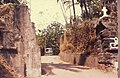 Gandaulim Fort Entrance Gate after Demolition
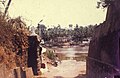 Gandaulim Fort Entrance Gate post Demolition


See also
References
- Fonseca, José Nicolau da (2026). An historical and Archaelogical sketch of the city of Goa (Reprint ed.). Thacker & Co, Limited, Bombay, 1878. ISBN 9788119808687.
- Fernandes, Paul (15 November 2021). "Croatian documentary team's visit stirs up Gandaulim's historic past". The Times of India. ISSN 0971-8257. Retrieved 19 January 2026.
- Tomas, Lora (19 May 2014). "Distant liaisons". Himal Southasian. Retrieved 20 September 2021.
- "Why this Goan village will root for Croatia". The Times of India. ISSN 0971-8257. Retrieved 26 March 2025.
- Andrijanić, Ivan (26 February 2018). "Hrvatska i Indija: Kulturno-povijesne i gospodarsko-političke veze". Zbornik sveučilišta Libertas (in Croatian). 3 (3). Zagreb, Croatia: Libertas international university: 351. ISSN 2584-6167.
U Goi, na zapadnoj obali indijskoga potkontinenta, trgovci iz Dubrovnika bogato su uresili crkvu Sv. Vlaha (São Braz). Na temelju toga svjedočanstva, koje navodi Jakov Lukarević (1605),[21] neki su istraživači pretpostavili postojanje dubrovačke kolonije São Braz u blizini Goe, ali za potvrdu te tvrdnje za sad nema dovoljno dokaza (Bašić, 1999: 85–93).
- "Why this Goan village will root for Croatia". The Times of India. 14 July 2018.
- D’Souza, Clinton (16 July 2024). "Unveiling a 400-yr-old bond: Historical connection between Croatia & Goa". The Goan. Retrieved 20 January 2026.
- "The Croats of Goa, India". 27 May 2018.
- Mendizabal, Isabel (6 December 2012). "Reconstructing the Population History of European Romani from Genome-wide Data". Current Biology. 22 (24): 2342–2349. doi:10.1016/j.cub.2012.10.039. hdl:10230/25348. PMID 23219723.
- "Ured vlade za nacionalne manjine-Obilježja Roma u RH". Archived from the original on 16 February 2013. Retrieved 9 March 2013.
- Tomas, Lora (19 May 2014). "Distant liaisons". Himal Southasian.
- Sindya N. Bhanoo (11 December 2012). "Genomic Study Traces Roma to Northern India". New York Times.
- "Can Romas be part of Indian diaspora?". khaleejtimes.com. 29 February 2016. Retrieved 4 March 2016.
- "Gaundalim Bridge, Goa | TPF". www.tpf.eu.
- "Gaundalim, Cumbarjua bridges opened for traffic". The Goan EveryDay.