In numerical analysis, Gauss–Jacobi quadrature (named after Carl Friedrich Gauss and Carl Gustav Jacob Jacobi) is a method of numerical quadrature based on Gaussian quadrature. Gauss–Jacobi quadrature can be used to approximate integrals of the form
-
∫
−
1
1
f
(
x
)
(
1
−
x
)
α
(
1
+
x
)
β
d
x
{\displaystyle \int _{-1}^{1}f(x)(1-x)^{\alpha }(1+x)^{\beta }\,dx}
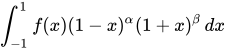
where ƒ is a smooth function on [−1, 1] and α, β > −1. The interval [−1, 1] can be replaced by any other interval by a linear transformation. Thus, Gauss–Jacobi quadrature can be used to approximate integrals with singularities at the end points. Gauss–Legendre quadrature is a special case of Gauss–Jacobi quadrature with α = β = 0. Similarly, the Chebyshev–Gauss quadrature of the first (second) kind arises when one takes α = β = −0.5 (+0.5). More generally, the special case α = β turns Jacobi polynomials into Gegenbauer polynomials, in which case the technique is sometimes called Gauss–Gegenbauer quadrature.
Gauss–Jacobi quadrature uses ω(x) = (1 − x)α (1 + x)β as the weight function. The corresponding sequence of orthogonal polynomials consist of Jacobi polynomials. Thus, the Gauss–Jacobi quadrature rule on n points has the form
-
∫
−
1
1
f
(
x
)
(
1
−
x
)
α
(
1
+
x
)
β
d
x
≈
λ
1
f
(
x
1
)
+
λ
2
f
(
x
2
)
+
…
+
λ
n
f
(
x
n
)
,
{\displaystyle \int _{-1}^{1}f(x)(1-x)^{\alpha }(1+x)^{\beta }\,dx\approx \lambda _{1}f(x_{1})+\lambda _{2}f(x_{2})+\ldots +\lambda _{n}f(x_{n}),}

where x1, …, xn are the roots of the Jacobi polynomial of degree n. The weights λ1, …, λn are given by the formula
-
λ
i
=
−
2
n
+
α
+
β
+
2
n
+
α
+
β
+
1
Γ
(
n
+
α
+
1
)
Γ
(
n
+
β
+
1
)
Γ
(
n
+
α
+
β
+
1
)
(
n
+
1
)
!
2
α
+
β
P
n
(
α
,
β
)
′
(
x
i
)
P
n
+
1
(
α
,
β
)
(
x
i
)
,
{\displaystyle \lambda _{i}=-{\frac {2n+\alpha +\beta +2}{n+\alpha +\beta +1}}\,{\frac {\Gamma (n+\alpha +1)\Gamma (n+\beta +1)}{\Gamma (n+\alpha +\beta +1)(n+1)!}}\,{\frac {2^{\alpha +\beta }}{P_{n}^{(\alpha ,\beta )\,\prime }(x_{i})P_{n+1}^{(\alpha ,\beta )}(x_{i})}},}

where Γ denotes the Gamma function and P(α, β)
n(x) the Jacobi polynomial of degree n.
The error term (difference between approximate and accurate value) is:
-
E
n
=
Γ
(
n
+
α
+
1
)
Γ
(
n
+
β
+
1
)
Γ
(
n
+
α
+
β
+
1
)
(
2
n
+
α
+
β
+
1
)
[
Γ
(
2
n
+
α
+
β
+
1
)
]
2
2
2
+
α
+
β
+
1
(
2
n
)
!
f
(
2
n
)
(
ξ
)
,
{\displaystyle E_{n}={\frac {\Gamma (n+\alpha +1)\Gamma (n+\beta +1)\Gamma (n+\alpha +\beta +1)}{(2n+\alpha +\beta +1)[\Gamma (2n+\alpha +\beta +1)]^{2}}}{\frac {2^{2+\alpha +\beta +1}}{(2n)!}}f^{(2n)}(\xi ),}
![{\displaystyle E_{n}={\frac {\Gamma (n+\alpha +1)\Gamma (n+\beta +1)\Gamma (n+\alpha +\beta +1)}{(2n+\alpha +\beta +1)[\Gamma (2n+\alpha +\beta +1)]^{2}}}{\frac {2^{2+\alpha +\beta +1}}{(2n)!}}f^{(2n)}(\xi ),}](https://wikimedia.org/api/rest_v1/media/math/render/svg/4bb6096eca80a1a9f93c9a0cc07e6cf31cbaa959)
where
−
1
<
ξ
<
1
{\displaystyle -1<\xi <1}

References
- Rabinowitz, Philip (2001), "§4.8-1: Gauss–Jacobi quadrature", A First Course in Numerical Analysis (2nd ed.), New York: Dover Publications, ISBN 978-0-486-41454-6.
External links
- Jacobi rule - free software (Matlab, C++, and Fortran) to evaluate integrals by Gauss–Jacobi quadrature rules.
- Gegenbauer rule - free software (Matlab, C++, and Fortran) for Gauss–Gegenbauer quadrature