In algebra, given a commutative ring R, the graded-symmetric algebra of a graded R-module M is the quotient of the tensor algebra of M by the ideal I generated by elements of the form:
-
x
y
−
(
−
1
)
|
x
|
|
y
|
y
x
{\displaystyle xy-(-1)^{|x||y|}yx}
-
x
2
{\displaystyle x^{2}}
when |x| is odd
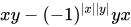
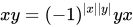
for homogeneous elements x, y in M of degree |x|, |y|. By construction, a graded-symmetric algebra is graded-commutative; i.e.,
x
y
=
(
−
1
)
|
x
|
|
y
|
y
x
{\displaystyle xy=(-1)^{|x||y|}yx}
In spite of the name, the notion is a common generalization of a symmetric algebra and an exterior algebra: indeed, if V is a (non-graded) R-module, then the graded-symmetric algebra of V with trivial grading is the usual symmetric algebra of V. Similarly, the graded-symmetric algebra of the graded module with V in degree one and zero elsewhere is the exterior algebra of V.
References
- David Eisenbud, Commutative Algebra. With a view toward algebraic geometry, Graduate Texts in Mathematics, vol 150, Springer-Verlag, New York, 1995. ISBN 0-387-94268-8
External links
- "rt.representation theory - Definition of the symmetric algebra in arbitrary characteristic for graded vector spaces". MathOverflow. Retrieved 2017-04-18.