In algebraic geometry and synthetic differential geometry, a Grothendieck connection is a way of viewing connections in terms of descent data from infinitesimal neighbourhoods of the diagonal.
Introduction and motivation
The Grothendieck connection is a generalization of the Gauss–Manin connection constructed in a manner analogous to that in which the Ehresmann connection generalizes the Koszul connection. The construction itself must satisfy a requirement of geometric invariance, which may be regarded as the analog of covariance for a wider class of structures including the schemes of algebraic geometry. Thus the connection in a certain sense must live in a natural sheaf on a Grothendieck topology. In this section, we discuss how to describe an Ehresmann connection in sheaf-theoretic terms as a Grothendieck connection.
Let
M
{\displaystyle M}
be a manifold and
π
:
E
→
M
{\displaystyle \pi :E\to M}
a surjective submersion, so that
E
{\displaystyle E}
is a manifold fibred over
M
.
{\displaystyle M.}
Let
J
1
(
M
,
E
)
{\displaystyle J^{1}(M,E)}
be the first-order jet bundle of sections of
E
.
{\displaystyle E.}
This may be regarded as a bundle over
M
{\displaystyle M}
or a bundle over the total space of
E
.
{\displaystyle E.}
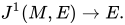
With the latter interpretation, an Ehresmann connection is a section of the bundle (over
E
{\displaystyle E}
)
J
1
(
M
,
E
)
→
E
.
{\displaystyle J^{1}(M,E)\to E.}
The problem is thus to obtain an intrinsic description of the sheaf of sections of this vector bundle.
Grothendieck's solution is to consider the diagonal embedding
Δ
:
M
→
M
×
M
.
{\displaystyle \Delta :M\to M\times M.}

The sheaf
I
{\displaystyle I}
of ideals of
Δ
{\displaystyle \Delta }
in
M
×
M
{\displaystyle M\times M}
consists of functions on
M
×
M
{\displaystyle M\times M}
which vanish along the diagonal. Much of the infinitesimal geometry of
M
{\displaystyle M}
can be realized in terms of
I
.
{\displaystyle I.}
For instance,
Δ
∗
(
I
,
I
2
)
{\displaystyle \Delta ^{*}\left(I,I^{2}\right)}
is the sheaf of sections of the cotangent bundle. One may define a first-order infinitesimal neighborhood
M
(
2
)
{\displaystyle M^{(2)}}
of
Δ
{\displaystyle \Delta }
in
M
×
M
{\displaystyle M\times M}
to be the subscheme corresponding to the sheaf of ideals
I
2
.
{\displaystyle I^{2}.}
(See below for a coordinate description.)
There are a pair of projections
p
1
,
p
2
:
M
×
M
→
M
{\displaystyle p_{1},p_{2}:M\times M\to M}

given by projection the respective factors of the Cartesian product, which restrict to give projections
p
1
,
p
2
:
M
(
2
)
→
M
.
{\displaystyle p_{1},p_{2}:M^{(2)}\to M.}
One may now form the pullback of the fibre space
E
{\displaystyle E}
along one or the other of
p
1
{\displaystyle p_{1}}
or
p
2
.
{\displaystyle p_{2}.}
In general, there is no canonical way to identify
p
1
∗
E
{\displaystyle p_{1}^{*}E}
and
p
2
∗
E
{\displaystyle p_{2}^{*}E}
with each other. A Grothendieck connection is a specified isomorphism between these two spaces. One may proceed to define curvature and p-curvature of a connection in the same language.
See also
- Connection (mathematics) – Function in mathematics
References
- Osserman, B., "Connections, curvature, and p-curvature", preprint.
- Katz, N., "Nilpotent connections and the monodromy theorem", IHES Publ. Math. 39 (1970) 175–232.