In mathematics, Hadamard's lemma, named after Jacques Hadamard, is essentially a first-order form of Taylor's theorem, in which we can express a smooth, real-valued function exactly in a convenient manner.
Statement
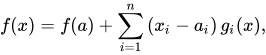
Hadamard's lemma[1]—Let
f
{\displaystyle f}
be a smooth, real-valued function defined on an open, star-convex neighborhood
U
{\displaystyle U}
of a point
a
{\displaystyle a}
in
n
{\displaystyle n}
-dimensional Euclidean space. Then
f
(
x
)
{\displaystyle f(x)}
can be expressed, for all
x
∈
U
,
{\displaystyle x\in U,}
in the form:
f
(
x
)
=
f
(
a
)
+
∑
i
=
1
n
(
x
i
−
a
i
)
g
i
(
x
)
,
{\displaystyle f(x)=f(a)+\sum _{i=1}^{n}\left(x_{i}-a_{i}\right)g_{i}(x),}
where each
g
i
{\displaystyle g_{i}}
is a smooth function on
U
,
{\displaystyle U,}
a
=
(
a
1
,
…
,
a
n
)
,
{\displaystyle a=\left(a_{1},\ldots ,a_{n}\right),}
and
x
=
(
x
1
,
…
,
x
n
)
.
{\displaystyle x=\left(x_{1},\ldots ,x_{n}\right).}
Proof
Let
x
∈
U
.
{\displaystyle x\in U.}
Define
h
:
[
0
,
1
]
→
R
{\displaystyle h:[0,1]\to \mathbb {R} }
by
h
(
t
)
=
f
(
a
+
t
(
x
−
a
)
)
for all
t
∈
[
0
,
1
]
.
{\displaystyle h(t)=f(a+t(x-a))\qquad {\text{ for all }}t\in [0,1].}
Then
h
′
(
t
)
=
∑
i
=
1
n
∂
f
∂
x
i
(
a
+
t
(
x
−
a
)
)
(
x
i
−
a
i
)
,
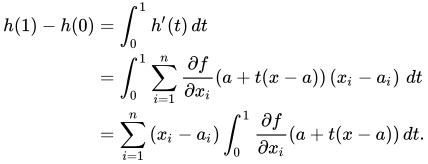
{\displaystyle h'(t)=\sum _{i=1}^{n}{\frac {\partial f}{\partial x_{i}}}(a+t(x-a))\left(x_{i}-a_{i}\right),}

which implies
h
(
1
)
−
h
(
0
)
=
∫
0
1
h
′
(
t
)
d
t
=
∫
0
1
∑
i
=
1
n
∂
f
∂
x
i
(
a
+
t
(
x
−
a
)
)
(
x
i
−
a
i
)
d
t
=
∑
i
=
1
n
(
x
i
−
a
i
)
∫
0
1
∂
f
∂
x
i
(
a
+
t
(
x
−
a
)
)
d
t
.
{\displaystyle {\begin{aligned}h(1)-h(0)&=\int _{0}^{1}h'(t)\,dt\\&=\int _{0}^{1}\sum _{i=1}^{n}{\frac {\partial f}{\partial x_{i}}}(a+t(x-a))\left(x_{i}-a_{i}\right)\,dt\\&=\sum _{i=1}^{n}\left(x_{i}-a_{i}\right)\int _{0}^{1}{\frac {\partial f}{\partial x_{i}}}(a+t(x-a))\,dt.\end{aligned}}}
But additionally,
h
(
1
)
−
h
(
0
)
=
f
(
x
)
−
f
(
a
)
,
{\displaystyle h(1)-h(0)=f(x)-f(a),}

so by letting
g
i
(
x
)
=
∫
0
1
∂
f
∂
x
i
(
a
+
t
(
x
−
a
)
)
d
t
,
{\displaystyle g_{i}(x)=\int _{0}^{1}{\frac {\partial f}{\partial x_{i}}}(a+t(x-a))\,dt,}
the theorem has been proven.
◼
{\displaystyle \blacksquare }
Consequences and applications
Corollary[1]—If
f
:
R
→
R
{\displaystyle f:\mathbb {R} \to \mathbb {R} }
is smooth and
f
(
0
)
=
0
{\displaystyle f(0)=0}
then
f
(
x
)
/
x
{\displaystyle f(x)/x}
is a smooth function on
R
.
{\displaystyle \mathbb {R} .}
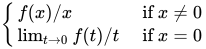
Explicitly, this conclusion means that the function
R
→
R
{\displaystyle \mathbb {R} \to \mathbb {R} }
that sends
x
∈
R
{\displaystyle x\in \mathbb {R} }
to
{
f
(
x
)
/
x
if
x
≠
0
lim
t
→
0
f
(
t
)
/
t
if
x
=
0
{\displaystyle {\begin{cases}f(x)/x&{\text{ if }}x\neq 0\\\lim _{t\to 0}f(t)/t&{\text{ if }}x=0\\\end{cases}}}
is a well-defined smooth function on
R
.
{\displaystyle \mathbb {R} .}
By Hadamard's lemma, there exists some
g
∈
C
∞
(
R
)
{\displaystyle g\in C^{\infty }(\mathbb {R} )}
such that
f
(
x
)
=
f
(
0
)
+
x
g
(
x
)
{\displaystyle f(x)=f(0)+xg(x)}
so that
f
(
0
)
=
0
{\displaystyle f(0)=0}
implies
f
(
x
)
/
x
=
g
(
x
)
.
{\displaystyle f(x)/x=g(x).}
◼
{\displaystyle \blacksquare }
Corollary[1]—If
y
,
z
∈
R
n
{\displaystyle y,z\in \mathbb {R} ^{n}}
are distinct points and
f
:
R
n
→
R
{\displaystyle f:\mathbb {R} ^{n}\to \mathbb {R} }
is a smooth function that satisfies
f
(
z
)
=
0
=
f
(
y
)
{\displaystyle f(z)=0=f(y)}
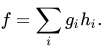
then there exist smooth functions
g
i
,
h
i
∈
C
∞
(
R
n
)
{\displaystyle g_{i},h_{i}\in C^{\infty }\left(\mathbb {R} ^{n}\right)}
(
i
=
1
,
…
,
3
n
−
2
{\displaystyle i=1,\ldots ,3n-2}
) satisfying
g
i
(
z
)
=
0
=
h
i
(
y
)
{\displaystyle g_{i}(z)=0=h_{i}(y)}
for every
i
{\displaystyle i}
such that
f
=
∑
i
g
i
h
i
.
{\displaystyle f=\sum _{i}^{}g_{i}h_{i}.}
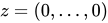
By applying an invertible affine linear change in coordinates, it may be assumed without loss of generality that
z
=
(
0
,
…
,
0
)
{\displaystyle z=(0,\ldots ,0)}
and
y
=
(
0
,
…
,
0
,
1
)
.
{\displaystyle y=(0,\ldots ,0,1).}
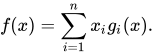
By Hadamard's lemma, there exist
g
1
,
…
,
g
n
∈
C
∞
(
R
n
)
{\displaystyle g_{1},\ldots ,g_{n}\in C^{\infty }\left(\mathbb {R} ^{n}\right)}
such that
f
(
x
)
=
∑
i
=
1
n
x
i
g
i
(
x
)
.
{\displaystyle f(x)=\sum _{i=1}^{n}x_{i}g_{i}(x).}
For every
i
=
1
,
…
,
n
,
{\displaystyle i=1,\ldots ,n,}
let
α
i
:=
g
i
(
y
)
{\displaystyle \alpha _{i}:=g_{i}(y)}
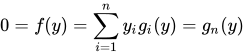
where
0
=
f
(
y
)
=
∑
i
=
1
n
y
i
g
i
(
y
)
=
g
n
(
y
)
{\displaystyle 0=f(y)=\sum _{i=1}^{n}y_{i}g_{i}(y)=g_{n}(y)}
implies
α
n
=
0.
{\displaystyle \alpha _{n}=0.}
Then for any
x
=
(
x
1
,
…
,
x
n
)
∈
R
n
,
{\displaystyle x=\left(x_{1},\ldots ,x_{n}\right)\in \mathbb {R} ^{n},}
f
(
x
)
=
∑
i
=
1
n
x
i
g
i
(
x
)
=
∑
i
=
1
n
[
x
i
(
g
i
(
x
)
−
α
i
)
]
+
∑
i
=
1
n
−
1
[
x
i
α
i
]
using
g
i
(
x
)
=
(
g
i
(
x
)
−
α
i
)
+
α
i
and
α
n
=
0
=
[
∑
i
=
1
n
x
i
(
g
i
(
x
)
−
α
i
)
]
+
[
∑
i
=
1
n
−
1
x
i
x
n
α
i
]
+
[
∑
i
=
1
n
−
1
x
i
(
1
−
x
n
)
α
i
]
using
x
i
=
x
n
x
i
+
x
i
(
1
−
x
n
)
.
{\displaystyle {\begin{alignedat}{8}f(x)&=\sum _{i=1}^{n}x_{i}g_{i}(x)&&\\&=\sum _{i=1}^{n}\left[x_{i}\left(g_{i}(x)-\alpha _{i}\right)\right]+\sum _{i=1}^{n-1}\left[x_{i}\alpha _{i}\right]&&\quad {\text{ using }}g_{i}(x)=\left(g_{i}(x)-\alpha _{i}\right)+\alpha _{i}{\text{ and }}\alpha _{n}=0\\&=\left[\sum _{i=1}^{n}x_{i}\left(g_{i}(x)-\alpha _{i}\right)\right]+\left[\sum _{i=1}^{n-1}x_{i}x_{n}\alpha _{i}\right]+\left[\sum _{i=1}^{n-1}x_{i}\left(1-x_{n}\right)\alpha _{i}\right]&&\quad {\text{ using }}x_{i}=x_{n}x_{i}+x_{i}\left(1-x_{n}\right).\\\end{alignedat}}}
Each of the
3
n
−
2
{\displaystyle 3n-2}
terms above has the desired properties.
◼
{\displaystyle \blacksquare }
See also
- Bump function – Smooth and compactly supported function
- Continuously differentiable – Degree of differentiability of a function or mapPages displaying short descriptions of redirect targets
- Smoothness – Degree of differentiability of a function or map
- Taylor's theorem – Approximation of a function by a polynomial
Citations
- Nestruev 2020, pp. 17–18.
References
- Nestruev, Jet (2002). Smooth manifolds and observables. Berlin: Springer. ISBN 0-387-95543-7.
- Nestruev, Jet (10 September 2020). Smooth Manifolds and Observables. Graduate Texts in Mathematics. Vol. 220. Cham, Switzerland: Springer Nature. ISBN 978-3-030-45649-8. OCLC 1195920718.