In mathematics, the Heisenberg group
H
{\displaystyle H}

-
(
1
a
c
0
1
b
0
0
1
)
{\displaystyle {\begin{pmatrix}1&a&c\\0&1&b\\0&0&1\\\end{pmatrix}}}
under the operation of matrix multiplication. Elements a, b and c can be taken from any commutative ring with identity, often taken to be the ring of real numbers (resulting in the "continuous Heisenberg group") or the ring of integers (resulting in the "discrete Heisenberg group").
The continuous Heisenberg group arises in the description of one-dimensional quantum mechanical systems, especially in the context of the Stone–von Neumann theorem. More generally, one can consider Heisenberg groups associated to n-dimensional systems, and most generally, to any symplectic vector space.
Three-dimensional case
In the three-dimensional case, the product of two Heisenberg matrices is given by
-
(
1
a
c
0
1
b
0
0
1
)
(
1
a
′
c
′
0
1
b
′
0
0
1
)
=
(
1
a
+
a
′
c
+
a
b
′
+
c
′
0
1
b
+
b
′
0
0
1
)
.
{\displaystyle {\begin{pmatrix}1&a&c\\0&1&b\\0&0&1\\\end{pmatrix}}{\begin{pmatrix}1&a'&c'\\0&1&b'\\0&0&1\\\end{pmatrix}}={\begin{pmatrix}1&a+a'&c+ab'+c'\\0&1&b+b'\\0&0&1\\\end{pmatrix}}.}

As one can see from the term ab′, the group is non-abelian.
The neutral element of the Heisenberg group is the identity matrix, and inverses are given by
-
(
1
a
c
0
1
b
0
0
1
)
−
1
=
(
1
−
a
a
b
−
c
0
1
−
b
0
0
1
)
.
{\displaystyle {\begin{pmatrix}1&a&c\\0&1&b\\0&0&1\\\end{pmatrix}}^{-1}={\begin{pmatrix}1&-a&ab-c\\0&1&-b\\0&0&1\\\end{pmatrix}}.}

The group is a subgroup of the 2-dimensional affine group Aff(2): the action of the element
(
1
a
c
0
1
b
0
0
1
)
{\displaystyle {\begin{pmatrix}1&a&c\\0&1&b\\0&0&1\\\end{pmatrix}}}
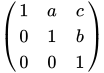


There are several prominent examples of the three-dimensional case.
Continuous Heisenberg group
If a, b, c, are real numbers (in the ring R), then one has the continuous Heisenberg group H3(R).
It is a nilpotent real Lie group of dimension 3.
In addition to the representation as real 3×3 matrices, the continuous Heisenberg group also has several different representations in terms of function spaces. By Stone–von Neumann theorem, there is, up to isomorphism, a unique irreducible unitary representation of H in which its centre acts by a given nontrivial character. This representation has several important realizations, or models. In the Schrödinger model, the Heisenberg group acts on the space of square integrable functions. In the theta, or holomorphic, model, the Heisenberg group acts on a Hilbert space of entire functions, with the model depending on a parameter in the upper half-plane.
Discrete Heisenberg group

If a, b, c are integers (in the ring Z), then one has the discrete Heisenberg group H3(Z). It is a non-abelian nilpotent group. It has two generators:
-
x
=
(
1
1
0
0
1
0
0
0
1
)
,
y
=
(
1
0
0
0
1
1
0
0
1
)
{\displaystyle x={\begin{pmatrix}1&1&0\\0&1&0\\0&0&1\end{pmatrix}},\quad y={\begin{pmatrix}1&0&0\\0&1&1\\0&0&1\end{pmatrix}}}

and relations
-
z
=
x
y
x
−
1
y
−
1
,
x
z
=
z
x
,
y
z
=
z
y
,
{\displaystyle z=xyx^{-1}y^{-1},\quad xz=zx,\quad yz=zy,}

where
-
z
=
(
1
0
1
0
1
0
0
0
1
)
{\displaystyle z={\begin{pmatrix}1&0&1\\0&1&0\\0&0&1\end{pmatrix}}}

is the generator of the center of H3. (Note that the inverses of x, y, and z replace the 1 above the diagonal with −1.)
By Bass's theorem, it has a polynomial growth rate of order 4.
One can generate any element through
-
(
1
a
c
0
1
b
0
0
1
)
=
y
b
z
c
x
a
.
{\displaystyle {\begin{pmatrix}1&a&c\\0&1&b\\0&0&1\end{pmatrix}}=y^{b}z^{c}x^{a}.}

Heisenberg group modulo an odd prime p
If one takes a, b, c in Z/p Z for an odd prime p, then one has the Heisenberg group modulo p. It is a group of order p3 with generators x, y and relations
-
z
=
x
y
x
−
1
y
−
1
,
x
p
=
y
p
=
z
p
=
1
,
x
z
=
z
x
,
y
z
=
z
y
.
{\displaystyle z=xyx^{-1}y^{-1},\quad x^{p}=y^{p}=z^{p}=1,\quad xz=zx,\quad yz=zy.}

Analogues of Heisenberg groups over finite fields of odd prime order p are called extra special groups, or more properly, extra special groups of exponent p. More generally, if the derived subgroup of a group G is contained in the center Z of G, then the map G/Z × G/Z → Z is a skew-symmetric bilinear operator on abelian groups.
However, requiring that G/Z to be a finite vector space requires the Frattini subgroup of G to be contained in the center, and requiring that Z be a one-dimensional vector space over Z/p Z requires that Z have order p, so if G is not abelian, then G is extra special. If G is extra special but does not have exponent p, then the general construction below applied to the symplectic vector space G/Z does not yield a group isomorphic to G.
Heisenberg group modulo 2
The Heisenberg group modulo 2 is of order 8 and is isomorphic to the dihedral group D4 (the symmetries of a square). Observe that if
-
x
=
(
1
1
0
0
1
0
0
0
1
)
,
y
=
(
1
0
0
0
1
1
0
0
1
)
,
{\displaystyle x={\begin{pmatrix}1&1&0\\0&1&0\\0&0&1\end{pmatrix}},\quad y={\begin{pmatrix}1&0&0\\0&1&1\\0&0&1\end{pmatrix}},}

then
-
x
y
=
(
1
1
1
0
1
1
0
0
1
)
,
{\displaystyle xy={\begin{pmatrix}1&1&1\\0&1&1\\0&0&1\end{pmatrix}},}

and
-
y
x
=
(
1
1
0
0
1
1
0
0
1
)
.
{\displaystyle yx={\begin{pmatrix}1&1&0\\0&1&1\\0&0&1\end{pmatrix}}.}

The elements x and y correspond to reflections (with 45° between them), whereas xy and yx correspond to rotations by 90°. The other reflections are xyx and yxy, and rotation by 180° is xyxy (= yxyx).
Heisenberg algebra
The Lie algebra
h
{\displaystyle {\mathfrak {h}}}

-
(
0
a
c
0
0
b
0
0
0
)
{\displaystyle {\begin{pmatrix}0&a&c\\0&0&b\\0&0&0\end{pmatrix}}}

with
a
,
b
,
c
∈
R
{\displaystyle a,b,c\in \mathbb {R} }

The following three elements form a basis for
h
{\displaystyle {\mathfrak {h}}}
-
X
=
(
0
1
0
0
0
0
0
0
0
)
,
Y
=
(
0
0
0
0
0
1
0
0
0
)
,
Z
=
(
0
0
1
0
0
0
0
0
0
)
.
{\displaystyle X={\begin{pmatrix}0&1&0\\0&0&0\\0&0&0\end{pmatrix}},\quad Y={\begin{pmatrix}0&0&0\\0&0&1\\0&0&0\end{pmatrix}},\quad Z={\begin{pmatrix}0&0&1\\0&0&0\\0&0&0\end{pmatrix}}.}

These basis elements satisfy the commutation relations
-
[
X
,
Y
]
=
Z
,
[
X
,
Z
]
=
0
,
[
Y
,
Z
]
=
0.
{\displaystyle [X,Y]=Z,\quad [X,Z]=0,\quad [Y,Z]=0.}
![{\displaystyle [X,Y]=Z,\quad [X,Z]=0,\quad [Y,Z]=0.}](https://wikimedia.org/api/rest_v1/media/math/render/svg/c8b050f4adae479b95baa95eb2043c21d7a0edce)
The name "Heisenberg group" is motivated by the preceding relations, which have the same form as the canonical commutation relations in quantum mechanics:
-
[
x
^
,
p
^
]
=
i
ℏ
I
,
[
x
^
,
i
ℏ
I
]
=
0
,
[
p
^
,
i
ℏ
I
]
=
0
,
{\displaystyle [{\hat {x}},{\hat {p}}]=i\hbar I,\quad [{\hat {x}},i\hbar I]=0,\quad [{\hat {p}},i\hbar I]=0,}
![{\displaystyle [{\hat {x}},{\hat {p}}]=i\hbar I,\quad [{\hat {x}},i\hbar I]=0,\quad [{\hat {p}},i\hbar I]=0,}](https://wikimedia.org/api/rest_v1/media/math/render/svg/4976e8df465295b4e0eb1f77541883d8d8b699a4)
where
x
^
{\displaystyle {\hat {x}}}


The Heisenberg group H has the special property that the exponential map is a one-to-one and onto map from the Lie algebra
h
{\displaystyle {\mathfrak {h}}}
-
exp
(
0
a
c
0
0
b
0
0
0
)
=
(
1
a
c
+
a
b
2
0
1
b
0
0
1
)
.
{\displaystyle \exp {\begin{pmatrix}0&a&c\\0&0&b\\0&0&0\end{pmatrix}}={\begin{pmatrix}1&a&c+{\frac {ab}{2}}\\0&1&b\\0&0&1\end{pmatrix}}.}

In conformal field theory
In conformal field theory, the term Heisenberg algebra is used to refer to an infinite-dimensional generalization of the above algebra. It is spanned by elements
a
n
,
n
∈
Z
{\displaystyle a_{n},n\in \mathbb {Z} }

-
[
a
n
,
a
m
]
=
δ
n
+
m
,
0
.
{\displaystyle [a_{n},a_{m}]=\delta _{n+m,0}.}
![{\displaystyle [a_{n},a_{m}]=\delta _{n+m,0}.}](https://wikimedia.org/api/rest_v1/media/math/render/svg/1f3aeebc4ad0eaf5b86249726424732dc3602877)
Under a rescaling, this is simply a countably-infinite number of copies of the above algebra.
Higher dimensions
More general Heisenberg groups
H
2
n
+
1
{\displaystyle H_{2n+1}}



-
[
1
a
c
0
I
n
b
0
0
1
]
,
{\displaystyle {\begin{bmatrix}1&\mathbf {a} &c\\\mathbf {0} &I_{n}&\mathbf {b} \\0&\mathbf {0} &1\end{bmatrix}},}

where
- a is a row vector of length n,
- b is a column vector of length n,
- In is the identity matrix of size n.
Group structure
This is indeed a group, as is shown by the multiplication:
-
[
1
a
c
0
I
n
b
0
0
1
]
⋅
[
1
a
′
c
′
0
I
n
b
′
0
0
1
]
=
[
1
a
+
a
′
c
+
c
′
+
a
⋅
b
′
0
I
n
b
+
b
′
0
0
1
]
{\displaystyle {\begin{bmatrix}1&\mathbf {a} &c\\\mathbf {0} &I_{n}&\mathbf {b} \\0&\mathbf {0} &1\end{bmatrix}}\cdot {\begin{bmatrix}1&\mathbf {a} '&c'\\\mathbf {0} &I_{n}&\mathbf {b} '\\0&\mathbf {0} &1\end{bmatrix}}={\begin{bmatrix}1&\mathbf {a} +\mathbf {a} '&c+c'+\mathbf {a} \cdot \mathbf {b} '\\\mathbf {0} &I_{n}&\mathbf {b} +\mathbf {b} '\\0&\mathbf {0} &1\end{bmatrix}}}

and
-
[
1
a
c
0
I
n
b
0
0
1
]
⋅
[
1
−
a
−
c
+
a
⋅
b
0
I
n
−
b
0
0
1
]
=
[
1
0
0
0
I
n
0
0
0
1
]
.
{\displaystyle {\begin{bmatrix}1&\mathbf {a} &c\\\mathbf {0} &I_{n}&\mathbf {b} \\0&\mathbf {0} &1\end{bmatrix}}\cdot {\begin{bmatrix}1&-\mathbf {a} &-c+\mathbf {a} \cdot \mathbf {b} \\\mathbf {0} &I_{n}&-\mathbf {b} \\0&\mathbf {0} &1\end{bmatrix}}={\begin{bmatrix}1&\mathbf {0} &0\\\mathbf {0} &I_{n}&\mathbf {0} \\0&\mathbf {0} &1\end{bmatrix}}.}

Lie algebra
The Heisenberg group is a simply-connected Lie group whose Lie algebra consists of matrices
-
[
0
a
c
0
0
n
b
0
0
0
]
,
{\displaystyle {\begin{bmatrix}0&\mathbf {a} &c\\\mathbf {0} &0_{n}&\mathbf {b} \\0&\mathbf {0} &0\end{bmatrix}},}

where
- a is a row vector of length n,
- b is a column vector of length n,
- 0n is the zero matrix of size n.
By letting e1, ..., en be the canonical basis of Rn and setting
-
p
i
=
[
0
e
i
T
0
0
0
n
0
0
0
0
]
,
q
j
=
[
0
0
0
0
0
n
e
j
0
0
0
]
,
z
=
[
0
0
1
0
0
n
0
0
0
0
]
,
{\displaystyle p_{i}={\begin{bmatrix}0&\operatorname {e} _{i}^{\mathrm {T} }&0\\\mathbf {0} &0_{n}&\mathbf {0} \\0&\mathbf {0} &0\end{bmatrix}},\quad q_{j}={\begin{bmatrix}0&\mathbf {0} &0\\\mathbf {0} &0_{n}&\operatorname {e} _{j}\\0&\mathbf {0} &0\end{bmatrix}},\quad z={\begin{bmatrix}0&\mathbf {0} &1\\\mathbf {0} &0_{n}&\mathbf {0} \\0&\mathbf {0} &0\end{bmatrix}},}

the associated Lie algebra can be characterized by the canonical commutation relations
[
p
i
,
q
j
]
=
δ
i
j
z
,
[
p
i
,
z
]
=
0
,
[
q
j
,
z
]
=
0
,
{\displaystyle {\begin{bmatrix}p_{i},q_{j}\end{bmatrix}}=\delta _{ij}z,\quad {\begin{bmatrix}p_{i},z\end{bmatrix}}=0,\quad {\begin{bmatrix}q_{j},z\end{bmatrix}}=0,}
 | 1 |
where p1, ..., pn, q1, ..., qn, z are the algebra generators.
In particular, z is a central element of the Heisenberg Lie algebra. Note that the Lie algebra of the Heisenberg group is nilpotent.
Exponential map
Let
-
u
=
[
0
a
c
0
0
n
b
0
0
0
]
,
{\displaystyle u={\begin{bmatrix}0&\mathbf {a} &c\\\mathbf {0} &0_{n}&\mathbf {b} \\0&\mathbf {0} &0\end{bmatrix}},}

which fulfills
u
3
=
0
n
+
2
{\displaystyle u^{3}=0_{n+2}}

-
exp
(
u
)
=
∑
k
=
0
∞
1
k
!
u
k
=
I
n
+
2
+
u
+
1
2
u
2
=
[
1
a
c
+
1
2
a
⋅
b
0
I
n
b
0
0
1
]
.
{\displaystyle \exp(u)=\sum _{k=0}^{\infty }{\frac {1}{k!}}u^{k}=I_{n+2}+u+{\tfrac {1}{2}}u^{2}={\begin{bmatrix}1&\mathbf {a} &c+{\frac {1}{2}}\mathbf {a} \cdot \mathbf {b} \\\mathbf {0} &I_{n}&\mathbf {b} \\0&\mathbf {0} &1\end{bmatrix}}.}

The exponential map of any nilpotent Lie algebra is a diffeomorphism between the Lie algebra and the unique associated connected, simply-connected Lie group.
This discussion (aside from statements referring to dimension and Lie group) further applies if we replace R by any commutative ring A. The corresponding group is denoted Hn(A).
Under the additional assumption that the prime 2 is invertible in the ring A, the exponential map is also defined, since it reduces to a finite sum and has the form above (e.g. A could be a ring Z/p Z with an odd prime p or any field of characteristic 0).
Representation theory
The unitary representation theory of the Heisenberg group is fairly simple – later generalized by Mackey theory – and was the motivation for its introduction in quantum physics, as discussed below.
For each nonzero real number
ℏ
{\displaystyle \hbar }


-
[
Π
ℏ
(
1
a
c
0
I
n
b
0
0
1
)
ψ
]
(
x
)
=
e
i
ℏ
c
e
i
b
⋅
x
ψ
(
x
+
ℏ
a
)
.
{\displaystyle \left[\Pi _{\hbar }{\begin{pmatrix}1&\mathbf {a} &c\\0&I_{n}&\mathbf {b} \\0&0&1\end{pmatrix}}\psi \right](\mathbf {x} )=e^{i\hbar c}e^{i\mathbf {b} \cdot \mathbf {x} }\psi (\mathbf {x} +\hbar \mathbf {a} ).}
=e^{i\hbar c}e^{i\mathbf {b} \cdot \mathbf {x} }\psi (\mathbf {x} +\hbar \mathbf {a} ).}](https://wikimedia.org/api/rest_v1/media/math/render/svg/fac06905dec90ca0f633ad496efb56abe903c43f)
This representation is known as the Schrödinger representation. The motivation for this representation is the action of the exponentiated position and momentum operators in quantum mechanics. The parameter
a
{\displaystyle a}


The key result is the Stone–von Neumann theorem, which states that every (strongly continuous) irreducible unitary representation of the Heisenberg group in which the center acts nontrivially is equivalent to
Π
ℏ
{\displaystyle \Pi _{\hbar }}
Since the Heisenberg group is a one-dimensional central extension of
R
2
n
{\displaystyle \mathbb {R} ^{2n}}

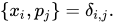
Plancherel theorem
The Plancherel theorem for the Heisenberg group describes the decomposition of
L
2
(
H
n
)
{\displaystyle L^{2}(H_{n})}


Let
π
λ
{\displaystyle \pi _{\lambda }}


-
f
^
(
λ
)
=
∫
H
n
f
(
g
)
π
λ
(
g
)
∗
d
g
,
λ
≠
0.
{\displaystyle {\widehat {f}}(\lambda )=\int _{H_{n}}f(g)\,\pi _{\lambda }(g)^{\ast }\,dg,\qquad \lambda \neq 0.}

Here
d
g
{\displaystyle dg}

With a common normalization of Haar measure and of the Schrödinger representations, the Plancherel formula is
-
‖
f
‖
L
2
(
H
n
)
2
=
(
2
π
)
−
(
n
+
1
)
∫
R
∖
{
0
}
‖
f
^
(
λ
)
‖
H
S
2
|
λ
|
n
d
λ
,
{\displaystyle \|f\|_{L^{2}(H_{n})}^{2}=(2\pi )^{-(n+1)}\int _{\mathbb {R} \setminus \{0\}}\|{\widehat {f}}(\lambda )\|_{\mathrm {HS} }^{2}|\lambda |^{n}\,d\lambda ,}

where
‖
⋅
‖
H
S
{\displaystyle \|\cdot \|_{\mathrm {HS} }}


-
∫
R
∖
{
0
}
⊕
H
S
(
L
2
(
R
n
)
)
|
λ
|
n
d
λ
,
{\displaystyle \int _{\mathbb {R} \setminus \{0\}}^{\oplus }\mathrm {HS} {\bigl (}L^{2}(\mathbb {R} ^{n}){\bigr )}\,|\lambda |^{n}\,d\lambda ,}

up to the same normalizing constant.[6][7]
For suitable functions, the corresponding Fourier inversion formula is
-
f
(
g
)
=
(
2
π
)
−
(
n
+
1
)
∫
R
∖
{
0
}
tr
(
π
λ
(
g
)
f
^
(
λ
)
)
|
λ
|
n
d
λ
.
{\displaystyle f(g)=(2\pi )^{-(n+1)}\int _{\mathbb {R} \setminus \{0\}}\operatorname {tr} \!\left(\pi _{\lambda }(g){\widehat {f}}(\lambda )\right)|\lambda |^{n}\,d\lambda .}

The one-dimensional unitary representations of
H
n
{\displaystyle H_{n}}

The Plancherel theorem describes how the representations classified by the Stone–von Neumann theorem occur in the regular representation of
H
n
{\displaystyle H_{n}}
On symplectic vector spaces
The general abstraction of a Heisenberg group is constructed from any symplectic vector space.[9] For example, let (V, ω) be a finite-dimensional real symplectic vector space (so ω is a nondegenerate skew symmetric bilinear form on V). The Heisenberg group H(V) on (V, ω) (or simply V for brevity) is the set V×R endowed with the group law
-
(
v
,
t
)
⋅
(
v
′
,
t
′
)
=
(
v
+
v
′
,
t
+
t
′
+
1
2
ω
(
v
,
v
′
)
)
.
{\displaystyle (v,t)\cdot \left(v',t'\right)=\left(v+v',t+t'+{\frac {1}{2}}\omega \left(v,v'\right)\right).}

The Heisenberg group is a central extension of the additive group V. Thus there is an exact sequence
-
0
→
R
→
H
(
V
)
→
V
→
0.
{\displaystyle 0\to \mathbf {R} \to H(V)\to V\to 0.}

Any symplectic vector space admits a Darboux basis {ej, fk}1 ≤ j,k ≤ n satisfying ω(ej, fk) = δjk and where 2n is the dimension of V (the dimension of V is necessarily even). In terms of this basis, every vector decomposes as
-
v
=
q
a
e
a
+
p
a
f
a
.
{\displaystyle v=q^{a}\mathbf {e} _{a}+p_{a}\mathbf {f} ^{a}.}

The qa and pa are canonically conjugate coordinates.
If {ej, fk}1 ≤ j,k ≤ n is a Darboux basis for V, then let {E} be a basis for R, and {ej, fk, E}1 ≤ j,k ≤ n is the corresponding basis for V×R. A vector in H(V) is then given by
-
v
=
q
a
e
a
+
p
a
f
a
+
t
E
{\displaystyle v=q^{a}\mathbf {e} _{a}+p_{a}\mathbf {f} ^{a}+tE}

and the group law becomes
-
(
p
,
q
,
t
)
⋅
(
p
′
,
q
′
,
t
′
)
=
(
p
+
p
′
,
q
+
q
′
,
t
+
t
′
+
1
2
(
p
q
′
−
p
′
q
)
)
.
{\displaystyle (p,q,t)\cdot \left(p',q',t'\right)=\left(p+p',q+q',t+t'+{\frac {1}{2}}(pq'-p'q)\right).}

Because the underlying manifold of the Heisenberg group is a linear space, vectors in the Lie algebra can be canonically identified with vectors in the group. The Lie algebra of the Heisenberg group is given by the commutation relation
-
[
(
v
1
,
t
1
)
,
(
v
2
,
t
2
)
]
=
ω
(
v
1
,
v
2
)
{\displaystyle {\begin{bmatrix}(v_{1},t_{1}),(v_{2},t_{2})\end{bmatrix}}=\omega (v_{1},v_{2})}

or written in terms of the Darboux basis
-
[
e
a
,
f
b
]
=
δ
a
b
{\displaystyle \left[\mathbf {e} _{a},\mathbf {f} ^{b}\right]=\delta _{a}^{b}}
![{\displaystyle \left[\mathbf {e} _{a},\mathbf {f} ^{b}\right]=\delta _{a}^{b}}](https://wikimedia.org/api/rest_v1/media/math/render/svg/b69ef660164760f5a0b8c08b86ac6745ea2a0f34)
and all other commutators vanish.
It is also possible to define the group law in a different way but which yields a group isomorphic to the group we have just defined. To avoid confusion, we will use u instead of t, so a vector is given by
-
v
=
q
a
e
a
+
p
a
f
a
+
u
E
{\displaystyle v=q^{a}\mathbf {e} _{a}+p_{a}\mathbf {f} ^{a}+uE}

and the group law is
-
(
p
,
q
,
u
)
⋅
(
p
′
,
q
′
,
u
′
)
=
(
p
+
p
′
,
q
+
q
′
,
u
+
u
′
+
p
q
′
)
.
{\displaystyle (p,q,u)\cdot \left(p',q',u'\right)=\left(p+p',q+q',u+u'+pq'\right).}

An element of the group
-
v
=
q
a
e
a
+
p
a
f
a
+
u
E
{\displaystyle v=q^{a}\mathbf {e} _{a}+p_{a}\mathbf {f} ^{a}+uE}
can then be expressed as a matrix
-
[
1
p
u
0
I
n
q
0
0
1
]
{\displaystyle {\begin{bmatrix}1&p&u\\0&I_{n}&q\\0&0&1\end{bmatrix}}}
,
which gives a faithful matrix representation of H(V). The u in this formulation is related to t in our previous formulation by
u
=
t
+
1
2
p
q
{\displaystyle u=t+{\tfrac {1}{2}}pq}

-
u
+
u
′
+
p
q
′
−
1
2
(
p
+
p
′
)
(
q
+
q
′
)
=
t
+
1
2
p
q
+
t
′
+
1
2
p
′
q
′
+
p
q
′
−
1
2
(
p
+
p
′
)
(
q
+
q
′
)
=
t
+
t
′
+
1
2
(
p
q
′
−
p
′
q
)
{\displaystyle {\begin{aligned}&u+u'+pq'-{\frac {1}{2}}\left(p+p'\right)\left(q+q'\right)\\={}&t+{\frac {1}{2}}pq+t'+{\frac {1}{2}}p'q'+pq'-{\frac {1}{2}}\left(p+p'\right)\left(q+q'\right)\\={}&t+t'+{\frac {1}{2}}\left(pq'-p'q\right)\end{aligned}}}
,
as before.
The isomorphism to the group using upper triangular matrices relies on the decomposition of V into a Darboux basis, which amounts to a choice of isomorphism V ≅ U ⊕ U*. Although the new group law yields a group isomorphic to the one given higher up, the group with this law is sometimes referred to as the polarized Heisenberg group as a reminder that this group law relies on a choice of basis (a choice of a Lagrangian subspace of V is a polarization).
To any Lie algebra, there is a unique connected, simply connected Lie group G. All other connected Lie groups with the same Lie algebra as G are of the form G/N where N is a central discrete group in G. In this case, the center of H(V) is R and the only discrete subgroups are isomorphic to Z. Thus H(V)/Z is another Lie group which shares this Lie algebra. Of note about this Lie group is that it admits no faithful finite-dimensional representations; it is not isomorphic to any matrix group. It does however have a well-known family of infinite-dimensional unitary representations.
Connection with the Weyl algebra
The Lie algebra
h
n
{\displaystyle {\mathfrak {h}}_{n}}


By the Poincaré–Birkhoff–Witt theorem, it is thus the free vector space generated by the monomials
-
z
j
p
1
k
1
p
2
k
2
⋯
p
n
k
n
q
1
ℓ
1
q
2
ℓ
2
⋯
q
n
ℓ
n
,
{\displaystyle z^{j}p_{1}^{k_{1}}p_{2}^{k_{2}}\cdots p_{n}^{k_{n}}q_{1}^{\ell _{1}}q_{2}^{\ell _{2}}\cdots q_{n}^{\ell _{n}}~,}

where the exponents are all non-negative.
Consequently,
U
(
h
n
)
{\displaystyle U({\mathfrak {h}}_{n})}
-
∑
j
,
k
→
,
ℓ
→
c
j
k
→
ℓ
→
z
j
p
1
k
1
p
2
k
2
⋯
p
n
k
n
q
1
ℓ
1
q
2
ℓ
2
⋯
q
n
ℓ
n
,
{\displaystyle \sum _{j,{\vec {k}},{\vec {\ell }}}c_{j{\vec {k}}{\vec {\ell }}}\,\,z^{j}p_{1}^{k_{1}}p_{2}^{k_{2}}\cdots p_{n}^{k_{n}}q_{1}^{\ell _{1}}q_{2}^{\ell _{2}}\cdots q_{n}^{\ell _{n}}~,}

with the commutation relations
-
p
k
p
ℓ
=
p
ℓ
p
k
,
q
k
q
ℓ
=
q
ℓ
q
k
,
p
k
q
ℓ
−
q
ℓ
p
k
=
δ
k
ℓ
z
,
z
p
k
−
p
k
z
=
0
,
z
q
k
−
q
k
z
=
0
.
{\displaystyle p_{k}p_{\ell }=p_{\ell }p_{k},\quad q_{k}q_{\ell }=q_{\ell }q_{k},\quad p_{k}q_{\ell }-q_{\ell }p_{k}=\delta _{k\ell }z,\quad zp_{k}-p_{k}z=0,\quad zq_{k}-q_{k}z=0~.}

The algebra
U
(
h
n
)
{\displaystyle U({\mathfrak {h}}_{n})}

-
P
=
∑
k
→
,
ℓ
→
c
k
→
ℓ
→
∂
x
1
k
1
∂
x
2
k
2
⋯
∂
x
n
k
n
x
1
ℓ
1
x
2
ℓ
2
⋯
x
n
ℓ
n
.
{\displaystyle P=\sum _{{\vec {k}},{\vec {\ell }}}c_{{\vec {k}}{\vec {\ell }}}\,\,\partial _{x_{1}}^{k_{1}}\partial _{x_{2}}^{k_{2}}\cdots \partial _{x_{n}}^{k_{n}}x_{1}^{\ell _{1}}x_{2}^{\ell _{2}}\cdots x_{n}^{\ell _{n}}~.}

This algebra is called the Weyl algebra. It follows from abstract nonsense that the Weyl algebra Wn is a quotient of
U
(
h
n
)
{\displaystyle U({\mathfrak {h}}_{n})}
-
z
j
p
1
k
1
p
2
k
2
⋯
p
n
k
n
q
1
ℓ
1
q
2
ℓ
2
⋯
q
n
ℓ
n
↦
∂
x
1
k
1
∂
x
2
k
2
⋯
∂
x
n
k
n
x
1
ℓ
1
x
2
ℓ
2
⋯
x
n
ℓ
n
.
{\displaystyle z^{j}p_{1}^{k_{1}}p_{2}^{k_{2}}\cdots p_{n}^{k_{n}}q_{1}^{\ell _{1}}q_{2}^{\ell _{2}}\cdots q_{n}^{\ell _{n}}\,\mapsto \,\partial _{x_{1}}^{k_{1}}\partial _{x_{2}}^{k_{2}}\cdots \partial _{x_{n}}^{k_{n}}x_{1}^{\ell _{1}}x_{2}^{\ell _{2}}\cdots x_{n}^{\ell _{n}}~.}

Applications
Weyl's parameterization of quantum mechanics
The application that led Hermann Weyl to an explicit realization of the Heisenberg group was the question of why the Schrödinger picture and Heisenberg picture are physically equivalent. Abstractly, the reason is the Stone–von Neumann theorem: there is a unique unitary representation with given action of the central Lie algebra element z, up to a unitary equivalence: the nontrivial elements of the algebra are all equivalent to the usual position and momentum operators.
Thus, the Schrödinger picture and Heisenberg picture are equivalent – they are just different ways of realizing this essentially unique representation.
Theta representation
The same uniqueness result was used by David Mumford for discrete Heisenberg groups, in his theory of equations defining abelian varieties. This is a large generalization of the approach used in Jacobi's elliptic functions, which is the case of the modulo 2 Heisenberg group, of order 8. The simplest case is the theta representation of the Heisenberg group, of which the discrete case gives the theta function.
In the simplest case, for
τ
{\displaystyle \tau }

-
ϑ
(
z
,
τ
)
=
∑
n
∈
Z
exp
(
π
i
n
2
τ
+
2
π
i
n
z
)
.
{\displaystyle \vartheta (z,\tau )=\sum _{n\in \mathbb {Z} }\exp(\pi in^{2}\tau +2\pi inz).}

It satisfies the transformation laws
-
ϑ
(
z
+
1
,
τ
)
=
ϑ
(
z
,
τ
)
,
ϑ
(
z
+
τ
,
τ
)
=
e
−
π
i
τ
−
2
π
i
z
ϑ
(
z
,
τ
)
.
{\displaystyle \vartheta (z+1,\tau )=\vartheta (z,\tau ),\qquad \vartheta (z+\tau ,\tau )=e^{-\pi i\tau -2\pi iz}\vartheta (z,\tau ).}

The Heisenberg group appears because translations of
z
{\displaystyle z}

-
(
S
b
f
)
(
z
)
=
f
(
z
+
b
)
,
(
T
a
f
)
(
z
)
=
e
π
i
a
2
τ
+
2
π
i
a
z
f
(
z
+
a
τ
)
.
{\displaystyle (S_{b}f)(z)=f(z+b),\qquad (T_{a}f)(z)=e^{\pi ia^{2}\tau +2\pi iaz}f(z+a\tau ).}

They satisfy
-
S
b
T
a
=
e
2
π
i
a
b
T
a
S
b
.
{\displaystyle S_{b}T_{a}=e^{2\pi iab}T_{a}S_{b}.}

Thus translations in the two period directions define a projective representation, and the corresponding central extension is a Heisenberg group. The ordinary theta function is, up to scalar, the unique entire function invariant under the integer subgroup generated by
S
1
{\displaystyle S_{1}}


Fourier analysis
The Heisenberg group also occurs in Fourier analysis, where it is used in some formulations of the Stone–von Neumann theorem. In this case, the Heisenberg group can be understood to act on the space of square integrable functions; the result is a representation of the Heisenberg groups sometimes called the Weyl representation.
As a sub-Riemannian manifold

The three-dimensional Heisenberg group H3(R) on the reals can also be understood to be a smooth manifold, and specifically, a simple example of a sub-Riemannian manifold.[11] Given a point p = (x, y, z) in R3, define a differential 1-form Θ at this point as
-
Θ
p
=
d
z
−
1
2
(
x
d
y
−
y
d
x
)
.
{\displaystyle \Theta _{p}=dz-{\frac {1}{2}}\left(xdy-ydx\right).}

This one-form belongs to the cotangent bundle of R3; that is,
-
Θ
p
:
T
p
R
3
→
R
{\displaystyle \Theta _{p}:T_{p}\mathbf {R} ^{3}\to \mathbf {R} }
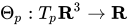
is a map on the tangent bundle. Let
-
H
p
=
{
v
∈
T
p
R
3
∣
Θ
p
(
v
)
=
0
}
.
{\displaystyle H_{p}=\left\{v\in T_{p}\mathbf {R} ^{3}\mid \Theta _{p}(v)=0\right\}.}

It can be seen that H is a subbundle of the tangent bundle TR3. A cometric on H is given by projecting vectors to the two-dimensional space spanned by vectors in the x and y direction. That is, given vectors
v
=
(
v
1
,
v
2
,
v
3
)
{\displaystyle v=(v_{1},v_{2},v_{3})}


-
⟨
v
,
w
⟩
=
v
1
w
1
+
v
2
w
2
.
{\displaystyle \langle v,w\rangle =v_{1}w_{1}+v_{2}w_{2}.}

The resulting structure turns H into the manifold of the Heisenberg group. An orthonormal frame on the manifold is given by the Lie vector fields
-
X
=
∂
∂
x
−
1
2
y
∂
∂
z
,
Y
=
∂
∂
y
+
1
2
x
∂
∂
z
,
Z
=
∂
∂
z
,
{\displaystyle {\begin{aligned}X&={\frac {\partial }{\partial x}}-{\frac {1}{2}}y{\frac {\partial }{\partial z}},\\Y&={\frac {\partial }{\partial y}}+{\frac {1}{2}}x{\frac {\partial }{\partial z}},\\Z&={\frac {\partial }{\partial z}},\end{aligned}}}

which obey the relations [X, Y] = Z and [X, Z] = [Y, Z] = 0. Being Lie vector fields, these form a left-invariant basis for the group action. The geodesics on the manifold are spirals, projecting down to circles in two dimensions. That is, if
-
γ
(
t
)
=
(
x
(
t
)
,
y
(
t
)
,
z
(
t
)
)
{\displaystyle \gamma (t)=(x(t),y(t),z(t))}

is a geodesic curve, then the curve
c
(
t
)
=
(
x
(
t
)
,
y
(
t
)
)
{\displaystyle c(t)=(x(t),y(t))}

-
z
(
t
)
=
1
2
∫
c
x
d
y
−
y
d
x
{\displaystyle z(t)={\frac {1}{2}}\int _{c}xdy-ydx}
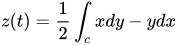
with the integral limited to the two-dimensional plane. That is, the height of the curve is proportional to the area of the circle subtended by the circular arc, which follows by Green's theorem.
Sub-Laplacian
The Heisenberg group is a basic example in the analysis of hypoelliptic operators. In coordinates
(
x
,
y
,
t
)
∈
R
n
×
R
n
×
R
{\displaystyle (x,y,t)\in \mathbb {R} ^{n}\times \mathbb {R} ^{n}\times \mathbb {R} }

-
X
j
=
∂
∂
x
j
−
1
2
y
j
∂
∂
t
,
Y
j
=
∂
∂
y
j
+
1
2
x
j
∂
∂
t
,
1
≤
j
≤
n
,
{\displaystyle X_{j}={\frac {\partial }{\partial x_{j}}}-{\frac {1}{2}}y_{j}{\frac {\partial }{\partial t}},\qquad Y_{j}={\frac {\partial }{\partial y_{j}}}+{\frac {1}{2}}x_{j}{\frac {\partial }{\partial t}},\qquad 1\leq j\leq n,}

together with the central vector field
-
T
=
∂
∂
t
.
{\displaystyle T={\frac {\partial }{\partial t}}.}

These vector fields satisfy
-
[
X
j
,
Y
k
]
=
δ
j
k
T
,
[
X
j
,
T
]
=
[
Y
j
,
T
]
=
0.
{\displaystyle [X_{j},Y_{k}]=\delta _{jk}T,\qquad [X_{j},T]=[Y_{j},T]=0.}
![{\displaystyle [X_{j},Y_{k}]=\delta _{jk}T,\qquad [X_{j},T]=[Y_{j},T]=0.}](https://wikimedia.org/api/rest_v1/media/math/render/svg/32b9a13ef9f6718c8cca6c8f233a97282da86141)
Thus the horizontal vector fields
X
j
,
Y
j
{\displaystyle X_{j},Y_{j}}

The operator
L
{\displaystyle {\mathcal {L}}}

-
δ
r
(
x
,
y
,
t
)
=
(
r
x
,
r
y
,
r
2
t
)
.
{\displaystyle \delta _{r}(x,y,t)=(rx,ry,r^{2}t).}

These dilations make the Heisenberg group a Carnot group, with stratified Lie algebra
-
h
n
=
V
1
⊕
V
2
,
[
V
1
,
V
1
]
=
V
2
,
[
V
1
,
V
2
]
=
0
,
{\displaystyle {\mathfrak {h}}_{n}=V_{1}\oplus V_{2},\qquad [V_{1},V_{1}]=V_{2},\qquad [V_{1},V_{2}]=0,}
![{\displaystyle {\mathfrak {h}}_{n}=V_{1}\oplus V_{2},\qquad [V_{1},V_{1}]=V_{2},\qquad [V_{1},V_{2}]=0,}](https://wikimedia.org/api/rest_v1/media/math/render/svg/37e1e2c0ec7482a006329b309de38e01e1685a36)
where
V
1
{\displaystyle V_{1}}


-
Q
=
2
n
+
2
,
{\displaystyle Q=2n+2,}

rather than the topological dimension
2
n
+
1
{\displaystyle 2n+1}
The sub-Laplacian on the Heisenberg group is the left-invariant differential operator
-
L
=
−
∑
j
=
1
n
(
X
j
2
+
Y
j
2
)
.
{\displaystyle {\mathcal {L}}=-\sum _{j=1}^{n}\left(X_{j}^{2}+Y_{j}^{2}\right).}

Unlike the ordinary Laplace operator on Euclidean space,
L
{\displaystyle {\mathcal {L}}}

![{\displaystyle [X_{j},Y_{j}]}](https://wikimedia.org/api/rest_v1/media/math/render/svg/3fb0945645a834fb1c1e750bd2792af84659a555)
The sub-Laplacian refines the decomposition of
L
2
(
H
n
)
{\displaystyle L^{2}(H_{n})}

-
d
π
λ
(
L
)
=
−
∑
j
=
1
n
∂
2
∂
ξ
j
2
+
λ
2
|
ξ
|
2
{\displaystyle d\pi _{\lambda }({\mathcal {L}})=-\sum _{j=1}^{n}{\frac {\partial ^{2}}{\partial \xi _{j}^{2}}}+\lambda ^{2}|\xi |^{2}}

where
ξ
=
(
ξ
1
,
…
,
ξ
n
)
{\displaystyle \xi =(\xi _{1},\ldots ,\xi _{n})}


-
(
2
|
α
|
+
n
)
|
λ
|
,
α
∈
N
n
,
{\displaystyle (2|\alpha |+n)|\lambda |,\qquad \alpha \in \mathbb {N} ^{n},}

up to normalization conventions.[7]: 350–406
Fundamental solution
The sub-Laplacian also has an explicit fundamental solution, analogous to the Euclidean fundamental solution of the ordinary Laplacian. In complex coordinates
(
z
,
τ
)
∈
C
n
×
R
{\displaystyle (z,\tau )\in \mathbb {C} ^{n}\times \mathbb {R} }

-
G
(
z
,
τ
)
=
c
n
(
|
z
|
4
+
τ
2
)
−
n
/
2
.
{\displaystyle G(z,\tau )=c_{n}\left(|z|^{4}+\tau ^{2}\right)^{-n/2}.}

The expression uses the natural homogeneous norm on the Heisenberg group, since
|
z
|
4
+
τ
2
{\displaystyle |z|^{4}+\tau ^{2}}


Brownian motion
The sub-Laplacian is the infinitesimal generator of the natural Brownian motion associated with the sub-Riemannian structure on the Heisenberg group. With the sign convention
-
L
=
−
∑
j
=
1
n
(
X
j
2
+
Y
j
2
)
,
{\displaystyle {\mathcal {L}}=-\sum _{j=1}^{n}(X_{j}^{2}+Y_{j}^{2}),}

the corresponding heat semigroup is generated by
−
1
2
L
{\displaystyle -{\frac {1}{2}}{\mathcal {L}}}


In the three-dimensional case, this diffusion can be described explicitly in terms of planar Brownian motion. If
B
t
=
(
B
t
1
,
B
t
2
)
{\displaystyle B_{t}=(B_{t}^{1},B_{t}^{2})}


-
(
B
t
1
,
B
t
2
,
A
t
)
,
{\displaystyle \left(B_{t}^{1},B_{t}^{2},A_{t}\right),}

where
-
A
t
=
1
2
∫
0
t
(
B
s
1
d
B
s
2
−
B
s
2
d
B
s
1
)
{\displaystyle A_{t}={\frac {1}{2}}\int _{0}^{t}\left(B_{s}^{1}\,dB_{s}^{2}-B_{s}^{2}\,dB_{s}^{1}\right)}

is the Lévy area of the planar Brownian path. Thus the central coordinate records the signed stochastic area swept out by the horizontal Brownian motion.[16]
The transition probabilities of this process are given by the heat kernel of the sub-Laplacian. This provides a probabilistic interpretation of the heat equation on the Heisenberg group and is used in the study of heat kernel estimates, gradient bounds, functional inequalities and couplings for hypoelliptic diffusions.[17][16]
Heat kernel
The heat equation associated with the positive sub-Laplacian
-
L
=
−
∑
j
=
1
n
(
X
j
2
+
Y
j
2
)
{\displaystyle {\mathcal {L}}=-\sum _{j=1}^{n}(X_{j}^{2}+Y_{j}^{2})}

is
-
∂
s
u
=
−
L
u
.
{\displaystyle \partial _{s}u=-{\mathcal {L}}u.}

Its fundamental solution is the heat kernel
p
s
{\displaystyle p_{s}}

-
e
−
s
L
f
=
f
∗
p
s
,
s
>
0
,
{\displaystyle e^{-s{\mathcal {L}}}f=f*p_{s},\qquad s>0,}

where convolution is taken with respect to the Heisenberg group law. In standard coordinates
(
x
,
y
,
t
)
∈
R
n
×
R
n
×
R
{\displaystyle (x,y,t)\in \mathbb {R} ^{n}\times \mathbb {R} ^{n}\times \mathbb {R} }
-
p
s
(
x
,
y
,
t
)
=
1
s
n
+
1
(
4
π
)
n
+
1
∫
0
∞
(
λ
sinh
λ
)
n
exp
(
−
λ
coth
λ
4
s
(
|
x
|
2
+
|
y
|
2
)
)
cos
(
λ
t
s
)
d
λ
.
{\displaystyle p_{s}(x,y,t)={\frac {1}{s^{n+1}(4\pi )^{n+1}}}\int _{0}^{\infty }\left({\frac {\lambda }{\sinh \lambda }}\right)^{n}\exp \!\left(-{\frac {\lambda \coth \lambda }{4s}}(|x|^{2}+|y|^{2})\right)\cos \!\left({\frac {\lambda t}{s}}\right)\,d\lambda .}

Equivalently,
-
p
s
(
x
,
y
,
t
)
=
s
−
(
n
+
1
)
p
1
(
x
s
,
y
s
,
t
s
)
,
{\displaystyle p_{s}(x,y,t)=s^{-(n+1)}p_{1}\left({\frac {x}{\sqrt {s}}},{\frac {y}{\sqrt {s}}},{\frac {t}{s}}\right),}

reflecting the Heisenberg dilations
δ
r
(
x
,
y
,
t
)
=
(
r
x
,
r
y
,
r
2
t
)
{\displaystyle \delta _{r}(x,y,t)=(rx,ry,r^{2}t)}


Heisenberg group of a locally compact abelian group
It is more generally possible to define the Heisenberg group of a locally compact abelian group K, equipped with a Haar measure.[20] Such a group has a Pontrjagin dual
K
^
{\displaystyle {\hat {K}}}


In more detail, the Hilbert space
L
2
(
K
)
{\displaystyle L^{2}(K)}
-
(
T
x
f
)
(
y
)
=
f
(
x
+
y
)
{\displaystyle (T_{x}f)(y)=f(x+y)}

for
x
,
y
∈
K
{\displaystyle x,y\in K}

-
(
M
χ
f
)
(
y
)
=
χ
(
y
)
f
(
y
)
{\displaystyle (M_{\chi }f)(y)=\chi (y)f(y)}

for
χ
∈
K
^
{\displaystyle \chi \in {\hat {K}}}

-
(
T
x
M
χ
T
x
−
1
M
χ
−
1
f
)
(
y
)
=
χ
(
x
)
¯
f
(
y
)
{\displaystyle \left(T_{x}M_{\chi }T_{x}^{-1}M_{\chi }^{-1}f\right)(y)={\overline {\chi (x)}}f(y)}

multiplication by a fixed unit modulus complex number.
So the Heisenberg group
H
(
K
)
{\displaystyle H(K)}


-
1
→
U
(
1
)
→
H
(
K
)
→
K
×
K
^
→
0.
{\displaystyle 1\to U(1)\to H(K)\to K\times {\hat {K}}\to 0.}

More general Heisenberg groups are described by 2-cocyles in the cohomology group
H
2
(
K
,
U
(
1
)
)
{\displaystyle H^{2}(K,U(1))}


The Heisenberg group acts irreducibly on
L
2
(
K
)
{\displaystyle L^{2}(K)}

A version of the Stone–von Neumann theorem, proved by George Mackey, holds for the Heisenberg group
H
(
K
)
{\displaystyle H(K)}

See also
Notes
- Woit, Peter. Topics in Representation Theory: The Heisenberg Algebra (PDF).
- Hall 2015. Proposition 3.26.
- Hall 2015. Chapter 2, Exercise 9.
- Hall 2013. Proposition 14.7.
- Hall 2013. Theorem 14.8.
- Folland, Gerald B. (1989). Harmonic Analysis in Phase Space. Annals of Mathematics Studies. Vol. 122. Princeton University Press. ISBN 978-0-691-08528-9.
- Thangavelu, Sundaram (1998). Harmonic Analysis on the Heisenberg Group. Progress in Mathematics. Vol. 159. Birkhäuser. ISBN 978-0-8176-4050-7.
- Howe, Roger (1980). "On the role of the Heisenberg group in harmonic analysis". Bulletin of the American Mathematical Society. 3 (2): 821–843. doi:10.1090/S0273-0979-1980-14825-9.
- Hans Tilgner, "A class of solvable Lie groups and their relation to the canonical formalism Archived 2011-06-05 at the Wayback Machine", Annales de l'institut Henri Poincaré (A) Physique théorique, 13 no. 2 (1970), pp. 103-127.
- Mumford, David (1983). Tata Lectures on Theta I. Progress in Mathematics. Vol. 28. Birkhäuser. ISBN 978-0-8176-4577-9.
- Richard Montgomery, A Tour of Subriemannian Geometries, Their Geodesics and Applications (Mathematical Surveys and Monographs, Volume 91), (2002) American Mathematical Society, ISBN 0-8218-1391-9.
- Hörmander, Lars (1967). "Hypoelliptic second order differential equations". Acta Mathematica. 119: 147–171.
- Folland, Gerald B. (1975). "Subelliptic estimates and function spaces on nilpotent Lie groups". Arkiv för Matematik. 13: 161–207.
- Folland, Gerald B.; Stein, Elias M. (1982). Hardy Spaces on Homogeneous Groups. Mathematical Notes. Vol. 28. Princeton University Press.
- Folland, Gerald B. (1973). "A fundamental solution for a subelliptic operator". Bulletin of the American Mathematical Society. 79 (2): 373–376.
- Bakry, Dominique; Baudoin, Fabrice; Bonnefont, Michel; Chafaï, Djalil (2008). "On gradient bounds for the heat kernel on the Heisenberg group". Journal of Functional Analysis. 255 (8): 1905–1938. arXiv:0710.3139.
- Driver, Bruce K.; Melcher, Tai (2005). "Hypoelliptic heat kernel inequalities on the Heisenberg group". Journal of Functional Analysis. 221 (2): 340–365. doi:10.1016/j.jfa.2004.06.012.
- Taylor, Michael E. (1986). Noncommutative Harmonic Analysis. American Mathematical Society.
- Strichartz, Robert S. (1991). "
L
p
{\displaystyle L^{p}}
harmonic analysis and Radon transforms on the Heisenberg group". Journal of Functional Analysis. 96 (2): 350–406. doi:10.1016/0022-1236(91)90066-E.
- David Mumford (1991), "Tata lectures on theta III", Progress in Mathematics, 97, Birkhauser
- Karl Heinrich Hofmann, Sidney A. Morris (2006), The structure of compact groups: a primer for students, a handbook for the expert, De Gruyter studies in mathematics 25 (2nd revised ed.), Walter de Gruyter, ISBN 9783110190069
- This argument appears in a slightly different setting in Roger Howe (1980), "On the role of the Heisenberg group in harmonic analysis", Bulletin of the American Mathematical Society, 3 (2): 821–844, doi:10.1090/S0273-0979-1980-14825-9, MR 0578375
- George Mackey (1949), "On a theorem of Stone and von Neumann", Duke Mathematical Journal, 16 (2): 313–326, doi:10.1215/s0012-7094-49-01631-2
- A Prasad (2009), "An easy proof of the Stone–von Neumann–Mackey theorem", Expositiones Mathematicae, 29: 110–118, arXiv:0912.0574, doi:10.1016/j.exmath.2010.06.001, S2CID 56340220
References
- Binz, Ernst; Pods, Sonja (2008). Geometry of Heisenberg Groups. American Mathematical Society. ISBN 978-0-8218-4495-3.
- Hall, Brian C. (2013), Quantum Theory for Mathematicians, Graduate Texts in Mathematics, vol. 267, Springer, Bibcode:2013qtm..book.....H, ISBN 978-1461471158
- Hall, Brian C. (2015). Lie Groups, Lie Algebras, and Representations: An Elementary Introduction. Graduate Texts in Mathematics. Vol. 222 (second ed.). Springer. ISBN 978-3319134666.
- Howe, Roger (1980). "On the role of the Heisenberg group in harmonic analysis". Bulletin of the American Mathematical Society. 3 (2): 821–843. doi:10.1090/s0273-0979-1980-14825-9. MR 0578375.
- Kirillov, Alexandre A. (2004). "Ch. 2: "Representations and Orbits of the Heisenberg Group". Lectures on the Orbit Method. American Mathematical Society. ISBN 0-8218-3530-0.
- Mackey, George (1976). The theory of Unitary Group Representations. Chicago Lectures in Mathematics. University of Chicago Press. ISBN 978-0226500522.
External links
- Groupprops, The Group Properties Wiki Unitriangular matrix group UT(3,p)