Hochschild cohomology

☆ Save On Wikipedia ↗

In mathematics, Hochschild homology (and cohomology) is a homology theory for associative algebras over rings. There is also a theory for Hochschild homology of certain functors. Hochschild cohomology was introduced by Gerhard Hochschild (1945) for algebras over a field, and extended to algebras over more general rings by Henri Cartan and Samuel Eilenberg (1956).

Definition of Hochschild homology of algebras

Let k be a field, A an associative k-algebra, and M an A-bimodule. The enveloping algebra of A is the tensor product A e = A ⊗ A o {\displaystyle A^{e}=A\otimes A^{o}} {\displaystyle A^{e}=A\otimes A^{o}} of A with its opposite algebra. Bimodules over A are essentially the same as modules over the enveloping algebra of A, so in particular A and M can be considered as Ae-modules. Cartan & Eilenberg (1956) defined the Hochschild homology and cohomology group of A with coefficients in M in terms of the Tor functor and Ext functor by

H H n ( A , M ) = Tor n A e ⁡ ( A , M ) {\displaystyle HH_{n}(A,M)=\operatorname {Tor} _{n}^{A^{e}}(A,M)} {\displaystyle HH_{n}(A,M)=\operatorname {Tor} _{n}^{A^{e}}(A,M)}
H H n ( A , M ) = Ext A e n ⁡ ( A , M ) {\displaystyle HH^{n}(A,M)=\operatorname {Ext} _{A^{e}}^{n}(A,M)} {\displaystyle HH^{n}(A,M)=\operatorname {Ext} _{A^{e}}^{n}(A,M)}


Hochschild complex

Let k be a ring, A an associative k-algebra that is a projective k-module, and M an A-bimodule. We will write A ⊗ n {\displaystyle A^{\otimes n}} {\displaystyle A^{\otimes n}} for the n-fold tensor product of A over k. The chain complex that gives rise to Hochschild homology is given by

C n ( A , M ) := M ⊗ A ⊗ n {\displaystyle C_{n}(A,M):=M\otimes A^{\otimes n}} {\displaystyle C_{n}(A,M):=M\otimes A^{\otimes n}}

with boundary operator d i {\displaystyle d_{i}} {\displaystyle d_{i}} defined by

d 0 ( m ⊗ a 1 ⊗ ⋯ ⊗ a n ) = m a 1 ⊗ a 2 ⋯ ⊗ a n d i ( m ⊗ a 1 ⊗ ⋯ ⊗ a n ) = m ⊗ a 1 ⊗ ⋯ ⊗ a i a i + 1 ⊗ ⋯ ⊗ a n d n ( m ⊗ a 1 ⊗ ⋯ ⊗ a n ) = a n m ⊗ a 1 ⊗ ⋯ ⊗ a n − 1 {\displaystyle {\begin{aligned}d_{0}(m\otimes a_{1}\otimes \cdots \otimes a_{n})&=ma_{1}\otimes a_{2}\cdots \otimes a_{n}\\d_{i}(m\otimes a_{1}\otimes \cdots \otimes a_{n})&=m\otimes a_{1}\otimes \cdots \otimes a_{i}a_{i+1}\otimes \cdots \otimes a_{n}\\d_{n}(m\otimes a_{1}\otimes \cdots \otimes a_{n})&=a_{n}m\otimes a_{1}\otimes \cdots \otimes a_{n-1}\end{aligned}}} {\displaystyle {\begin{aligned}d_{0}(m\otimes a_{1}\otimes \cdots \otimes a_{n})&=ma_{1}\otimes a_{2}\cdots \otimes a_{n}\\d_{i}(m\otimes a_{1}\otimes \cdots \otimes a_{n})&=m\otimes a_{1}\otimes \cdots \otimes a_{i}a_{i+1}\otimes \cdots \otimes a_{n}\\d_{n}(m\otimes a_{1}\otimes \cdots \otimes a_{n})&=a_{n}m\otimes a_{1}\otimes \cdots \otimes a_{n-1}\end{aligned}}}

where a i {\displaystyle a_{i}} {\displaystyle a_{i}} is in A for all 1 ≤ i ≤ n {\displaystyle 1\leq i\leq n} {\displaystyle 1\leq i\leq n} and m ∈ M {\displaystyle m\in M} {\displaystyle m\in M}. If we let

b n = ∑ i = 0 n ( − 1 ) i d i , {\displaystyle b_{n}=\sum _{i=0}^{n}(-1)^{i}d_{i},} {\displaystyle b_{n}=\sum _{i=0}^{n}(-1)^{i}d_{i},}
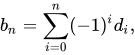
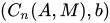
then b n − 1 ∘ b n = 0 {\displaystyle b_{n-1}\circ b_{n}=0} {\displaystyle b_{n-1}\circ b_{n}=0}, so ( C n ( A , M ) , b n ) {\displaystyle (C_{n}(A,M),b_{n})} {\displaystyle (C_{n}(A,M),b_{n})} is a chain complex called the Hochschild complex, and its homology is the Hochschild homology of A with coefficients in M. Henceforth, we will write b n {\displaystyle b_{n}} {\displaystyle b_{n}} as simply b {\displaystyle b} {\displaystyle b}.

Remark

The maps d i {\displaystyle d_{i}} {\displaystyle d_{i}} are face maps making the family of modules ( C n ( A , M ) , b ) {\displaystyle (C_{n}(A,M),b)} {\displaystyle (C_{n}(A,M),b)} a simplicial object in the category of k-modules, i.e., a functor Δok-mod, where Δ is the simplex category and k-mod is the category of k-modules. Here Δo is the opposite category of Δ. The degeneracy maps are defined by
s i ( a 0 ⊗ ⋯ ⊗ a n ) = a 0 ⊗ ⋯ ⊗ a i ⊗ 1 ⊗ a i + 1 ⊗ ⋯ ⊗ a n . {\displaystyle s_{i}(a_{0}\otimes \cdots \otimes a_{n})=a_{0}\otimes \cdots \otimes a_{i}\otimes 1\otimes a_{i+1}\otimes \cdots \otimes a_{n}.} {\displaystyle s_{i}(a_{0}\otimes \cdots \otimes a_{n})=a_{0}\otimes \cdots \otimes a_{i}\otimes 1\otimes a_{i+1}\otimes \cdots \otimes a_{n}.}

Hochschild homology is the homology of this simplicial module.

Relation with the bar complex

There is a similar looking complex B ( A / k ) {\displaystyle B(A/k)} {\displaystyle B(A/k)} called the bar complex which formally looks very similar to the Hochschild complex[1]pg 4-5. In fact, the Hochschild complex H H ( A / k ) {\displaystyle HH(A/k)} {\displaystyle HH(A/k)} can be recovered from the bar complex as H H ( A / k ) ≅ A ⊗ A ⊗ A o p B ( A / k ) {\displaystyle HH(A/k)\cong A\otimes _{A\otimes A^{op}}B(A/k)} {\displaystyle HH(A/k)\cong A\otimes _{A\otimes A^{op}}B(A/k)}giving an explicit isomorphism.

As a derived self-intersection

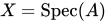
There's another useful interpretation of the Hochschild complex in the case of commutative rings, and more generally, for sheaves of commutative rings: it is constructed from the derived self-intersection of a scheme (or even derived scheme) X {\displaystyle X} {\displaystyle X} over some base scheme S {\displaystyle S} {\displaystyle S}. For example, we can form the derived fiber product X × S L X {\displaystyle X\times _{S}^{\mathbf {L} }X} {\displaystyle X\times _{S}^{\mathbf {L} }X}which has the sheaf of derived rings O X ⊗ O S L O X {\displaystyle {\mathcal {O}}_{X}\otimes _{{\mathcal {O}}_{S}}^{\mathbf {L} }{\mathcal {O}}_{X}} {\displaystyle {\mathcal {O}}_{X}\otimes _{{\mathcal {O}}_{S}}^{\mathbf {L} }{\mathcal {O}}_{X}}. Then, if embed X {\displaystyle X} {\displaystyle X} with the diagonal map Δ : X → X × S L X {\displaystyle \Delta :X\to X\times _{S}^{\mathbf {L} }X} {\displaystyle \Delta :X\to X\times _{S}^{\mathbf {L} }X}the Hochschild complex is constructed as the pullback of the derived self intersection of the diagonal in the diagonal product scheme H H ( X / S ) := Δ ∗ ( O X ⊗ O X ⊗ O S L O X L O X ) {\displaystyle HH(X/S):=\Delta ^{*}({\mathcal {O}}_{X}\otimes _{{\mathcal {O}}_{X}\otimes _{{\mathcal {O}}_{S}}^{\mathbf {L} }{\mathcal {O}}_{X}}^{\mathbf {L} }{\mathcal {O}}_{X})} {\displaystyle HH(X/S):=\Delta ^{*}({\mathcal {O}}_{X}\otimes _{{\mathcal {O}}_{X}\otimes _{{\mathcal {O}}_{S}}^{\mathbf {L} }{\mathcal {O}}_{X}}^{\mathbf {L} }{\mathcal {O}}_{X})}From this interpretation, it should be clear the Hochschild homology should have some relation to the Kähler differentials Ω X / S {\displaystyle \Omega _{X/S}} {\displaystyle \Omega _{X/S}} since the Kähler differentials can be defined using a self-intersection from the diagonal, or more generally, the cotangent complex L X / S ∙ {\displaystyle \mathbf {L} _{X/S}^{\bullet }} {\displaystyle \mathbf {L} _{X/S}^{\bullet }} since this is the derived replacement for the Kähler differentials. We can recover the original definition of the Hochschild complex of a commutative k {\displaystyle k} {\displaystyle k}-algebra A {\displaystyle A} {\displaystyle A} by setting S = Spec ( k ) {\displaystyle S={\text{Spec}}(k)} {\displaystyle S={\text{Spec}}(k)} and X = Spec ( A ) {\displaystyle X={\text{Spec}}(A)} {\displaystyle X={\text{Spec}}(A)}Then, the Hochschild complex is quasi-isomorphic to H H ( A / k ) ≃ q i s o A ⊗ A ⊗ k L A L A {\displaystyle HH(A/k)\simeq _{qiso}A\otimes _{A\otimes _{k}^{\mathbf {L} }A}^{\mathbf {L} }A} {\displaystyle HH(A/k)\simeq _{qiso}A\otimes _{A\otimes _{k}^{\mathbf {L} }A}^{\mathbf {L} }A}If A {\displaystyle A} {\displaystyle A} is a flat k {\displaystyle k} {\displaystyle k}-algebra, then there's the chain of isomorphisms A ⊗ k L A ≅ A ⊗ k A ≅ A ⊗ k A o p {\displaystyle A\otimes _{k}^{\mathbf {L} }A\cong A\otimes _{k}A\cong A\otimes _{k}A^{op}} {\displaystyle A\otimes _{k}^{\mathbf {L} }A\cong A\otimes _{k}A\cong A\otimes _{k}A^{op}}giving an alternative but equivalent presentation of the Hochschild complex.

Hochschild homology of functors

The simplicial circle S 1 {\displaystyle S^{1}} {\displaystyle S^{1}} is a simplicial object in the category Fin ∗ {\displaystyle \operatorname {Fin} _{*}} {\displaystyle \operatorname {Fin} _{*}} of finite pointed sets, i.e., a functor Δ o → Fin ∗ . {\displaystyle \Delta ^{o}\to \operatorname {Fin} _{*}.} {\displaystyle \Delta ^{o}\to \operatorname {Fin} _{*}.} Thus, if F is a functor F : Fin → k -mod {\displaystyle F\colon \operatorname {Fin} \to k{\text{-mod}}} {\displaystyle F\colon \operatorname {Fin} \to k{\text{-mod}}}, we get a simplicial module by composing F with S 1 {\displaystyle S^{1}} {\displaystyle S^{1}}.

Δ o ⟶ S 1 Fin ∗ ⟶ F k -mod . {\displaystyle \Delta ^{o}{\overset {S^{1}}{\longrightarrow }}\operatorname {Fin} _{*}{\overset {F}{\longrightarrow }}k{\text{-mod}}.} {\displaystyle \Delta ^{o}{\overset {S^{1}}{\longrightarrow }}\operatorname {Fin} _{*}{\overset {F}{\longrightarrow }}k{\text{-mod}}.}

The homology of this simplicial module is the Hochschild homology of the functor F. The above definition of Hochschild homology of commutative algebras is the special case where F is the Loday functor.

Loday functor

A skeleton for the category of finite pointed sets is given by the objects

n + = { 0 , 1 , … , n } , {\displaystyle n_{+}=\{0,1,\ldots ,n\},} {\displaystyle n_{+}=\{0,1,\ldots ,n\},}

where 0 is the basepoint, and the morphisms are the basepoint preserving set maps. Let A be a commutative k-algebra and M be a symmetric A-bimodule. The Loday functor L ( A , M ) {\displaystyle L(A,M)} {\displaystyle L(A,M)} is given on objects in Fin ∗ {\displaystyle \operatorname {Fin} _{*}} {\displaystyle \operatorname {Fin} _{*}} by

n + ↦ M ⊗ A ⊗ n . {\displaystyle n_{+}\mapsto M\otimes A^{\otimes n}.} {\displaystyle n_{+}\mapsto M\otimes A^{\otimes n}.}

A morphism

f : m + → n + {\displaystyle f:m_{+}\to n_{+}} {\displaystyle f:m_{+}\to n_{+}}

is sent to the morphism f ∗ {\displaystyle f_{*}} {\displaystyle f_{*}} given by

f ∗ ( a 0 ⊗ ⋯ ⊗ a m ) = b 0 ⊗ ⋯ ⊗ b n {\displaystyle f_{*}(a_{0}\otimes \cdots \otimes a_{m})=b_{0}\otimes \cdots \otimes b_{n}} {\displaystyle f_{*}(a_{0}\otimes \cdots \otimes a_{m})=b_{0}\otimes \cdots \otimes b_{n}}

where

∀ j ∈ { 0 , … , n } : b j = { ∏ i ∈ f − 1 ( j ) a i f − 1 ( j ) ≠ ∅ 1 f − 1 ( j ) = ∅ {\displaystyle \forall j\in \{0,\ldots ,n\}:\qquad b_{j}={\begin{cases}\prod _{i\in f^{-1}(j)}a_{i}&f^{-1}(j)\neq \emptyset \\1&f^{-1}(j)=\emptyset \end{cases}}} {\displaystyle \forall j\in \{0,\ldots ,n\}:\qquad b_{j}={\begin{cases}\prod _{i\in f^{-1}(j)}a_{i}&f^{-1}(j)\neq \emptyset \\1&f^{-1}(j)=\emptyset \end{cases}}}

Another description of Hochschild homology of algebras

The Hochschild homology of a commutative algebra A with coefficients in a symmetric A-bimodule M is the homology associated to the composition

Δ o ⟶ S 1 Fin ∗ ⟶ L ( A , M ) k -mod , {\displaystyle \Delta ^{o}{\overset {S^{1}}{\longrightarrow }}\operatorname {Fin} _{*}{\overset {{\mathcal {L}}(A,M)}{\longrightarrow }}k{\text{-mod}},} {\displaystyle \Delta ^{o}{\overset {S^{1}}{\longrightarrow }}\operatorname {Fin} _{*}{\overset {{\mathcal {L}}(A,M)}{\longrightarrow }}k{\text{-mod}},}

and this definition agrees with the one above.

Examples

The examples of Hochschild homology computations can be stratified into a number of distinct cases with fairly general theorems describing the structure of the homology groups and the homology ring H H ∗ ( A ) {\displaystyle HH_{*}(A)} {\displaystyle HH_{*}(A)} for an associative algebra A {\displaystyle A} {\displaystyle A}. For the case of commutative algebras, there are a number of theorems describing the computations over characteristic 0 yielding a straightforward understanding of what the homology and cohomology compute.

Commutative characteristic 0 case

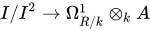
In the case of commutative algebras A / k {\displaystyle A/k} {\displaystyle A/k} where Q ⊆ k {\displaystyle \mathbb {Q} \subseteq k} {\displaystyle \mathbb {Q} \subseteq k}, the Hochschild homology has two main theorems concerning smooth algebras, and more general non-flat algebras A {\displaystyle A} {\displaystyle A}; but, the second is a direct generalization of the first. In the smooth case, i.e. for a smooth algebra A {\displaystyle A} {\displaystyle A}, the Hochschild-Kostant-Rosenberg theorem[2]pg 43-44 states there is an isomorphism Ω A / k n ≅ H H n ( A / k ) {\displaystyle \Omega _{A/k}^{n}\cong HH_{n}(A/k)} {\displaystyle \Omega _{A/k}^{n}\cong HH_{n}(A/k)} for every n ≥ 0 {\displaystyle n\geq 0} {\displaystyle n\geq 0}. This isomorphism can be described explicitly using the anti-symmetrization map. That is, a differential n {\displaystyle n} {\displaystyle n}-form has the map a d b 1 ∧ ⋯ ∧ d b n ↦ ∑ σ ∈ S n sign ⁡ ( σ ) a ⊗ b σ ( 1 ) ⊗ ⋯ ⊗ b σ ( n ) . {\displaystyle a\,db_{1}\wedge \cdots \wedge db_{n}\mapsto \sum _{\sigma \in S_{n}}\operatorname {sign} (\sigma )a\otimes b_{\sigma (1)}\otimes \cdots \otimes b_{\sigma (n)}.} {\displaystyle a\,db_{1}\wedge \cdots \wedge db_{n}\mapsto \sum _{\sigma \in S_{n}}\operatorname {sign} (\sigma )a\otimes b_{\sigma (1)}\otimes \cdots \otimes b_{\sigma (n)}.} If the algebra A / k {\displaystyle A/k} {\displaystyle A/k} isn't smooth, or even flat, then there is an analogous theorem using the cotangent complex. For a simplicial resolution P ∙ → A {\displaystyle P_{\bullet }\to A} {\displaystyle P_{\bullet }\to A}, we set L A / k i = Ω P ∙ / k i ⊗ P ∙ A {\displaystyle \mathbb {L} _{A/k}^{i}=\Omega _{P_{\bullet }/k}^{i}\otimes _{P_{\bullet }}A} {\displaystyle \mathbb {L} _{A/k}^{i}=\Omega _{P_{\bullet }/k}^{i}\otimes _{P_{\bullet }}A}. Then, there exists a descending N {\displaystyle \mathbb {N} } {\displaystyle \mathbb {N} }-filtration F ∙ {\displaystyle F_{\bullet }} {\displaystyle F_{\bullet }} on H H n ( A / k ) {\displaystyle HH_{n}(A/k)} {\displaystyle HH_{n}(A/k)} whose graded pieces are isomorphic to F i F i + 1 ≅ L A / k i [ + i ] . {\displaystyle {\frac {F_{i}}{F_{i+1}}}\cong \mathbb {L} _{A/k}^{i}[+i].} {\displaystyle {\frac {F_{i}}{F_{i+1}}}\cong \mathbb {L} _{A/k}^{i}[+i].} Note this theorem makes it accessible to compute the Hochschild homology not just for smooth algebras, but also for local complete intersection algebras. In this case, given a presentation A = R / I {\displaystyle A=R/I} {\displaystyle A=R/I} for R = k [ x 1 , … , x n ] {\displaystyle R=k[x_{1},\dotsc ,x_{n}]} {\displaystyle R=k[x_{1},\dotsc ,x_{n}]}, the cotangent complex is the two-term complex I / I 2 → Ω R / k 1 ⊗ k A {\displaystyle I/I^{2}\to \Omega _{R/k}^{1}\otimes _{k}A} {\displaystyle I/I^{2}\to \Omega _{R/k}^{1}\otimes _{k}A}.

Polynomial rings over the rationals

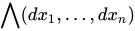
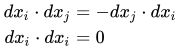
One simple example is to compute the Hochschild homology of a polynomial ring of Q {\displaystyle \mathbb {Q} } {\displaystyle \mathbb {Q} } with n {\displaystyle n} {\displaystyle n}-generators. The HKR theorem gives the isomorphism H H ∗ ( Q [ x 1 , … , x n ] ) = Q [ x 1 , … , x n ] ⊗ Λ ( d x 1 , … , d x n ) {\displaystyle HH_{*}(\mathbb {Q} [x_{1},\ldots ,x_{n}])=\mathbb {Q} [x_{1},\ldots ,x_{n}]\otimes \Lambda (dx_{1},\dotsc ,dx_{n})} {\displaystyle HH_{*}(\mathbb {Q} [x_{1},\ldots ,x_{n}])=\mathbb {Q} [x_{1},\ldots ,x_{n}]\otimes \Lambda (dx_{1},\dotsc ,dx_{n})} where the algebra ⋀ ( d x 1 , … , d x n ) {\displaystyle \bigwedge (dx_{1},\ldots ,dx_{n})} {\displaystyle \bigwedge (dx_{1},\ldots ,dx_{n})} is the free antisymmetric algebra over Q {\displaystyle \mathbb {Q} } {\displaystyle \mathbb {Q} } in n {\displaystyle n} {\displaystyle n}-generators. Its product structure is given by the wedge product of vectors, so d x i ⋅ d x j = − d x j ⋅ d x i d x i ⋅ d x i = 0 {\displaystyle {\begin{aligned}dx_{i}\cdot dx_{j}&=-dx_{j}\cdot dx_{i}\\dx_{i}\cdot dx_{i}&=0\end{aligned}}} {\displaystyle {\begin{aligned}dx_{i}\cdot dx_{j}&=-dx_{j}\cdot dx_{i}\\dx_{i}\cdot dx_{i}&=0\end{aligned}}} for i ≠ j {\displaystyle i\neq j} {\displaystyle i\neq j}.

Commutative characteristic p case

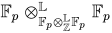
In the characteristic p case, there is a userful counter-example to the Hochschild-Kostant-Rosenberg theorem which elucidates for the need of a theory beyond simplicial algebras for defining Hochschild homology. Consider the Z {\displaystyle \mathbb {Z} } {\displaystyle \mathbb {Z} }-algebra F p {\displaystyle \mathbb {F} _{p}} {\displaystyle \mathbb {F} _{p}}. We can compute a resolution of F p {\displaystyle \mathbb {F} _{p}} {\displaystyle \mathbb {F} _{p}} as the free differential graded algebras Z → ⋅ p Z {\displaystyle \mathbb {Z} \xrightarrow {\cdot p} \mathbb {Z} } {\displaystyle \mathbb {Z} \xrightarrow {\cdot p} \mathbb {Z} }giving the derived intersection F p ⊗ Z L F p ≅ F p [ ε ] / ( ε 2 ) {\displaystyle \mathbb {F} _{p}\otimes _{\mathbb {Z} }^{\mathbf {L} }\mathbb {F} _{p}\cong \mathbb {F} _{p}[\varepsilon ]/(\varepsilon ^{2})} {\displaystyle \mathbb {F} _{p}\otimes _{\mathbb {Z} }^{\mathbf {L} }\mathbb {F} _{p}\cong \mathbb {F} _{p}[\varepsilon ]/(\varepsilon ^{2})} where deg ( ε ) = 1 {\displaystyle {\text{deg}}(\varepsilon )=1} {\displaystyle {\text{deg}}(\varepsilon )=1} and the differential is the zero map. This is because we just tensor the complex above by F p {\displaystyle \mathbb {F} _{p}} {\displaystyle \mathbb {F} _{p}}, giving a formal complex with a generator in degree 1 {\displaystyle 1} {\displaystyle 1} which squares to 0 {\displaystyle 0} {\displaystyle 0}. Then, the Hochschild complex is given by F p ⊗ F p ⊗ Z L F p L F p {\displaystyle \mathbb {F} _{p}\otimes _{\mathbb {F} _{p}\otimes _{\mathbb {Z} }^{\mathbb {L} }\mathbb {F} _{p}}^{\mathbb {L} }\mathbb {F} _{p}} {\displaystyle \mathbb {F} _{p}\otimes _{\mathbb {F} _{p}\otimes _{\mathbb {Z} }^{\mathbb {L} }\mathbb {F} _{p}}^{\mathbb {L} }\mathbb {F} _{p}}In order to compute this, we must resolve F p {\displaystyle \mathbb {F} _{p}} {\displaystyle \mathbb {F} _{p}} as an F p ⊗ Z L F p {\displaystyle \mathbb {F} _{p}\otimes _{\mathbb {Z} }^{\mathbf {L} }\mathbb {F} _{p}} {\displaystyle \mathbb {F} _{p}\otimes _{\mathbb {Z} }^{\mathbf {L} }\mathbb {F} _{p}}-algebra. Observe that the algebra structure

F p [ ε ] / ( ε 2 ) → F p {\displaystyle \mathbb {F} _{p}[\varepsilon ]/(\varepsilon ^{2})\to \mathbb {F} _{p}} {\displaystyle \mathbb {F} _{p}[\varepsilon ]/(\varepsilon ^{2})\to \mathbb {F} _{p}}

forces ε ↦ 0 {\displaystyle \varepsilon \mapsto 0} {\displaystyle \varepsilon \mapsto 0}. This gives the degree zero term of the complex. Then, because we have to resolve the kernel ε ⋅ F p ⊗ Z L F p {\displaystyle \varepsilon \cdot \mathbb {F} _{p}\otimes _{\mathbb {Z} }^{\mathbf {L} }\mathbb {F} _{p}} {\displaystyle \varepsilon \cdot \mathbb {F} _{p}\otimes _{\mathbb {Z} }^{\mathbf {L} }\mathbb {F} _{p}}, we can take a copy of F p ⊗ Z L F p {\displaystyle \mathbb {F} _{p}\otimes _{\mathbb {Z} }^{\mathbf {L} }\mathbb {F} _{p}} {\displaystyle \mathbb {F} _{p}\otimes _{\mathbb {Z} }^{\mathbf {L} }\mathbb {F} _{p}} shifted in degree 2 {\displaystyle 2} {\displaystyle 2} and have it map to ε ⋅ F p ⊗ Z L F p {\displaystyle \varepsilon \cdot \mathbb {F} _{p}\otimes _{\mathbb {Z} }^{\mathbf {L} }\mathbb {F} _{p}} {\displaystyle \varepsilon \cdot \mathbb {F} _{p}\otimes _{\mathbb {Z} }^{\mathbf {L} }\mathbb {F} _{p}}, with kernel in degree 3 {\displaystyle 3} {\displaystyle 3} ε ⋅ F p ⊗ Z L F p = Ker ( F p ⊗ Z L F p → ε ⋅ F p ⊗ Z L F p ) . {\displaystyle \varepsilon \cdot \mathbb {F} _{p}\otimes _{\mathbb {Z} }^{\mathbf {L} }\mathbb {F} _{p}={\text{Ker}}({\displaystyle \mathbb {F} _{p}\otimes _{\mathbb {Z} }^{\mathbf {L} }\mathbb {F} _{p}}\to {\displaystyle \varepsilon \cdot \mathbb {F} _{p}\otimes _{\mathbb {Z} }^{\mathbf {L} }\mathbb {F} _{p}}).} {\displaystyle \varepsilon \cdot \mathbb {F} _{p}\otimes _{\mathbb {Z} }^{\mathbf {L} }\mathbb {F} _{p}={\text{Ker}}({\displaystyle \mathbb {F} _{p}\otimes _{\mathbb {Z} }^{\mathbf {L} }\mathbb {F} _{p}}\to {\displaystyle \varepsilon \cdot \mathbb {F} _{p}\otimes _{\mathbb {Z} }^{\mathbf {L} }\mathbb {F} _{p}}).}We can perform this recursively to get the underlying module of the divided power algebra ( F p ⊗ Z L F p ) ⟨ x ⟩ = ( F p ⊗ Z L F p ) [ x 1 , x 2 , … ] x i x j = ( i + j i ) x i + j {\displaystyle (\mathbb {F} _{p}\otimes _{\mathbb {Z} }^{\mathbf {L} }\mathbb {F} _{p})\langle x\rangle ={\frac {(\mathbb {F} _{p}\otimes _{\mathbb {Z} }^{\mathbf {L} }\mathbb {F} _{p})[x_{1},x_{2},\ldots ]}{x_{i}x_{j}={\binom {i+j}{i}}x_{i+j}}}} {\displaystyle (\mathbb {F} _{p}\otimes _{\mathbb {Z} }^{\mathbf {L} }\mathbb {F} _{p})\langle x\rangle ={\frac {(\mathbb {F} _{p}\otimes _{\mathbb {Z} }^{\mathbf {L} }\mathbb {F} _{p})[x_{1},x_{2},\ldots ]}{x_{i}x_{j}={\binom {i+j}{i}}x_{i+j}}}}with d x i = ε ⋅ x i − 1 {\displaystyle dx_{i}=\varepsilon \cdot x_{i-1}} {\displaystyle dx_{i}=\varepsilon \cdot x_{i-1}} and the degree of x i {\displaystyle x_{i}} {\displaystyle x_{i}} is 2 i {\displaystyle 2i} {\displaystyle 2i}, namely | x i | = 2 i {\displaystyle |x_{i}|=2i} {\displaystyle |x_{i}|=2i}. Tensoring this algebra with F p {\displaystyle \mathbb {F} _{p}} {\displaystyle \mathbb {F} _{p}} over F p ⊗ Z L F p {\displaystyle \mathbb {F} _{p}\otimes _{\mathbb {Z} }^{\mathbf {L} }\mathbb {F} _{p}} {\displaystyle \mathbb {F} _{p}\otimes _{\mathbb {Z} }^{\mathbf {L} }\mathbb {F} _{p}} gives H H ∗ ( F p ) = F p ⟨ x ⟩ {\displaystyle HH_{*}(\mathbb {F} _{p})=\mathbb {F} _{p}\langle x\rangle } {\displaystyle HH_{*}(\mathbb {F} _{p})=\mathbb {F} _{p}\langle x\rangle }since ε {\displaystyle \varepsilon } {\displaystyle \varepsilon } multiplied with any element in F p {\displaystyle \mathbb {F} _{p}} {\displaystyle \mathbb {F} _{p}} is zero. The algebra structure comes from general theory on divided power algebras and differential graded algebras.[3] Note this computation is seen as a technical artifact because the ring F p ⟨ x ⟩ {\displaystyle \mathbb {F} _{p}\langle x\rangle } {\displaystyle \mathbb {F} _{p}\langle x\rangle } is not well behaved. For instance, x p = 0 {\displaystyle x^{p}=0} {\displaystyle x^{p}=0}. One technical response to this problem is through Topological Hochschild homology, where the base ring Z {\displaystyle \mathbb {Z} } {\displaystyle \mathbb {Z} } is replaced by the sphere spectrum S {\displaystyle \mathbb {S} } {\displaystyle \mathbb {S} }.

Topological Hochschild homology

The above construction of the Hochschild complex can be adapted to more general situations, namely by replacing the category of (complexes of) k {\displaystyle k} {\displaystyle k}-modules by an ∞-category (equipped with a tensor product) C {\displaystyle {\mathcal {C}}} {\displaystyle {\mathcal {C}}}, and A {\displaystyle A} {\displaystyle A} by an associative algebra in this category. Applying this to the category C = Spectra {\displaystyle {\mathcal {C}}={\textbf {Spectra}}} {\displaystyle {\mathcal {C}}={\textbf {Spectra}}} of spectra, and A {\displaystyle A} {\displaystyle A} being the Eilenberg–MacLane spectrum associated to an ordinary ring R {\displaystyle R} {\displaystyle R} yields topological Hochschild homology, denoted T H H ( R ) {\displaystyle THH(R)} {\displaystyle THH(R)}. The (non-topological) Hochschild homology introduced above can be reinterpreted along these lines, by taking for C = D ( Z ) {\displaystyle {\mathcal {C}}=D(\mathbb {Z} )} {\displaystyle {\mathcal {C}}=D(\mathbb {Z} )} the derived category of Z {\displaystyle \mathbb {Z} } {\displaystyle \mathbb {Z} }-modules (as an ∞-category).

Replacing tensor products over the sphere spectrum by tensor products over Z {\displaystyle \mathbb {Z} } {\displaystyle \mathbb {Z} } (or the Eilenberg–MacLane-spectrum H Z {\displaystyle H\mathbb {Z} } {\displaystyle H\mathbb {Z} }) leads to a natural comparison map T H H ( R ) → H H ( R ) {\displaystyle THH(R)\to HH(R)} {\displaystyle THH(R)\to HH(R)}. It induces an isomorphism on homotopy groups in degrees 0, 1, and 2. In general, however, they are different, and T H H {\displaystyle THH} {\displaystyle THH} tends to yield simpler groups than HH. For example,

T H H ( F p ) = F p [ x ] , {\displaystyle THH(\mathbb {F} _{p})=\mathbb {F} _{p}[x],} {\displaystyle THH(\mathbb {F} _{p})=\mathbb {F} _{p}[x],}
H H ( F p ) = F p ⟨ x ⟩ {\displaystyle HH(\mathbb {F} _{p})=\mathbb {F} _{p}\langle x\rangle } {\displaystyle HH(\mathbb {F} _{p})=\mathbb {F} _{p}\langle x\rangle }

is the polynomial ring (with x in degree 2), compared to the ring of divided powers in one variable.

Lars Hesselholt (2016) showed that the Hasse–Weil zeta function of a smooth proper variety over F p {\displaystyle \mathbb {F} _{p}} {\displaystyle \mathbb {F} _{p}} can be expressed using regularized determinants involving topological Hochschild homology.

See also

References

  1. Morrow, Matthew. "Topological Hochschild homology in arithmetic geometry" (PDF). Archived (PDF) from the original on 24 Dec 2020.
  2. Ginzburg, Victor (2005-06-29). "Lectures on Noncommutative Geometry". arXiv:math/0506603.
  3. "Section 23.6 (09PF): Tate resolutions—The Stacks project". stacks.math.columbia.edu. Retrieved 2020-12-31.

Introductory articles

Commutative case

Noncommutative case