Horndeski's theory is the most general theory of gravity in four dimensions whose Lagrangian is constructed out of the metric tensor and a scalar field and leads to second order equations of motion. The theory was first proposed by Gregory Horndeski in 1974[1] and has found numerous applications, particularly in the construction of cosmological models of Inflation and dark energy.[2] Horndeski's theory contains many theories of gravity, including general relativity, Brans–Dicke theory, quintessence, dilaton, chameleon particle and covariant Galileon[3] as special cases.
Action
Horndeski's theory can be written in terms of an action as[4]
S
[
g
μ
ν
,
ϕ
]
=
∫
d
4
x
−
g
[
∑
i
=
2
5
1
8
π
G
N
L
i
[
g
μ
ν
,
ϕ
]
+
L
m
[
g
μ
ν
,
ψ
M
]
]
{\displaystyle S[g_{\mu \nu },\phi ]=\int \mathrm {d} ^{4}x\,{\sqrt {-g}}\left[\sum _{i=2}^{5}{\frac {1}{8\pi G_{\text{N}}}}{\mathcal {L}}_{i}[g_{\mu \nu },\phi ]\,+{\mathcal {L}}_{\text{m}}[g_{\mu \nu },\psi _{M}]\right]}
![{\displaystyle S[g_{\mu \nu },\phi ]=\int \mathrm {d} ^{4}x\,{\sqrt {-g}}\left[\sum _{i=2}^{5}{\frac {1}{8\pi G_{\text{N}}}}{\mathcal {L}}_{i}[g_{\mu \nu },\phi ]\,+{\mathcal {L}}_{\text{m}}[g_{\mu \nu },\psi _{M}]\right]}](https://wikimedia.org/api/rest_v1/media/math/render/svg/cc6af494c355074154618ad2196c2098e2aedc4d)
with the Lagrangian densities
L
2
=
G
2
(
ϕ
,
X
)
{\displaystyle {\mathcal {L}}_{2}=G_{2}(\phi ,\,X)}

L
3
=
G
3
(
ϕ
,
X
)
◻
ϕ
{\displaystyle {\mathcal {L}}_{3}=G_{3}(\phi ,\,X)\Box \phi }

L
4
=
G
4
(
ϕ
,
X
)
R
+
G
4
,
X
(
ϕ
,
X
)
[
(
◻
ϕ
)
2
−
ϕ
;
μ
ν
ϕ
;
μ
ν
]
{\displaystyle {\mathcal {L}}_{4}=G_{4}(\phi ,\,X)R+G_{4,X}(\phi ,\,X)\left[\left(\Box \phi \right)^{2}-\phi _{;\mu \nu }\phi ^{;\mu \nu }\right]}
![{\displaystyle {\mathcal {L}}_{4}=G_{4}(\phi ,\,X)R+G_{4,X}(\phi ,\,X)\left[\left(\Box \phi \right)^{2}-\phi _{;\mu \nu }\phi ^{;\mu \nu }\right]}](https://wikimedia.org/api/rest_v1/media/math/render/svg/b31fe1e5dce3e6d458f391c835f77f9043a1bd12)
L
5
=
G
5
(
ϕ
,
X
)
G
μ
ν
ϕ
;
μ
ν
−
1
6
G
5
,
X
(
ϕ
,
X
)
[
(
◻
ϕ
)
3
+
2
ϕ
;
μ
ν
ϕ
;
ν
α
ϕ
;
α
μ
−
3
ϕ
;
μ
ν
ϕ
;
μ
ν
◻
ϕ
]
{\displaystyle {\mathcal {L}}_{5}=G_{5}(\phi ,\,X)G_{\mu \nu }\phi ^{;\mu \nu }-{\frac {1}{6}}G_{5,X}(\phi ,\,X)\left[\left(\Box \phi \right)^{3}+2{\phi _{;\mu }}^{\nu }{\phi _{;\nu }}^{\alpha }{\phi _{;\alpha }}^{\mu }-3\phi _{;\mu \nu }\phi ^{;\mu \nu }\Box \phi \right]}
![{\displaystyle {\mathcal {L}}_{5}=G_{5}(\phi ,\,X)G_{\mu \nu }\phi ^{;\mu \nu }-{\frac {1}{6}}G_{5,X}(\phi ,\,X)\left[\left(\Box \phi \right)^{3}+2{\phi _{;\mu }}^{\nu }{\phi _{;\nu }}^{\alpha }{\phi _{;\alpha }}^{\mu }-3\phi _{;\mu \nu }\phi ^{;\mu \nu }\Box \phi \right]}](https://wikimedia.org/api/rest_v1/media/math/render/svg/f0a8c65eae6414ec7c15f003c21afd4e25828a13)
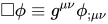
Here
G
N
{\displaystyle G_{N}}



Constraints on parameters
Many of the free parameters of the theory have been constrained,
L
1
{\displaystyle {\mathcal {L}}_{1}}


See also
References
- Horndeski, Gregory Walter (1974-09-01). "Second-order scalar-tensor field equations in a four-dimensional space". International Journal of Theoretical Physics. 10 (6): 363–384. Bibcode:1974IJTP...10..363H. doi:10.1007/BF01807638. ISSN 0020-7748. S2CID 122346086.
- Clifton, Timothy; Ferreira, Pedro G.; Padilla, Antonio; Skordis, Constantinos (March 2012). "Modified Gravity and Cosmology". Physics Reports. 513 (1–3): 1–189. arXiv:1106.2476. Bibcode:2012PhR...513....1C. doi:10.1016/j.physrep.2012.01.001. S2CID 119258154.
- Deffayet, C.; Esposito-Farese, G.; Vikman, A. (2009-04-03). "Covariant Galileon". Physical Review D. 79 (8) 084003. arXiv:0901.1314. Bibcode:2009PhRvD..79h4003D. doi:10.1103/PhysRevD.79.084003. ISSN 1550-7998. S2CID 118855364.
- Kobayashi, Tsutomu; Yamaguchi, Masahide; Yokoyama, Jun'ichi (2011-09-01). "Generalized G-inflation: Inflation with the most general second-order field equations". Progress of Theoretical Physics. 126 (3): 511–529. arXiv:1105.5723. Bibcode:2011PThPh.126..511K. doi:10.1143/PTP.126.511. ISSN 0033-068X. S2CID 118587117.
- ATLAS Collaboration (2019-03-04). "Constraints on mediator-based dark matter and scalar dark energy models using
s
=
13
{\displaystyle {\sqrt {s}}=13}
TeV p p {\displaystyle pp}
collision data collected by the ATLAS detector". Jhep. 05: 142. arXiv:1903.01400. doi:10.1007/JHEP05(2019)142. S2CID 119182921.
- Lombriser, Lucas; Taylor, Andy (2016-03-16). "Breaking a Dark Degeneracy with Gravitational Waves". Journal of Cosmology and Astroparticle Physics. 2016 (3): 031. arXiv:1509.08458. Bibcode:2016JCAP...03..031L. doi:10.1088/1475-7516/2016/03/031. ISSN 1475-7516. S2CID 73517974.
- Bettoni, Dario; Ezquiaga, Jose María; Hinterbichler, Kurt; Zumalacárregui, Miguel (2017-04-14). "Speed of Gravitational Waves and the Fate of Scalar-Tensor Gravity". Physical Review D. 95 (8) 084029. arXiv:1608.01982. Bibcode:2017PhRvD..95h4029B. doi:10.1103/PhysRevD.95.084029. ISSN 2470-0010. S2CID 119186001.
- Creminelli, Paolo; Vernizzi, Filippo (2017-10-16). "Dark Energy after GW170817". Physical Review Letters. 119 (25) 251302. arXiv:1710.05877. Bibcode:2017PhRvL.119y1302C. doi:10.1103/PhysRevLett.119.251302. PMID 29303308. S2CID 206304918.
- Sakstein, Jeremy; Jain, Bhuvnesh (2017-10-16). "Implications of the Neutron Star Merger GW170817 for Cosmological Scalar-Tensor Theories". Physical Review Letters. 119 (25) 251303. arXiv:1710.05893. Bibcode:2017PhRvL.119y1303S. doi:10.1103/PhysRevLett.119.251303. PMID 29303345. S2CID 39068360.
- Ezquiaga, Jose María; Zumalacárregui, Miguel (2017-12-18). "Dark Energy After GW170817: Dead Ends and the Road Ahead". Physical Review Letters. 119 (25) 251304. arXiv:1710.05901. Bibcode:2017PhRvL.119y1304E. doi:10.1103/PhysRevLett.119.251304. PMID 29303304. S2CID 38618360.
- Grossman, Lisa (2017-10-24). "What detecting gravitational waves means for the expansion of the universe". Science News. Retrieved 2017-11-08.