In mathematics, Hua's lemma,[1] named for Hua Loo-keng, is an estimate for exponential sums.
It states that if P is an integral-valued polynomial of degree k,
ε
{\displaystyle \varepsilon }

-
f
(
α
)
=
∑
x
=
1
N
exp
(
2
π
i
P
(
x
)
α
)
,
{\displaystyle f(\alpha )=\sum _{x=1}^{N}\exp(2\pi iP(x)\alpha ),}
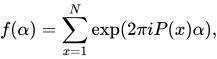
then
-
∫
0
1
|
f
(
α
)
|
λ
d
α
≪
P
,
ε
N
μ
(
λ
)
{\displaystyle \int _{0}^{1}|f(\alpha )|^{\lambda }d\alpha \ll _{P,\varepsilon }N^{\mu (\lambda )}}
,
where
(
λ
,
μ
(
λ
)
)
{\displaystyle (\lambda ,\mu (\lambda ))}

-
(
2
ν
,
2
ν
−
ν
+
ε
)
,
ν
=
1
,
…
,
k
.
{\displaystyle (2^{\nu },2^{\nu }-\nu +\varepsilon ),\quad \nu =1,\ldots ,k.}

References
- Hua Loo-keng (1938). "On Waring's problem". Quarterly Journal of Mathematics. 9 (1): 199–202. doi:10.1093/qmath/os-9.1.199.