| Johnson's SU | |||
|---|---|---|---|
|
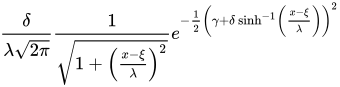
Probability density function  | |||
|
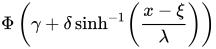
Cumulative distribution function  | |||
| Parameters |
γ
,
ξ
,
δ
>
0
,
λ
>
0
{\displaystyle \gamma ,\xi ,\delta >0,\lambda >0}
 (real) (real) | ||
| Support |
−
∞
to
+
∞
{\displaystyle -\infty {\text{ to }}+\infty }
 | ||
δ
λ
2
π
1
1
+
(
x
−
ξ
λ
)
2
e
−
1
2
(
γ
+
δ
sinh
−
1
(
x
−
ξ
λ
)
)
2
{\displaystyle {\frac {\delta }{\lambda {\sqrt {2\pi }}}}{\frac {1}{\sqrt {1+\left({\frac {x-\xi }{\lambda }}\right)^{2}}}}e^{-{\frac {1}{2}}\left(\gamma +\delta \sinh ^{-1}\left({\frac {x-\xi }{\lambda }}\right)\right)^{2}}}
 | |||
| CDF |
Φ
(
γ
+
δ
sinh
−
1
(
x
−
ξ
λ
)
)
{\displaystyle \Phi \left(\gamma +\delta \sinh ^{-1}\left({\frac {x-\xi }{\lambda }}\right)\right)}
 | ||
| Mean |
ξ
−
λ
exp
δ
−
2
2
sinh
(
γ
δ
)
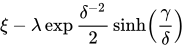
{\displaystyle \xi -\lambda \exp {\frac {\delta ^{-2}}{2}}\sinh \left({\frac {\gamma }{\delta }}\right)}
 | ||
| Median |
ξ
+
λ
sinh
(
−
γ
δ
)
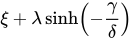
{\displaystyle \xi +\lambda \sinh \left(-{\frac {\gamma }{\delta }}\right)}
 | ||
| Variance |
λ
2
2
(
exp
(
δ
−
2
)
−
1
)
(
exp
(
δ
−
2
)
cosh
(
2
γ
δ
)
+
1
)
{\displaystyle {\frac {\lambda ^{2}}{2}}(\exp(\delta ^{-2})-1)\left(\exp(\delta ^{-2})\cosh \left({\frac {2\gamma }{\delta }}\right)+1\right)}
 | ||
| Skewness |
−
λ
3
e
δ
−
2
(
e
δ
−
2
−
1
)
2
(
(
e
δ
−
2
)
(
e
δ
−
2
+
2
)
sinh
(
3
γ
δ
)
+
3
sinh
(
γ
δ
)
)
4
(
Variance
X
)
1.5
{\displaystyle -{\frac {\lambda ^{3}{\sqrt {e^{\delta ^{-2}}}}(e^{\delta ^{-2}}-1)^{2}((e^{\delta ^{-2}})(e^{\delta ^{-2}}+2)\sinh({\frac {3\gamma }{\delta }})+3\sinh({\frac {\gamma }{\delta }}))}{4(\operatorname {Variance} X)^{1.5}}}}
 | ||
| Excess kurtosis |
λ
4
(
e
δ
−
2
−
1
)
2
(
K
1
+
K
2
+
K
3
)
8
(
Variance
X
)
2
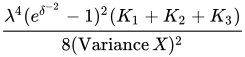
{\displaystyle {\frac {\lambda ^{4}(e^{\delta ^{-2}}-1)^{2}(K_{1}+K_{2}+K_{3})}{8(\operatorname {Variance} X)^{2}}}}
 K 1 = ( e δ − 2 ) 2 ( ( e δ − 2 ) 4 + 2 ( e δ − 2 ) 3 + 3 ( e δ − 2 ) 2 − 3 ) cosh ( 4 γ δ ) {\displaystyle K_{1}=\left(e^{\delta ^{-2}}\right)^{2}\left(\left(e^{\delta ^{-2}}\right)^{4}+2\left(e^{\delta ^{-2}}\right)^{3}+3\left(e^{\delta ^{-2}}\right)^{2}-3\right)\cosh \left({\frac {4\gamma }{\delta }}\right)}  K 2 = 4 ( e δ − 2 ) 2 ( ( e δ − 2 ) + 2 ) cosh ( 3 γ δ ) {\displaystyle K_{2}=4\left(e^{\delta ^{-2}}\right)^{2}\left(\left(e^{\delta ^{-2}}\right)+2\right)\cosh \left({\frac {3\gamma }{\delta }}\right)}  K 3 = 3 ( 2 ( e δ − 2 ) + 1 ) {\displaystyle K_{3}=3\left(2\left(e^{\delta ^{-2}}\right)+1\right)} 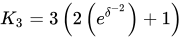 | ||
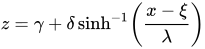
The Johnson's SU-distribution is a four-parameter family of probability distributions first investigated by N. L. Johnson in 1949.[1][2] Johnson proposed it as a transformation of the normal distribution:[1]
-
z
=
γ
+
δ
sinh
−
1
(
x
−
ξ
λ
)
{\displaystyle z=\gamma +\delta \sinh ^{-1}\left({\frac {x-\xi }{\lambda }}\right)}
where
z
∼
N
(
0
,
1
)
{\displaystyle z\sim {\mathcal {N}}(0,1)}

Generation of random variables
Let U be a random variable that is uniformly distributed on the unit interval [0, 1]. Johnson's SU random variables can be generated from U as follows:
-
x
=
λ
sinh
(
Φ
−
1
(
U
)
−
γ
δ
)
+
ξ
{\displaystyle x=\lambda \sinh \left({\frac {\Phi ^{-1}(U)-\gamma }{\delta }}\right)+\xi }
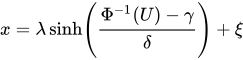
where Φ is the cumulative distribution function of the normal distribution.
Johnson's SB-distribution
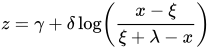
N. L. Johnson[1] firstly proposes the transformation :
-
z
=
γ
+
δ
log
(
x
−
ξ
ξ
+
λ
−
x
)
{\displaystyle z=\gamma +\delta \log \left({\frac {x-\xi }{\xi +\lambda -x}}\right)}
where
z
∼
N
(
0
,
1
)
{\displaystyle z\sim {\mathcal {N}}(0,1)}
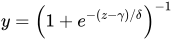
Johnson's SB random variables can be generated from U as follows:
-
y
=
(
1
+
e
−
(
z
−
γ
)
/
δ
)
−
1
{\displaystyle y={\left(1+{e}^{-\left(z-\gamma \right)/\delta }\right)}^{-1}}
-
x
=
λ
y
+
ξ
{\displaystyle x=\lambda y+\xi }

The SB-distribution is convenient to Platykurtic distributions (Kurtosis). To simulate SU, sample of code for its density and cumulative distribution function is available here
Applications
Johnson's
S
U
{\displaystyle S_{U}}

An alternative to the Johnson system of distributions is the quantile-parameterized distributions (QPDs). QPDs can provide greater shape flexibility than the Johnson system. Instead of fitting moments, QPDs are typically fit to empirical CDF data with linear least squares.
Johnson's
S
U
{\displaystyle S_{U}}
References
- Johnson, N. L. (1949). "Systems of Frequency Curves Generated by Methods of Translation". Biometrika. 36 (1/2): 149–176. doi:10.2307/2332539. JSTOR 2332539.
- Johnson, N. L. (1949). "Bivariate Distributions Based on Simple Translation Systems". Biometrika. 36 (3/4): 297–304. doi:10.1093/biomet/36.3-4.297. JSTOR 2332669.
- Tsai, Cindy Sin-Yi (2011). "The Real World is Not Normal" (PDF). Morningstar Alternative Investments Observer.
- As an example, see: LHCb Collaboration (2022). "Precise determination of the
B
s
0
{\displaystyle {B}_{\mathrm {s} }^{0}}
– B ¯ s 0 {\displaystyle {\overline {B}}_{\mathrm {s} }^{0}}
oscillation frequency". Nature Physics. 18: 1–5. arXiv:2104.04421. doi:10.1038/s41567-021-01394-x.
Further reading
- Hill, I. D.; Hill, R.; Holder, R. L. (1976). "Algorithm AS 99: Fitting Johnson Curves by Moments". Journal of the Royal Statistical Society. Series C (Applied Statistics). 25 (2).
- Jones, M. C.; Pewsey, A. (2009). "Sinh-arcsinh distributions" (PDF). Biometrika. 96 (4): 761. doi:10.1093/biomet/asp053.( Preprint)
- Tuenter, Hans J. H. (November 2001). "An algorithm to determine the parameters of SU-curves in the Johnson system of probability distributions by moment matching". The Journal of Statistical Computation and Simulation. 70 (4): 325–347. doi:10.1080/00949650108812126. MR 1872992. Zbl 1098.62523.