In mathematics, the term linear function refers to two distinct but related notions:[1]
- In calculus and related areas, a linear function is a function whose graph is a straight line, that is, a polynomial function of degree zero (a constant polynomial) or one (a linear polynomial).[2] For distinguishing such a linear function from the other concept, the term affine function is often used.[3]
- In linear algebra, mathematical analysis,[4] and functional analysis, a linear function is a kind of function between vector spaces.[5]
As a polynomial function

In calculus, analytic geometry and related areas, a linear function is a polynomial of degree one or less, including the zero polynomial. (The latter is a polynomial with no terms, and it is not considered to have degree zero.)
When the function is of only one variable, it is of the form
-
f
(
x
)
=
a
x
+
b
,
{\displaystyle f(x)=ax+b,}

where a and b are constants, often real numbers. The graph of such a function of one variable is a nonvertical line. a is frequently referred to as the slope of the line, and b as the intercept.
If a > 0 then the gradient is positive and the graph slopes upwards.
If a < 0 then the gradient is negative and the graph slopes downwards.
For a function
f
(
x
1
,
…
,
x
k
)
{\displaystyle f(x_{1},\ldots ,x_{k})}
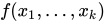
-
f
(
x
1
,
…
,
x
k
)
=
b
+
a
1
x
1
+
⋯
+
a
k
x
k
,
{\displaystyle f(x_{1},\ldots ,x_{k})=b+a_{1}x_{1}+\cdots +a_{k}x_{k},}

and the graph is a hyperplane of dimension k.
A constant function is also considered linear in this context, as it is a polynomial of degree zero or is the zero polynomial. Its graph, when there is only one variable, is a horizontal line.
In this context, a function that is also a linear map (the other meaning of linear functions, see the below) may be referred to as a homogeneous linear function or a linear form. In the context of linear algebra, the polynomial functions of degree 0 or 1 are the scalar-valued affine maps.
As a linear map

In linear algebra, a linear function is a map
f
{\displaystyle f}


-
f
(
x
+
y
)
=
f
(
x
)
+
f
(
y
)
{\displaystyle f(\mathbf {x} +\mathbf {y} )=f(\mathbf {x} )+f(\mathbf {y} )}
-
f
(
a
x
)
=
a
f
(
x
)
.
{\displaystyle f(a\mathbf {x} )=af(\mathbf {x} ).}


Here a denotes a constant belonging to the field K of scalars (for example, the real numbers), and x and y are elements of
V
{\displaystyle \mathbf {V} }


In other terms the linear function preserves vector addition and scalar multiplication.
Some authors use "linear function" only for linear maps that take values in the scalar field;[6] these are more commonly called linear forms.
The "linear functions" of calculus qualify as "linear maps" when (and only when) f(0, ..., 0) = 0, or, equivalently, when the constant b equals zero in the one-degree polynomial above. Geometrically, the graph of the function must pass through the origin.
See also
Notes
- "The term linear function means a linear form in some textbooks and an affine function in others." Vaserstein 2006, p. 50-1
- Stewart 2012, p. 23
- A. Kurosh (1975). Higher Algebra. Mir Publishers. p. 214.
- T. M. Apostol (1981). Mathematical Analysis. Addison-Wesley. p. 345.
- Shores 2007, p. 71
- Gelfand 1961
References
- Izrail Moiseevich Gelfand (1961), Lectures on Linear Algebra, Interscience Publishers, Inc., New York. Reprinted by Dover, 1989. ISBN 0-486-66082-6
- Shores, Thomas S. (2007). Applied Linear Algebra and Matrix Analysis. Undergraduate Texts in Mathematics. Springer. ISBN 978-0-387-33195-9.
- Stewart, James (2012). Calculus: Early Transcendentals (7E ed.). Brooks/Cole. ISBN 978-0-538-49790-9.
- Leonid N. Vaserstein (2006), "Linear Programming", in Leslie Hogben, ed., Handbook of Linear Algebra, Discrete Mathematics and Its Applications, Chapman and Hall/CRC, chap. 50. ISBN 1-584-88510-6