

In mathematics, a Littlewood polynomial is a polynomial all of whose coefficients are +1 or −1. Littlewood's problem asks for bounds on the values of such a polynomial on the unit circle in the complex plane. The answer to this would yield information about the autocorrelation of binary sequences. They are named for J. E. Littlewood who studied them in the 1950s.
Definition
A polynomial
-
p
(
x
)
=
∑
i
=
0
n
a
i
x
i
{\displaystyle p(x)=\sum _{i=0}^{n}a_{i}x^{i}\,}
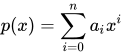
is a Littlewood polynomial if all the ai = ±1.
Littlewood's problem asks for constants c1 and c2 such that there are infinitely many Littlewood polynomials pn, of increasing degree n satisfying
-
c
1
n
+
1
≤
|
p
n
(
z
)
|
≤
c
2
n
+
1
.
{\displaystyle c_{1}{\sqrt {n+1}}\leq |p_{n}(z)|\leq c_{2}{\sqrt {n+1}}.\,}

for all z on the unit circle. The Rudin–Shapiro polynomials provide a sequence satisfying the upper bound with c2 = √2. In 2019, an infinite family of Littlewood polynomials satisfying both the upper and lower bound was constructed by Paul Balister, Béla Bollobás, Robert Morris, Julian Sahasrabudhe, and Marius Tiba.
References
- Peter Borwein (2002). Computational Excursions in Analysis and Number Theory. CMS Books in Mathematics. Springer-Verlag. pp. 2–5, 121–132. ISBN 0-387-95444-9.
- J.E. Littlewood (1968). Some problems in real and complex analysis. D.C. Heath.
- Balister, Paul; Bollobás, Béla; Morris, Robert; Sahasrabudhe, Julian; Tiba, Marius (9 November 2020). "Flat Littlewood polynomials exist". Annals of Mathematics. 192 (3): 977–1004. arXiv:1907.09464. doi:10.4007/annals.2020.192.3.6.