Mahāvīrā (Mahāvīrāchārya) | |
|---|---|
| Personal life | |
| Born | Karnataka, Rashtrakuta Kingdom |
| Dynasty | Rashtrakuta |
| Notable work | "Gaṇita Sāra Saṅgraha" |
| Occupation | Mathematician, Philosopher |
| Religious life | |
| Religion | Jainism |
| Sect | Digambara |
| Religious career | |
| Dynasty | Rashtrakuta |
Mahāvīra (or Mahaviracharya, "Mahavira the Teacher") was a 9th-century Indian Jain mathematician possibly born in Mysore, in India.[1][2][3] He authored Gaṇita-sāra-saṅgraha (Ganita Sara Sangraha) or the Compendium on the gist of Mathematics in 850 CE.[4] He was patronised by the Rashtrakuta emperor Amoghavarsha.[4] He separated astrology from mathematics. It is the earliest Indian text entirely devoted to mathematics.[5] He expounded on the same subjects on which Aryabhata and Brahmagupta contended, but he expressed them more clearly. His work is a highly syncopated approach to algebra and the emphasis in much of his text is on developing the techniques necessary to solve algebraic problems.[6] He is highly respected among Indian mathematicians, because of his establishment of terminology for concepts such as equilateral, and isosceles triangle; rhombus; circle and semicircle.[7] Mahāvīra's eminence spread throughout southern India and his books proved inspirational to other mathematicians in Southern India.[8] It was translated into the Telugu language by Pavuluri Mallana as Saara Sangraha Ganitamu.[9]
He discovered algebraic identities like a3 = a (a + b) (a − b) + b2 (a − b) + b3.[3] He also found out the formula for nCr as
[n (n − 1) (n − 2) ... (n − r + 1)] / [r (r − 1) (r − 2) ... 2 * 1].[10] He devised a formula which approximated the area and perimeters of ellipses and found methods to calculate the square of a number and cube roots of a number.[11] He asserted that the square root of a negative number does not exist.[12] Arithmetic operations utilized in his works like Gaṇita-sāra-saṅgraha(Ganita Sara Sangraha) uses decimal place-value system and include the use of zero. However, he erroneously states that a number divided by zero remains unchanged.[13]
Rules for decomposing fractions
Mahāvīra's Gaṇita-sāra-saṅgraha gave systematic rules for expressing a fraction as the sum of unit fractions.[14] This follows the use of unit fractions in Indian mathematics in the Vedic period, and the Śulba Sūtras' giving an approximation of √2 equivalent to
1
+
1
3
+
1
3
⋅
4
−
1
3
⋅
4
⋅
34
{\displaystyle 1+{\tfrac {1}{3}}+{\tfrac {1}{3\cdot 4}}-{\tfrac {1}{3\cdot 4\cdot 34}}}

In the Gaṇita-sāra-saṅgraha (GSS), the second section of the chapter on arithmetic is named kalā-savarṇa-vyavahāra (lit. "the operation of the reduction of fractions"). In this, the bhāgajāti section (verses 55–98) gives rules for the following:[14]
- To express 1 as the sum of n unit fractions (GSS kalāsavarṇa 75, examples in 76):[14]
rūpāṃśakarāśīnāṃ rūpādyās triguṇitā harāḥ kramaśaḥ /
dvidvitryaṃśābhyastāv ādimacaramau phale rūpe //
When the result is one, the denominators of the quantities having one as numerators are [the numbers] beginning with one and multiplied by three, in order. The first and the last are multiplied by two and two-thirds [respectively].
-
1
=
1
1
⋅
2
+
1
3
+
1
3
2
+
⋯
+
1
3
n
−
2
+
1
2
3
⋅
3
n
−
1
{\displaystyle 1={\frac {1}{1\cdot 2}}+{\frac {1}{3}}+{\frac {1}{3^{2}}}+\dots +{\frac {1}{3^{n-2}}}+{\frac {1}{{\frac {2}{3}}\cdot 3^{n-1}}}}
-
1
=
1
1
⋅
2
+
1
3
+
1
3
2
+
⋯
+
1
3
n
−
2
+
1
2
3
⋅
3
n
−
1
{\displaystyle 1={\frac {1}{1\cdot 2}}+{\frac {1}{3}}+{\frac {1}{3^{2}}}+\dots +{\frac {1}{3^{n-2}}}+{\frac {1}{{\frac {2}{3}}\cdot 3^{n-1}}}}

- To express 1 as the sum of an odd number of unit fractions (GSS kalāsavarṇa 77):[14]
-
1
=
1
2
⋅
3
⋅
1
/
2
+
1
3
⋅
4
⋅
1
/
2
+
⋯
+
1
(
2
n
−
1
)
⋅
2
n
⋅
1
/
2
+
1
2
n
⋅
1
/
2
{\displaystyle 1={\frac {1}{2\cdot 3\cdot 1/2}}+{\frac {1}{3\cdot 4\cdot 1/2}}+\dots +{\frac {1}{(2n-1)\cdot 2n\cdot 1/2}}+{\frac {1}{2n\cdot 1/2}}}
-
1
=
1
2
⋅
3
⋅
1
/
2
+
1
3
⋅
4
⋅
1
/
2
+
⋯
+
1
(
2
n
−
1
)
⋅
2
n
⋅
1
/
2
+
1
2
n
⋅
1
/
2
{\displaystyle 1={\frac {1}{2\cdot 3\cdot 1/2}}+{\frac {1}{3\cdot 4\cdot 1/2}}+\dots +{\frac {1}{(2n-1)\cdot 2n\cdot 1/2}}+{\frac {1}{2n\cdot 1/2}}}

- To express a unit fraction
1
/
q
{\displaystyle 1/q}
as the sum of n other fractions with given numerators a 1 , a 2 , … , a n {\displaystyle a_{1},a_{2},\dots ,a_{n}}
(GSS kalāsavarṇa 78, examples in 79):
-
1
q
=
a
1
q
(
q
+
a
1
)
+
a
2
(
q
+
a
1
)
(
q
+
a
1
+
a
2
)
+
⋯
+
a
n
−
1
(
q
+
a
1
+
⋯
+
a
n
−
2
)
(
q
+
a
1
+
⋯
+
a
n
−
1
)
+
a
n
a
n
(
q
+
a
1
+
⋯
+
a
n
−
1
)
{\displaystyle {\frac {1}{q}}={\frac {a_{1}}{q(q+a_{1})}}+{\frac {a_{2}}{(q+a_{1})(q+a_{1}+a_{2})}}+\dots +{\frac {a_{n-1}}{(q+a_{1}+\dots +a_{n-2})(q+a_{1}+\dots +a_{n-1})}}+{\frac {a_{n}}{a_{n}(q+a_{1}+\dots +a_{n-1})}}}
-
1
q
=
a
1
q
(
q
+
a
1
)
+
a
2
(
q
+
a
1
)
(
q
+
a
1
+
a
2
)
+
⋯
+
a
n
−
1
(
q
+
a
1
+
⋯
+
a
n
−
2
)
(
q
+
a
1
+
⋯
+
a
n
−
1
)
+
a
n
a
n
(
q
+
a
1
+
⋯
+
a
n
−
1
)
{\displaystyle {\frac {1}{q}}={\frac {a_{1}}{q(q+a_{1})}}+{\frac {a_{2}}{(q+a_{1})(q+a_{1}+a_{2})}}+\dots +{\frac {a_{n-1}}{(q+a_{1}+\dots +a_{n-2})(q+a_{1}+\dots +a_{n-1})}}+{\frac {a_{n}}{a_{n}(q+a_{1}+\dots +a_{n-1})}}}

- To express any fraction
p
/
q
{\displaystyle p/q}
as a sum of unit fractions (GSS kalāsavarṇa 80, examples in 81):[14]
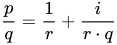
- Choose an integer i such that
q
+
i
p
{\displaystyle {\tfrac {q+i}{p}}}
is an integer r, then write
-
p
q
=
1
r
+
i
r
⋅
q
{\displaystyle {\frac {p}{q}}={\frac {1}{r}}+{\frac {i}{r\cdot q}}}
-
p
q
=
1
r
+
i
r
⋅
q
{\displaystyle {\frac {p}{q}}={\frac {1}{r}}+{\frac {i}{r\cdot q}}}
- and repeat the process for the second term, recursively. (Note that if i is always chosen to be the smallest such integer, this is identical to the greedy algorithm for Egyptian fractions.)
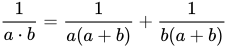
- To express a unit fraction as the sum of two other unit fractions (GSS kalāsavarṇa 85, example in 86):[14]
-
1
n
=
1
p
⋅
n
+
1
p
⋅
n
n
−
1
{\displaystyle {\frac {1}{n}}={\frac {1}{p\cdot n}}+{\frac {1}{\frac {p\cdot n}{n-1}}}}
where p {\displaystyle p}
is to be chosen such that p ⋅ n n − 1 {\displaystyle {\frac {p\cdot n}{n-1}}}
is an integer (for which p {\displaystyle p}
).
-
1
a
⋅
b
=
1
a
(
a
+
b
)
+
1
b
(
a
+
b
)
{\displaystyle {\frac {1}{a\cdot b}}={\frac {1}{a(a+b)}}+{\frac {1}{b(a+b)}}}
-
1
n
=
1
p
⋅
n
+
1
p
⋅
n
n
−
1
{\displaystyle {\frac {1}{n}}={\frac {1}{p\cdot n}}+{\frac {1}{\frac {p\cdot n}{n-1}}}}
- To express a fraction
p
/
q
{\displaystyle p/q}
and b {\displaystyle b}
(GSS kalāsavarṇa 87, example in 88):[14]
-
p
q
=
a
a
i
+
b
p
⋅
q
i
+
b
a
i
+
b
p
⋅
q
i
⋅
i
{\displaystyle {\frac {p}{q}}={\frac {a}{{\frac {ai+b}{p}}\cdot {\frac {q}{i}}}}+{\frac {b}{{\frac {ai+b}{p}}\cdot {\frac {q}{i}}\cdot {i}}}}
where i {\displaystyle i}
is to be chosen such that p {\displaystyle p}
-
p
q
=
a
a
i
+
b
p
⋅
q
i
+
b
a
i
+
b
p
⋅
q
i
⋅
i
{\displaystyle {\frac {p}{q}}={\frac {a}{{\frac {ai+b}{p}}\cdot {\frac {q}{i}}}}+{\frac {b}{{\frac {ai+b}{p}}\cdot {\frac {q}{i}}\cdot {i}}}}

Some further rules were given in the Gaṇita-kaumudi of Nārāyaṇa in the 14th century.[14]
See also
Notes
- Pingree 1970.
- O'Connor & Robertson 2000.
- Tabak 2009, p. 42.
- Puttaswamy 2012, p. 231.
- The Math Book: From Pythagoras to the 57th Dimension, 250 Milestones in the ... by Clifford A. Pickover: page 88
- Algebra: Sets, Symbols, and the Language of Thought by John Tabak: p.43
- Geometry in Ancient and Medieval India by T. A. Sarasvati Amma: page 122
- Hayashi 2013.
- Census of the Exact Sciences in Sanskrit by David Pingree: page 388
- Tabak 2009, p. 43.
- Krebs 2004, p. 132.
- Selin 2008, p. 1268.
- A Concise History of Science in India (Eds.) D. M. Bose, S. N. Sen and B.V. Subbarayappa. Indian National Science Academy. 15 October 1971. p. 167.
- Kusuba 2004, pp. 497–516
References
- Bibhutibhusan Datta and Avadhesh Narayan Singh (1962). History of Hindu Mathematics: A Source Book.
- Pingree, David (1970). "Mahāvīra". Dictionary of Scientific Biography. New York: Charles Scribner's Sons. ISBN 978-0-684-10114-9. (Available, along with many other entries from other encyclopaedias for other Mahāvīra-s, online.)
- Selin, Helaine (2008), Encyclopaedia of the History of Science, Technology, and Medicine in Non-Western Cultures, Springer, Bibcode:2008ehst.book.....S, ISBN 978-1-4020-4559-2
- Hayashi, Takao (2013), "Mahavira", Encyclopædia Britannica
- O'Connor, John J.; Robertson, Edmund F. (2000), "Mahavira", MacTutor History of Mathematics Archive, University of St Andrews
- Tabak, John (2009), Algebra: Sets, Symbols, and the Language of Thought, Infobase Publishing, ISBN 978-0-8160-6875-3
- Krebs, Robert E. (2004), Groundbreaking Scientific Experiments, Inventions, and Discoveries of the Middle Ages and the Renaissance, Greenwood Publishing Group, ISBN 978-0-313-32433-8
- Puttaswamy, T.K (2012), Mathematical Achievements of Pre-modern Indian Mathematicians, Newnes, ISBN 978-0-12-397938-4
- Kusuba, Takanori (2004), "Indian Rules for the Decomposition of Fractions", in Charles Burnett; Jan P. Hogendijk; Kim Plofker; et al. (eds.), Studies in the History of the Exact Sciences in Honour of David Pingree, Brill, ISBN 9004132023, ISSN 0169-8729