
A circular sector, also known as circle sector or disk sector or simply a sector (symbol: ⌔), is the portion of a disk (a closed region bounded by a circle) enclosed by two radii and an arc, with the smaller area being known as the minor sector and the larger being the major sector.[1] In the diagram, θ is the central angle, r the radius of the circle, and L is the arc length of the minor sector.
Types
A sector with the central angle of 180° is called a half-disk and is bounded by a diameter and a semicircle. Sectors with other central angles are sometimes given special names, such as quadrants (90°), sextants (60°), and octants (45°), which come from the sector being one quarter, sixth or eighth part of a full circle, respectively.
Area
The total area of a circle is πr2.
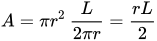
The area of a sector in terms of L can be obtained by multiplying the total area πr2 by the ratio of L to the total perimeter 2πr.
A
=
π
r
2
L
2
π
r
=
r
L
2
{\displaystyle A=\pi r^{2}\,{\frac {L}{2\pi r}}={\frac {rL}{2}}}
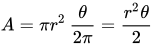

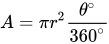
Converting the central angle into degrees gives[2]
A
=
π
r
2
θ
∘
360
∘
{\displaystyle A=\pi r^{2}{\frac {\theta ^{\circ }}{360^{\circ }}}}
Arc length
The formula for the length of an arc is:[3]
L
=
r
θ
{\displaystyle L=r\theta }

If the value of angle is given in degrees, then we can also use the following formula by:[5]
L
=
2
π
r
θ
360
∘
{\displaystyle L=2\pi r{\frac {\theta }{360^{\circ }}}}

Perimeter
The length of the perimeter of a sector is the sum of the arc length and the two radii:
P
=
L
+
2
r
=
θ
r
+
2
r
=
r
(
θ
+
2
)
{\displaystyle P=L+2r=\theta r+2r=r(\theta +2)}

Chord length
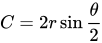
The length of a chord formed with the extremal points of the arc is given by
C
=
2
r
sin
θ
2
{\displaystyle C=2r\sin {\frac {\theta }{2}}}
See also
- Circular segment – the part of the sector which remains after removing the triangle formed by the center of the circle and the two endpoints of the circular arc on the boundary.
- Circle-circle intersection
- Conic section
- Earth quadrant
- Hyperbolic sector
- Sector of (mathematics)
- Spherical sector – the analogous 3D figure
- Spherical wedge – another 3D generalization
References
- Dewan, Rajesh K. (2016). Saraswati Mathematics. New Delhi: New Saraswati House India Pvt Ltd. p. 234. ISBN 978-8173358371.
- Uppal, Shveta (2019). Mathematics: Textbook for class X. New Delhi: National Council of Educational Research and Training. pp. 226, 227. ISBN 978-81-7450-634-4. OCLC 1145113954.
- Larson, Ron; Edwards, Bruce H. (2002). Calculus I with Precalculus (3rd ed.). Boston, MA.: Brooks/Cole. p. 570. ISBN 978-0-8400-6833-0. OCLC 706621772.
- Wicks, Alan (2004). Mathematics Standard Level for the International Baccalaureate : a text for the new syllabus. West Conshohocken, PA: Infinity Publishing.com. p. 79. ISBN 0-7414-2141-0. OCLC 58869667.
- Uppal (2019).
Sources
- Gerard, L. J. V. (1874). The Elements of Geometry, in Eight Books; or, First Step in Applied Logic. London: Longmans, Green, Reader and Dyer. p. 285.
- Legendre, Adrien-Marie (1858). Davies, Charles (ed.). Elements of Geometry and Trigonometry. New York: A. S. Barnes & Co. p. 119.