The pseudo-Hadamard transform is a reversible transformation of a bit string that provides cryptographic diffusion. See Hadamard transform.
The bit string must be of even length so that it can be split into two bit strings a and b of equal lengths, each of n bits. To compute the transform for Twofish algorithm, a' and b', from these we use the equations:
-
a
′
=
a
+
b
(
mod
2
n
)
{\displaystyle a'=a+b\,{\pmod {2^{n}}}}

-
b
′
=
a
+
2
b
(
mod
2
n
)
{\displaystyle b'=a+2b\,{\pmod {2^{n}}}}

To reverse this, clearly:
-
b
=
b
′
−
a
′
(
mod
2
n
)
{\displaystyle b=b'-a'\,{\pmod {2^{n}}}}

-
a
=
2
a
′
−
b
′
(
mod
2
n
)
{\displaystyle a=2a'-b'\,{\pmod {2^{n}}}}

On the other hand, the transformation for SAFER+ encryption is as follows:
-
a
′
=
2
a
+
b
(
mod
2
n
)
{\displaystyle a'=2a+b\,{\pmod {2^{n}}}}

-
b
′
=
a
+
b
(
mod
2
n
)
{\displaystyle b'=a+b\,{\pmod {2^{n}}}}

Generalization
The above equations can be expressed in matrix algebra, by considering a and b as two elements of a vector, and the transform itself as multiplication by a matrix of the form:
-
H
1
=
[
2
1
1
1
]
{\displaystyle H_{1}={\begin{bmatrix}2&1\\1&1\end{bmatrix}}}
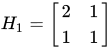
The inverse can then be derived by inverting the matrix.
However, the matrix can be generalised to higher dimensions, allowing vectors of any power-of-two size to be transformed, using the following recursive rule:
-
H
n
=
[
2
×
H
n
−
1
H
n
−
1
H
n
−
1
H
n
−
1
]
{\displaystyle H_{n}={\begin{bmatrix}2\times H_{n-1}&H_{n-1}\\H_{n-1}&H_{n-1}\end{bmatrix}}}

For example:
-
H
2
=
[
4
2
2
1
2
2
1
1
2
1
2
1
1
1
1
1
]
{\displaystyle H_{2}={\begin{bmatrix}4&2&2&1\\2&2&1&1\\2&1&2&1\\1&1&1&1\end{bmatrix}}}

See also
This is the Kronecker product of an Arnold Cat Map matrix with a Hadamard matrix.
References
- James Massey, "On the Optimality of SAFER+ Diffusion", 2nd AES Conference, 1999.
- Bruce Schneier, John Kelsey, Doug Whiting, David Wagner, Chris Hall, "Twofish: A 128-Bit Block Cipher", 1998.
- Helger Lipmaa. On Differential Properties of Pseudo-Hadamard Transform and Related Mappings. INDOCRYPT 2002, LNCS 2551, pp 48-61, 2002.