Raikov's theorem

☆ Save On Wikipedia ↗

Raikov’s theorem, named for Russian mathematician Dmitrii Abramovich Raikov, is a result in the probability theory. It is well known that if each of two independent random variables ξ 1 {\displaystyle \xi _{1}} {\displaystyle \xi _{1}} and ξ 2 {\displaystyle \xi _{2}} {\displaystyle \xi _{2}} has a Poisson distribution, then their sum ξ = ξ 1 + ξ 2 {\displaystyle \xi =\xi _{1}+\xi _{2}} {\displaystyle \xi =\xi _{1}+\xi _{2}} has a Poisson distribution as well. It turns out that the converse is also valid.[1]

Statement of the theorem

Suppose that a random variable ξ {\displaystyle \xi } {\displaystyle \xi } has a Poisson distribution and admits a decomposition as a sum ξ = ξ 1 + ξ 2 {\displaystyle \xi =\xi _{1}+\xi _{2}} {\displaystyle \xi =\xi _{1}+\xi _{2}} of two independent random variables. Then the distribution of each summand is a shifted Poisson distribution.

Raikov's theorem is similar to Cramér’s decomposition theorem. The latter result claims that if a sum of two independent random variables has a normal distribution, then each summand is normally distributed as well. It was also proved by Yu. V. Linnik that a convolution of normal distribution and Poisson's distribution possesses a similar property (Linnik's theorem).

An extension to locally compact Abelian groups

Let X {\displaystyle X} {\displaystyle X} be a locally compact Abelian group. Denote by M 1 ( X ) {\displaystyle M^{1}(X)} {\displaystyle M^{1}(X)} the convolution semigroup of probability distributions on X {\displaystyle X} {\displaystyle X}, and by E x {\displaystyle E_{x}} {\displaystyle E_{x}}the degenerate distribution concentrated at x ∈ X {\displaystyle x\in X} {\displaystyle x\in X}. Let x 0 ∈ X , λ > 0 {\displaystyle x_{0}\in X,\lambda >0} {\displaystyle x_{0}\in X,\lambda >0}.

The Poisson distribution generated by the measure λ E x 0 {\displaystyle \lambda E_{x_{0}}} {\displaystyle \lambda E_{x_{0}}} is defined as a distribution of the form

μ = e ( λ E x 0 ) = e − λ ( E 0 + λ E x 0 + λ 2 E 2 x 0 2 ! + ⋯ + λ n E n x 0 n ! + ⋯ ) . {\displaystyle \mu =e(\lambda E_{x_{0}})=e^{-\lambda }\left(E_{0}+\lambda E_{x_{0}}+{\frac {\lambda ^{2}E_{2x_{0}}}{2!}}+\cdots +{\frac {\lambda ^{n}E_{nx_{0}}}{n!}}+\cdots \right).} {\displaystyle \mu =e(\lambda E_{x_{0}})=e^{-\lambda }\left(E_{0}+\lambda E_{x_{0}}+{\frac {\lambda ^{2}E_{2x_{0}}}{2!}}+\cdots +{\frac {\lambda ^{n}E_{nx_{0}}}{n!}}+\cdots \right).}

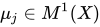
Theorem[2] Let μ {\displaystyle \mu } {\displaystyle \mu } be the Poisson distribution generated by the measure λ E x 0 {\displaystyle \lambda E_{x_{0}}} {\displaystyle \lambda E_{x_{0}}}. Suppose that μ = μ 1 ∗ μ 2 {\displaystyle \mu =\mu _{1}*\mu _{2}} {\displaystyle \mu =\mu _{1}*\mu _{2}}, with μ j ∈ M 1 ( X ) {\displaystyle \mu _{j}\in M^{1}(X)} {\displaystyle \mu _{j}\in M^{1}(X)}. Then each of μ j {\displaystyle \mu _{j}} {\displaystyle \mu _{j}} is a shift of a Poisson distribution if and only if x 0 {\displaystyle x_{0}} {\displaystyle x_{0}} is either an infinite-order element or has order 2.

References

  1. Raikov, D. A. (1937). "On the decomposition of Poisson laws". Doklady Akademii Nauk SSSR. 14: 9–12.
  2. Rukhin, A. L. (1970). "Certain statistical and probability problems on groups". Proceedings of the Steklov Institute of Mathematics. 111: 59–129.