In number theory, Ramanujan's sum, usually denoted cq(n), is a function of two positive integer variables q and n defined by the formula
-
c
q
(
n
)
=
∑
1
≤
a
≤
q
(
a
,
q
)
=
1
e
2
π
i
a
q
n
,
{\displaystyle c_{q}(n)=\sum _{1\leq a\leq q \atop (a,q)=1}e^{2\pi i{\tfrac {a}{q}}n},}
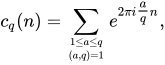
where (a, q) = 1 means that a only takes on values coprime to q.
Srinivasa Ramanujan mentioned the sums in a 1918 paper.[1] In addition to the expansions discussed in this article, Ramanujan's sums are used in the proof of Vinogradov's theorem that every sufficiently large odd number is the sum of three primes.[2]
Notation
For integers a and b,
a
∣
b
{\displaystyle a\mid b}


-
∑
d
∣
m
f
(
d
)
{\displaystyle \sum _{d\,\mid \,m}f(d)}

means that d goes through all the positive divisors of m, e.g.
-
∑
d
∣
12
f
(
d
)
=
f
(
1
)
+
f
(
2
)
+
f
(
3
)
+
f
(
4
)
+
f
(
6
)
+
f
(
12
)
.
{\displaystyle \sum _{d\,\mid \,12}f(d)=f(1)+f(2)+f(3)+f(4)+f(6)+f(12).}

(
a
,
b
)
{\displaystyle (a,\,b)}

ϕ
(
n
)
{\displaystyle \phi (n)}

μ
(
n
)
{\displaystyle \mu (n)}

ζ
(
s
)
{\displaystyle \zeta (s)}

Formulas for cq(n)
Trigonometry
These formulas come from the definition, Euler's formula
e
i
x
=
cos
x
+
i
sin
x
,
{\displaystyle e^{ix}=\cos x+i\sin x,}

-
c
1
(
n
)
=
1
c
2
(
n
)
=
cos
n
π
c
3
(
n
)
=
2
cos
2
3
n
π
c
4
(
n
)
=
2
cos
1
2
n
π
c
5
(
n
)
=
2
cos
2
5
n
π
+
2
cos
4
5
n
π
c
6
(
n
)
=
2
cos
1
3
n
π
c
7
(
n
)
=
2
cos
2
7
n
π
+
2
cos
4
7
n
π
+
2
cos
6
7
n
π
c
8
(
n
)
=
2
cos
1
4
n
π
+
2
cos
3
4
n
π
c
9
(
n
)
=
2
cos
2
9
n
π
+
2
cos
4
9
n
π
+
2
cos
8
9
n
π
c
10
(
n
)
=
2
cos
1
5
n
π
+
2
cos
3
5
n
π
{\displaystyle {\begin{aligned}c_{1}(n)&=1\\c_{2}(n)&=\cos n\pi \\c_{3}(n)&=2\cos {\tfrac {2}{3}}n\pi \\c_{4}(n)&=2\cos {\tfrac {1}{2}}n\pi \\c_{5}(n)&=2\cos {\tfrac {2}{5}}n\pi +2\cos {\tfrac {4}{5}}n\pi \\c_{6}(n)&=2\cos {\tfrac {1}{3}}n\pi \\c_{7}(n)&=2\cos {\tfrac {2}{7}}n\pi +2\cos {\tfrac {4}{7}}n\pi +2\cos {\tfrac {6}{7}}n\pi \\c_{8}(n)&=2\cos {\tfrac {1}{4}}n\pi +2\cos {\tfrac {3}{4}}n\pi \\c_{9}(n)&=2\cos {\tfrac {2}{9}}n\pi +2\cos {\tfrac {4}{9}}n\pi +2\cos {\tfrac {8}{9}}n\pi \\c_{10}(n)&=2\cos {\tfrac {1}{5}}n\pi +2\cos {\tfrac {3}{5}}n\pi \\\end{aligned}}}
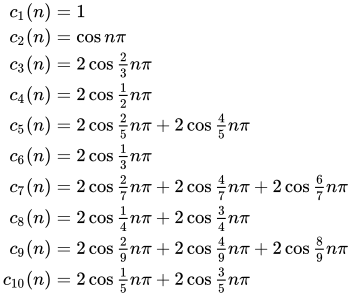
and so on (OEIS: A000012, OEIS: A033999, OEIS: A099837, OEIS: A176742,.., OEIS: A100051,...). cq(n) is always an integer.
Kluyver
Let
ζ
q
=
e
2
π
i
q
.
{\displaystyle \zeta _{q}=e^{\frac {2\pi i}{q}}.}

-
ζ
q
,
ζ
q
2
,
…
,
ζ
q
q
−
1
,
ζ
q
q
=
ζ
q
0
=
1
{\displaystyle \zeta _{q},\zeta _{q}^{2},\ldots ,\zeta _{q}^{q-1},\zeta _{q}^{q}=\zeta _{q}^{0}=1}

is also a root. Therefore, since there are q of them, they are all of the roots. The numbers
ζ
q
n
{\displaystyle \zeta _{q}^{n}}


Thus, the Ramanujan sum cq(n) is the sum of the n-th powers of the primitive q-th roots of unity.
It is a fact[3] that the powers of ζq are precisely the primitive roots for all the divisors of q.
Example. Let q = 12. Then
-
ζ
12
,
ζ
12
5
,
ζ
12
7
,
{\displaystyle \zeta _{12},\zeta _{12}^{5},\zeta _{12}^{7},}
and ζ 12 11 {\displaystyle \zeta _{12}^{11}}
are the primitive twelfth roots of unity,
-
ζ
12
2
{\displaystyle \zeta _{12}^{2}}
and ζ 12 10 {\displaystyle \zeta _{12}^{10}}
are the primitive sixth roots of unity,
-
ζ
12
3
=
i
{\displaystyle \zeta _{12}^{3}=i}
and ζ 12 9 = − i {\displaystyle \zeta _{12}^{9}=-i}
are the primitive fourth roots of unity,
-
ζ
12
4
{\displaystyle \zeta _{12}^{4}}
and ζ 12 8 {\displaystyle \zeta _{12}^{8}}
are the primitive third roots of unity,
-
ζ
12
6
=
−
1
{\displaystyle \zeta _{12}^{6}=-1}
is the primitive second root of unity, and
-
ζ
12
12
=
1
{\displaystyle \zeta _{12}^{12}=1}
is the primitive first root of unity.
Therefore, if
-
η
q
(
n
)
=
∑
k
=
1
q
ζ
q
k
n
{\displaystyle \eta _{q}(n)=\sum _{k=1}^{q}\zeta _{q}^{kn}}
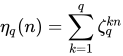
is the sum of the n-th powers of all the roots, primitive and imprimitive,
-
η
q
(
n
)
=
∑
d
∣
q
c
d
(
n
)
,
{\displaystyle \eta _{q}(n)=\sum _{d\mid q}c_{d}(n),}
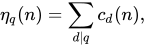
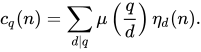
and by Möbius inversion,
-
c
q
(
n
)
=
∑
d
∣
q
μ
(
q
d
)
η
d
(
n
)
.
{\displaystyle c_{q}(n)=\sum _{d\mid q}\mu \left({\frac {q}{d}}\right)\eta _{d}(n).}
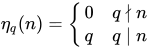
It follows from the identity xq − 1 = (x − 1)(xq−1 + xq−2 + ... + x + 1) that
-
η
q
(
n
)
=
{
0
q
∤
n
q
q
∣
n
{\displaystyle \eta _{q}(n)={\begin{cases}0&q\nmid n\\q&q\mid n\\\end{cases}}}
and this leads to the formula
-
c
q
(
n
)
=
∑
d
∣
(
q
,
n
)
μ
(
q
d
)
d
,
{\displaystyle c_{q}(n)=\sum _{d\mid (q,n)}\mu \left({\frac {q}{d}}\right)d,}
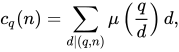
published by Kluyver in 1906.[4]
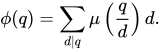
This shows that cq(n) is always an integer. Compare it with the formula
-
ϕ
(
q
)
=
∑
d
∣
q
μ
(
q
d
)
d
.
{\displaystyle \phi (q)=\sum _{d\mid q}\mu \left({\frac {q}{d}}\right)d.}
von Sterneck
It is easily shown from the definition that cq(n) is multiplicative when considered as a function of q for a fixed value of n:[5] i.e.
-
If
(
q
,
r
)
=
1
then
c
q
(
n
)
c
r
(
n
)
=
c
q
r
(
n
)
.
{\displaystyle {\mbox{If }}\;(q,r)=1\;{\mbox{ then }}\;c_{q}(n)c_{r}(n)=c_{qr}(n).}

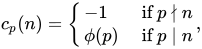
From the definition (or Kluyver's formula) it is straightforward to prove that, if p is a prime number,
-
c
p
(
n
)
=
{
−
1
if
p
∤
n
ϕ
(
p
)
if
p
∣
n
,
{\displaystyle c_{p}(n)={\begin{cases}-1&{\mbox{ if }}p\nmid n\\\phi (p)&{\mbox{ if }}p\mid n\\\end{cases}},}
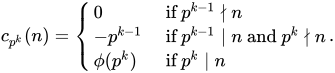
and if pk is a prime power where k > 1,
-
c
p
k
(
n
)
=
{
0
if
p
k
−
1
∤
n
−
p
k
−
1
if
p
k
−
1
∣
n
and
p
k
∤
n
ϕ
(
p
k
)
if
p
k
∣
n
.
{\displaystyle c_{p^{k}}(n)={\begin{cases}0&{\mbox{ if }}p^{k-1}\nmid n\\-p^{k-1}&{\mbox{ if }}p^{k-1}\mid n{\mbox{ and }}p^{k}\nmid n\\\phi (p^{k})&{\mbox{ if }}p^{k}\mid n\\\end{cases}}.}
This result and the multiplicative property can be used to prove
-
c
q
(
n
)
=
μ
(
q
(
q
,
n
)
)
ϕ
(
q
)
ϕ
(
q
(
q
,
n
)
)
.
{\displaystyle c_{q}(n)=\mu \left({\frac {q}{(q,n)}}\right){\frac {\phi (q)}{\phi \left({\frac {q}{(q,n)}}\right)}}.}
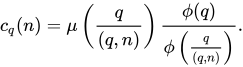
This is called von Sterneck's arithmetic function.[6] The equivalence of it and Ramanujan's sum is due to Hölder.[7][8]
Other properties of cq(n)
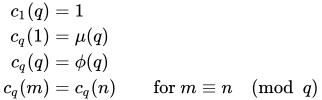
For all positive integers q,
-
c
1
(
q
)
=
1
c
q
(
1
)
=
μ
(
q
)
c
q
(
q
)
=
ϕ
(
q
)
c
q
(
m
)
=
c
q
(
n
)
for
m
≡
n
(
mod
q
)
{\displaystyle {\begin{aligned}c_{1}(q)&=1\\c_{q}(1)&=\mu (q)\\c_{q}(q)&=\phi (q)\\c_{q}(m)&=c_{q}(n)&&{\text{for }}m\equiv n{\pmod {q}}\\\end{aligned}}}
For a fixed value of q the absolute value of the sequence
{
c
q
(
1
)
,
c
q
(
2
)
,
…
}
{\displaystyle \{c_{q}(1),c_{q}(2),\ldots \}}


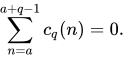
If q > 1
-
∑
n
=
a
a
+
q
−
1
c
q
(
n
)
=
0.
{\displaystyle \sum _{n=a}^{a+q-1}c_{q}(n)=0.}
Let m1, m2 > 0, m = lcm(m1, m2). Then[9] Ramanujan's sums satisfy an orthogonality property:
-
1
m
∑
k
=
1
m
c
m
1
(
k
)
c
m
2
(
k
)
=
{
ϕ
(
m
)
m
1
=
m
2
=
m
,
0
otherwise
{\displaystyle {\frac {1}{m}}\sum _{k=1}^{m}c_{m_{1}}(k)c_{m_{2}}(k)={\begin{cases}\phi (m)&m_{1}=m_{2}=m,\\0&{\text{otherwise}}\end{cases}}}

Let n, k > 0. Then[10]
-
∑
gcd
(
d
,
k
)
=
1
d
∣
n
d
μ
(
n
d
)
ϕ
(
d
)
=
μ
(
n
)
c
n
(
k
)
ϕ
(
n
)
,
{\displaystyle \sum _{\stackrel {d\mid n}{\gcd(d,k)=1}}d\;{\frac {\mu ({\tfrac {n}{d}})}{\phi (d)}}={\frac {\mu (n)c_{n}(k)}{\phi (n)}},}
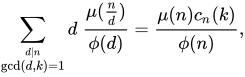
known as the Brauer - Rademacher identity.
If n > 0 and a is any integer, we also have[11]
-
∑
gcd
(
k
,
n
)
=
1
1
≤
k
≤
n
c
n
(
k
−
a
)
=
μ
(
n
)
c
n
(
a
)
,
{\displaystyle \sum _{\stackrel {1\leq k\leq n}{\gcd(k,n)=1}}c_{n}(k-a)=\mu (n)c_{n}(a),}
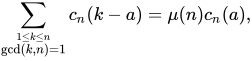
due to Cohen.
Table
| n | |||||||||||||||||||||||||||||||
|---|---|---|---|---|---|---|---|---|---|---|---|---|---|---|---|---|---|---|---|---|---|---|---|---|---|---|---|---|---|---|---|
| 1 | 2 | 3 | 4 | 5 | 6 | 7 | 8 | 9 | 10 | 11 | 12 | 13 | 14 | 15 | 16 | 17 | 18 | 19 | 20 | 21 | 22 | 23 | 24 | 25 | 26 | 27 | 28 | 29 | 30 | ||
| s | 1 | 1 | 1 | 1 | 1 | 1 | 1 | 1 | 1 | 1 | 1 | 1 | 1 | 1 | 1 | 1 | 1 | 1 | 1 | 1 | 1 | 1 | 1 | 1 | 1 | 1 | 1 | 1 | 1 | 1 | 1 |
| 2 | −1 | 1 | −1 | 1 | −1 | 1 | −1 | 1 | −1 | 1 | −1 | 1 | −1 | 1 | −1 | 1 | −1 | 1 | −1 | 1 | −1 | 1 | −1 | 1 | −1 | 1 | −1 | 1 | −1 | 1 | |
| 3 | −1 | −1 | 2 | −1 | −1 | 2 | −1 | −1 | 2 | −1 | −1 | 2 | −1 | −1 | 2 | −1 | −1 | 2 | −1 | −1 | 2 | −1 | −1 | 2 | −1 | −1 | 2 | −1 | −1 | 2 | |
| 4 | 0 | −2 | 0 | 2 | 0 | −2 | 0 | 2 | 0 | −2 | 0 | 2 | 0 | −2 | 0 | 2 | 0 | −2 | 0 | 2 | 0 | −2 | 0 | 2 | 0 | −2 | 0 | 2 | 0 | −2 | |
| 5 | −1 | −1 | −1 | −1 | 4 | −1 | −1 | −1 | −1 | 4 | −1 | −1 | −1 | −1 | 4 | −1 | −1 | −1 | −1 | 4 | −1 | −1 | −1 | −1 | 4 | −1 | −1 | −1 | −1 | 4 | |
| 6 | 1 | −1 | −2 | −1 | 1 | 2 | 1 | −1 | −2 | −1 | 1 | 2 | 1 | −1 | −2 | −1 | 1 | 2 | 1 | −1 | −2 | −1 | 1 | 2 | 1 | −1 | −2 | −1 | 1 | 2 | |
| 7 | −1 | −1 | −1 | −1 | −1 | −1 | 6 | −1 | −1 | −1 | −1 | −1 | −1 | 6 | −1 | −1 | −1 | −1 | −1 | −1 | 6 | −1 | −1 | −1 | −1 | −1 | −1 | 6 | −1 | −1 | |
| 8 | 0 | 0 | 0 | −4 | 0 | 0 | 0 | 4 | 0 | 0 | 0 | −4 | 0 | 0 | 0 | 4 | 0 | 0 | 0 | −4 | 0 | 0 | 0 | 4 | 0 | 0 | 0 | −4 | 0 | 0 | |
| 9 | 0 | 0 | −3 | 0 | 0 | −3 | 0 | 0 | 6 | 0 | 0 | −3 | 0 | 0 | −3 | 0 | 0 | 6 | 0 | 0 | −3 | 0 | 0 | −3 | 0 | 0 | 6 | 0 | 0 | −3 | |
| 10 | 1 | −1 | 1 | −1 | −4 | −1 | 1 | −1 | 1 | 4 | 1 | −1 | 1 | −1 | −4 | −1 | 1 | −1 | 1 | 4 | 1 | −1 | 1 | −1 | −4 | −1 | 1 | −1 | 1 | 4 | |
| 11 | −1 | −1 | −1 | −1 | −1 | −1 | −1 | −1 | −1 | −1 | 10 | −1 | −1 | −1 | −1 | −1 | −1 | −1 | −1 | −1 | −1 | 10 | −1 | −1 | −1 | −1 | −1 | −1 | −1 | −1 | |
| 12 | 0 | 2 | 0 | −2 | 0 | −4 | 0 | −2 | 0 | 2 | 0 | 4 | 0 | 2 | 0 | −2 | 0 | −4 | 0 | −2 | 0 | 2 | 0 | 4 | 0 | 2 | 0 | −2 | 0 | −4 | |
| 13 | −1 | −1 | −1 | −1 | −1 | −1 | −1 | −1 | −1 | −1 | −1 | −1 | 12 | −1 | −1 | −1 | −1 | −1 | −1 | −1 | −1 | −1 | −1 | −1 | −1 | 12 | −1 | −1 | −1 | −1 | |
| 14 | 1 | −1 | 1 | −1 | 1 | −1 | −6 | −1 | 1 | −1 | 1 | −1 | 1 | 6 | 1 | −1 | 1 | −1 | 1 | −1 | −6 | −1 | 1 | −1 | 1 | −1 | 1 | 6 | 1 | −1 | |
| 15 | 1 | 1 | −2 | 1 | −4 | −2 | 1 | 1 | −2 | −4 | 1 | −2 | 1 | 1 | 8 | 1 | 1 | −2 | 1 | −4 | −2 | 1 | 1 | −2 | −4 | 1 | −2 | 1 | 1 | 8 | |
| 16 | 0 | 0 | 0 | 0 | 0 | 0 | 0 | −8 | 0 | 0 | 0 | 0 | 0 | 0 | 0 | 8 | 0 | 0 | 0 | 0 | 0 | 0 | 0 | −8 | 0 | 0 | 0 | 0 | 0 | 0 | |
| 17 | −1 | −1 | −1 | −1 | −1 | −1 | −1 | −1 | −1 | −1 | −1 | −1 | −1 | −1 | −1 | −1 | 16 | −1 | −1 | −1 | −1 | −1 | −1 | −1 | −1 | −1 | −1 | −1 | −1 | −1 | |
| 18 | 0 | 0 | 3 | 0 | 0 | −3 | 0 | 0 | −6 | 0 | 0 | −3 | 0 | 0 | 3 | 0 | 0 | 6 | 0 | 0 | 3 | 0 | 0 | −3 | 0 | 0 | −6 | 0 | 0 | −3 | |
| 19 | −1 | −1 | −1 | −1 | −1 | −1 | −1 | −1 | −1 | −1 | −1 | −1 | −1 | −1 | −1 | −1 | −1 | −1 | 18 | −1 | −1 | −1 | −1 | −1 | −1 | −1 | −1 | −1 | −1 | −1 | |
| 20 | 0 | 2 | 0 | −2 | 0 | 2 | 0 | −2 | 0 | −8 | 0 | −2 | 0 | 2 | 0 | −2 | 0 | 2 | 0 | 8 | 0 | 2 | 0 | −2 | 0 | 2 | 0 | −2 | 0 | −8 | |
| 21 | 1 | 1 | −2 | 1 | 1 | −2 | −6 | 1 | −2 | 1 | 1 | −2 | 1 | −6 | −2 | 1 | 1 | −2 | 1 | 1 | 12 | 1 | 1 | −2 | 1 | 1 | −2 | −6 | 1 | −2 | |
| 22 | 1 | −1 | 1 | −1 | 1 | −1 | 1 | −1 | 1 | −1 | −10 | −1 | 1 | −1 | 1 | −1 | 1 | −1 | 1 | −1 | 1 | 10 | 1 | −1 | 1 | −1 | 1 | −1 | 1 | −1 | |
| 23 | −1 | −1 | −1 | −1 | −1 | −1 | −1 | −1 | −1 | −1 | −1 | −1 | −1 | −1 | −1 | −1 | −1 | −1 | −1 | −1 | −1 | −1 | 22 | −1 | −1 | −1 | −1 | −1 | −1 | −1 | |
| 24 | 0 | 0 | 0 | 4 | 0 | 0 | 0 | −4 | 0 | 0 | 0 | −8 | 0 | 0 | 0 | −4 | 0 | 0 | 0 | 4 | 0 | 0 | 0 | 8 | 0 | 0 | 0 | 4 | 0 | 0 | |
| 25 | 0 | 0 | 0 | 0 | −5 | 0 | 0 | 0 | 0 | −5 | 0 | 0 | 0 | 0 | −5 | 0 | 0 | 0 | 0 | −5 | 0 | 0 | 0 | 0 | 20 | 0 | 0 | 0 | 0 | −5 | |
| 26 | 1 | −1 | 1 | −1 | 1 | −1 | 1 | −1 | 1 | −1 | 1 | −1 | −12 | −1 | 1 | −1 | 1 | −1 | 1 | −1 | 1 | −1 | 1 | −1 | 1 | 12 | 1 | −1 | 1 | −1 | |
| 27 | 0 | 0 | 0 | 0 | 0 | 0 | 0 | 0 | −9 | 0 | 0 | 0 | 0 | 0 | 0 | 0 | 0 | −9 | 0 | 0 | 0 | 0 | 0 | 0 | 0 | 0 | 18 | 0 | 0 | 0 | |
| 28 | 0 | 2 | 0 | −2 | 0 | 2 | 0 | −2 | 0 | 2 | 0 | −2 | 0 | −12 | 0 | −2 | 0 | 2 | 0 | −2 | 0 | 2 | 0 | −2 | 0 | 2 | 0 | 12 | 0 | 2 | |
| 29 | −1 | −1 | −1 | −1 | −1 | −1 | −1 | −1 | −1 | −1 | −1 | −1 | −1 | −1 | −1 | −1 | −1 | −1 | −1 | −1 | −1 | −1 | −1 | −1 | −1 | −1 | −1 | −1 | 28 | −1 | |
| 30 | −1 | 1 | 2 | 1 | 4 | −2 | −1 | 1 | 2 | −4 | −1 | −2 | −1 | 1 | −8 | 1 | −1 | −2 | −1 | −4 | 2 | 1 | −1 | −2 | 4 | 1 | 2 | 1 | −1 | 8 | |
Ramanujan expansions
If f (n) is an arithmetic function (i.e. a complex-valued function of the integers or natural numbers), then a convergent infinite series of the form:
-
f
(
n
)
=
∑
q
=
1
∞
a
q
c
q
(
n
)
{\displaystyle f(n)=\sum _{q=1}^{\infty }a_{q}c_{q}(n)}
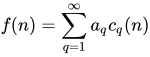
or of the form:
-
f
(
q
)
=
∑
n
=
1
∞
a
n
c
q
(
n
)
{\displaystyle f(q)=\sum _{n=1}^{\infty }a_{n}c_{q}(n)}
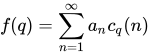
where the ak ∈ C, is called a Ramanujan expansion[12] of f (n).
Ramanujan found expansions of some of the well-known functions of number theory. All of these results are proved in an "elementary" manner (i.e. only using formal manipulations of series and the simplest results about convergence).[13][14][15]
The expansion of the zero function depends on a result from the analytic theory of prime numbers, namely that the series
-
∑
n
=
1
∞
μ
(
n
)
n
{\displaystyle \sum _{n=1}^{\infty }{\frac {\mu (n)}{n}}}

converges to 0, and the results for r(n) and r′(n) depend on theorems in an earlier paper.[16]
All the formulas in this section are from Ramanujan's 1918 paper.
Generating functions
The generating functions of the Ramanujan sums are Dirichlet series:
-
ζ
(
s
)
∑
δ
∣
q
μ
(
q
δ
)
δ
1
−
s
=
∑
n
=
1
∞
c
q
(
n
)
n
s
{\displaystyle \zeta (s)\sum _{\delta \,\mid \,q}\mu \left({\frac {q}{\delta }}\right)\delta ^{1-s}=\sum _{n=1}^{\infty }{\frac {c_{q}(n)}{n^{s}}}}

is a generating function for the sequence cq(1), cq(2), ... where q is kept constant, and
-
σ
r
−
1
(
n
)
n
r
−
1
ζ
(
r
)
=
∑
q
=
1
∞
c
q
(
n
)
q
r
{\displaystyle {\frac {\sigma _{r-1}(n)}{n^{r-1}\zeta (r)}}=\sum _{q=1}^{\infty }{\frac {c_{q}(n)}{q^{r}}}}

is a generating function for the sequence c1(n), c2(n), ... where n is kept constant.
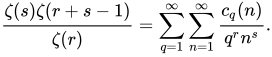
There is also the double Dirichlet series
-
ζ
(
s
)
ζ
(
r
+
s
−
1
)
ζ
(
r
)
=
∑
q
=
1
∞
∑
n
=
1
∞
c
q
(
n
)
q
r
n
s
.
{\displaystyle {\frac {\zeta (s)\zeta (r+s-1)}{\zeta (r)}}=\sum _{q=1}^{\infty }\sum _{n=1}^{\infty }{\frac {c_{q}(n)}{q^{r}n^{s}}}.}
The polynomial with Ramanujan sum's as coefficients can be expressed with cyclotomic polynomial[17]
-
∑
n
=
1
q
c
q
(
n
)
x
n
−
1
=
(
x
q
−
1
)
Φ
q
′
(
x
)
Φ
q
(
x
)
=
Φ
q
′
(
x
)
∏
d
∣
q
d
≠
q
Φ
d
(
x
)
{\displaystyle \sum _{n=1}^{q}c_{q}(n)x^{n-1}=(x^{q}-1){\frac {\Phi _{q}'(x)}{\Phi _{q}(x)}}=\Phi _{q}'(x)\prod _{\begin{array}{c}d\mid q\\[-4pt]d\neq q\end{array}}\Phi _{d}(x)}
![{\displaystyle \sum _{n=1}^{q}c_{q}(n)x^{n-1}=(x^{q}-1){\frac {\Phi _{q}'(x)}{\Phi _{q}(x)}}=\Phi _{q}'(x)\prod _{\begin{array}{c}d\mid q\\[-4pt]d\neq q\end{array}}\Phi _{d}(x)}](https://wikimedia.org/api/rest_v1/media/math/render/svg/04fbd2b895e28864e08c6f7c4f2a1eabdb66c1f1)
σk(n)
σk(n) is the divisor function (i.e. the sum of the k-th powers of the divisors of n, including 1 and n). σ0(n), the number of divisors of n, is usually written d(n) and σ1(n), the sum of the divisors of n, is usually written σ(n).
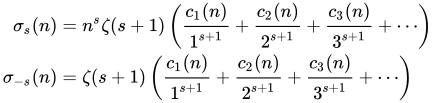
If s > 0,
-
σ
s
(
n
)
=
n
s
ζ
(
s
+
1
)
(
c
1
(
n
)
1
s
+
1
+
c
2
(
n
)
2
s
+
1
+
c
3
(
n
)
3
s
+
1
+
⋯
)
σ
−
s
(
n
)
=
ζ
(
s
+
1
)
(
c
1
(
n
)
1
s
+
1
+
c
2
(
n
)
2
s
+
1
+
c
3
(
n
)
3
s
+
1
+
⋯
)
{\displaystyle {\begin{aligned}\sigma _{s}(n)&=n^{s}\zeta (s+1)\left({\frac {c_{1}(n)}{1^{s+1}}}+{\frac {c_{2}(n)}{2^{s+1}}}+{\frac {c_{3}(n)}{3^{s+1}}}+\cdots \right)\\\sigma _{-s}(n)&=\zeta (s+1)\left({\frac {c_{1}(n)}{1^{s+1}}}+{\frac {c_{2}(n)}{2^{s+1}}}+{\frac {c_{3}(n)}{3^{s+1}}}+\cdots \right)\end{aligned}}}
Setting s = 1 gives
-
σ
(
n
)
=
π
2
6
n
(
c
1
(
n
)
1
+
c
2
(
n
)
4
+
c
3
(
n
)
9
+
⋯
)
.
{\displaystyle \sigma (n)={\frac {\pi ^{2}}{6}}n\left({\frac {c_{1}(n)}{1}}+{\frac {c_{2}(n)}{4}}+{\frac {c_{3}(n)}{9}}+\cdots \right).}

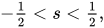
If the Riemann hypothesis is true, and
−
1
2
<
s
<
1
2
,
{\displaystyle -{\tfrac {1}{2}}<s<{\tfrac {1}{2}},}
-
σ
s
(
n
)
=
ζ
(
1
−
s
)
(
c
1
(
n
)
1
1
−
s
+
c
2
(
n
)
2
1
−
s
+
c
3
(
n
)
3
1
−
s
+
⋯
)
=
n
s
ζ
(
1
+
s
)
(
c
1
(
n
)
1
1
+
s
+
c
2
(
n
)
2
1
+
s
+
c
3
(
n
)
3
1
+
s
+
⋯
)
.
{\displaystyle \sigma _{s}(n)=\zeta (1-s)\left({\frac {c_{1}(n)}{1^{1-s}}}+{\frac {c_{2}(n)}{2^{1-s}}}+{\frac {c_{3}(n)}{3^{1-s}}}+\cdots \right)=n^{s}\zeta (1+s)\left({\frac {c_{1}(n)}{1^{1+s}}}+{\frac {c_{2}(n)}{2^{1+s}}}+{\frac {c_{3}(n)}{3^{1+s}}}+\cdots \right).}

d(n)
d(n) = σ0(n) is the number of divisors of n, including 1 and n itself.
-
−
d
(
n
)
=
log
1
1
c
1
(
n
)
+
log
2
2
c
2
(
n
)
+
log
3
3
c
3
(
n
)
+
⋯
−
d
(
n
)
(
2
γ
+
log
n
)
=
log
2
1
1
c
1
(
n
)
+
log
2
2
2
c
2
(
n
)
+
log
2
3
3
c
3
(
n
)
+
⋯
{\displaystyle {\begin{aligned}-d(n)&={\frac {\log 1}{1}}c_{1}(n)+{\frac {\log 2}{2}}c_{2}(n)+{\frac {\log 3}{3}}c_{3}(n)+\cdots \\-d(n)(2\gamma +\log n)&={\frac {\log ^{2}1}{1}}c_{1}(n)+{\frac {\log ^{2}2}{2}}c_{2}(n)+{\frac {\log ^{2}3}{3}}c_{3}(n)+\cdots \end{aligned}}}

where γ = 0.5772... is the Euler–Mascheroni constant.
φ(n)
Euler's totient function φ(n) is the number of positive integers less than n and coprime to n. Ramanujan defines a generalization of it, if
-
n
=
p
1
a
1
p
2
a
2
p
3
a
3
⋯
{\displaystyle n=p_{1}^{a_{1}}p_{2}^{a_{2}}p_{3}^{a_{3}}\cdots }

is the prime factorization of n, and s is a complex number, let
-
φ
s
(
n
)
=
n
s
(
1
−
p
1
−
s
)
(
1
−
p
2
−
s
)
(
1
−
p
3
−
s
)
⋯
,
{\displaystyle \varphi _{s}(n)=n^{s}(1-p_{1}^{-s})(1-p_{2}^{-s})(1-p_{3}^{-s})\cdots ,}

so that φ1(n) = φ(n) is Euler's function.[18]
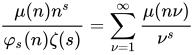
He proves that
-
μ
(
n
)
n
s
φ
s
(
n
)
ζ
(
s
)
=
∑
ν
=
1
∞
μ
(
n
ν
)
ν
s
{\displaystyle {\frac {\mu (n)n^{s}}{\varphi _{s}(n)\zeta (s)}}=\sum _{\nu =1}^{\infty }{\frac {\mu (n\nu )}{\nu ^{s}}}}
and uses this to show that
-
φ
s
(
n
)
ζ
(
s
+
1
)
n
s
=
μ
(
1
)
c
1
(
n
)
φ
s
+
1
(
1
)
+
μ
(
2
)
c
2
(
n
)
φ
s
+
1
(
2
)
+
μ
(
3
)
c
3
(
n
)
φ
s
+
1
(
3
)
+
⋯
.
{\displaystyle {\frac {\varphi _{s}(n)\zeta (s+1)}{n^{s}}}={\frac {\mu (1)c_{1}(n)}{\varphi _{s+1}(1)}}+{\frac {\mu (2)c_{2}(n)}{\varphi _{s+1}(2)}}+{\frac {\mu (3)c_{3}(n)}{\varphi _{s+1}(3)}}+\cdots .}

Letting s = 1,
-
φ
(
n
)
=
6
π
2
n
(
c
1
(
n
)
−
c
2
(
n
)
2
2
−
1
−
c
3
(
n
)
3
2
−
1
−
c
5
(
n
)
5
2
−
1
+
c
6
(
n
)
(
2
2
−
1
)
(
3
2
−
1
)
−
c
7
(
n
)
7
2
−
1
+
c
10
(
n
)
(
2
2
−
1
)
(
5
2
−
1
)
−
⋯
)
.
{\displaystyle \varphi (n)={\frac {6}{\pi ^{2}}}n\left(c_{1}(n)-{\frac {c_{2}(n)}{2^{2}-1}}-{\frac {c_{3}(n)}{3^{2}-1}}-{\frac {c_{5}(n)}{5^{2}-1}}+{\frac {c_{6}(n)}{(2^{2}-1)(3^{2}-1)}}-{\frac {c_{7}(n)}{7^{2}-1}}+{\frac {c_{10}(n)}{(2^{2}-1)(5^{2}-1)}}-\cdots \right).}

Note that the constant is the inverse[19] of the one in the formula for σ(n).
Λ(n)
Von Mangoldt's function Λ(n) = 0 unless n = pk is a power of a prime number, in which case it is the natural logarithm log p.
-
−
Λ
(
m
)
=
c
m
(
1
)
+
1
2
c
m
(
2
)
+
1
3
c
m
(
3
)
+
⋯
{\displaystyle -\Lambda (m)=c_{m}(1)+{\frac {1}{2}}c_{m}(2)+{\frac {1}{3}}c_{m}(3)+\cdots }

Zero
For all n > 0,
-
0
=
c
1
(
n
)
+
1
2
c
2
(
n
)
+
1
3
c
3
(
n
)
+
⋯
.
{\displaystyle 0=c_{1}(n)+{\frac {1}{2}}c_{2}(n)+{\frac {1}{3}}c_{3}(n)+\cdots .}

This is equivalent to the prime number theorem.[20][21]
r2s(n) (sums of squares)
r2s(n) is the number of ways of representing n as the sum of 2s squares, counting different orders and signs as different (e.g., r2(13) = 8, as 13 = (±2)2 + (±3)2 = (±3)2 + (±2)2.)
Ramanujan defines a function δ2s(n) and references a paper[22] in which he proved that r2s(n) = δ2s(n) for s = 1, 2, 3, and 4. For s > 4 he shows that δ2s(n) is a good approximation to r2s(n).
s = 1 has a special formula:
-
δ
2
(
n
)
=
π
(
c
1
(
n
)
1
−
c
3
(
n
)
3
+
c
5
(
n
)
5
−
⋯
)
.
{\displaystyle \delta _{2}(n)=\pi \left({\frac {c_{1}(n)}{1}}-{\frac {c_{3}(n)}{3}}+{\frac {c_{5}(n)}{5}}-\cdots \right).}

In the following formulas the signs repeat with a period of 4.
-
δ
2
s
(
n
)
=
π
s
n
s
−
1
(
s
−
1
)
!
(
c
1
(
n
)
1
s
+
c
4
(
n
)
2
s
+
c
3
(
n
)
3
s
+
c
8
(
n
)
4
s
+
c
5
(
n
)
5
s
+
c
12
(
n
)
6
s
+
c
7
(
n
)
7
s
+
c
16
(
n
)
8
s
+
⋯
)
s
≡
0
(
mod
4
)
δ
2
s
(
n
)
=
π
s
n
s
−
1
(
s
−
1
)
!
(
c
1
(
n
)
1
s
−
c
4
(
n
)
2
s
+
c
3
(
n
)
3
s
−
c
8
(
n
)
4
s
+
c
5
(
n
)
5
s
−
c
12
(
n
)
6
s
+
c
7
(
n
)
7
s
−
c
16
(
n
)
8
s
+
⋯
)
s
≡
2
(
mod
4
)
δ
2
s
(
n
)
=
π
s
n
s
−
1
(
s
−
1
)
!
(
c
1
(
n
)
1
s
+
c
4
(
n
)
2
s
−
c
3
(
n
)
3
s
+
c
8
(
n
)
4
s
+
c
5
(
n
)
5
s
+
c
12
(
n
)
6
s
−
c
7
(
n
)
7
s
+
c
16
(
n
)
8
s
+
⋯
)
s
≡
1
(
mod
4
)
and
s
>
1
δ
2
s
(
n
)
=
π
s
n
s
−
1
(
s
−
1
)
!
(
c
1
(
n
)
1
s
−
c
4
(
n
)
2
s
−
c
3
(
n
)
3
s
−
c
8
(
n
)
4
s
+
c
5
(
n
)
5
s
−
c
12
(
n
)
6
s
−
c
7
(
n
)
7
s
−
c
16
(
n
)
8
s
+
⋯
)
s
≡
3
(
mod
4
)
{\displaystyle {\begin{aligned}\delta _{2s}(n)&={\frac {\pi ^{s}n^{s-1}}{(s-1)!}}\left({\frac {c_{1}(n)}{1^{s}}}+{\frac {c_{4}(n)}{2^{s}}}+{\frac {c_{3}(n)}{3^{s}}}+{\frac {c_{8}(n)}{4^{s}}}+{\frac {c_{5}(n)}{5^{s}}}+{\frac {c_{12}(n)}{6^{s}}}+{\frac {c_{7}(n)}{7^{s}}}+{\frac {c_{16}(n)}{8^{s}}}+\cdots \right)&&s\equiv 0{\pmod {4}}\\[6pt]\delta _{2s}(n)&={\frac {\pi ^{s}n^{s-1}}{(s-1)!}}\left({\frac {c_{1}(n)}{1^{s}}}-{\frac {c_{4}(n)}{2^{s}}}+{\frac {c_{3}(n)}{3^{s}}}-{\frac {c_{8}(n)}{4^{s}}}+{\frac {c_{5}(n)}{5^{s}}}-{\frac {c_{12}(n)}{6^{s}}}+{\frac {c_{7}(n)}{7^{s}}}-{\frac {c_{16}(n)}{8^{s}}}+\cdots \right)&&s\equiv 2{\pmod {4}}\\[6pt]\delta _{2s}(n)&={\frac {\pi ^{s}n^{s-1}}{(s-1)!}}\left({\frac {c_{1}(n)}{1^{s}}}+{\frac {c_{4}(n)}{2^{s}}}-{\frac {c_{3}(n)}{3^{s}}}+{\frac {c_{8}(n)}{4^{s}}}+{\frac {c_{5}(n)}{5^{s}}}+{\frac {c_{12}(n)}{6^{s}}}-{\frac {c_{7}(n)}{7^{s}}}+{\frac {c_{16}(n)}{8^{s}}}+\cdots \right)&&s\equiv 1{\pmod {4}}{\text{ and }}s>1\\[6pt]\delta _{2s}(n)&={\frac {\pi ^{s}n^{s-1}}{(s-1)!}}\left({\frac {c_{1}(n)}{1^{s}}}-{\frac {c_{4}(n)}{2^{s}}}-{\frac {c_{3}(n)}{3^{s}}}-{\frac {c_{8}(n)}{4^{s}}}+{\frac {c_{5}(n)}{5^{s}}}-{\frac {c_{12}(n)}{6^{s}}}-{\frac {c_{7}(n)}{7^{s}}}-{\frac {c_{16}(n)}{8^{s}}}+\cdots \right)&&s\equiv 3{\pmod {4}}\\\end{aligned}}}
![{\displaystyle {\begin{aligned}\delta _{2s}(n)&={\frac {\pi ^{s}n^{s-1}}{(s-1)!}}\left({\frac {c_{1}(n)}{1^{s}}}+{\frac {c_{4}(n)}{2^{s}}}+{\frac {c_{3}(n)}{3^{s}}}+{\frac {c_{8}(n)}{4^{s}}}+{\frac {c_{5}(n)}{5^{s}}}+{\frac {c_{12}(n)}{6^{s}}}+{\frac {c_{7}(n)}{7^{s}}}+{\frac {c_{16}(n)}{8^{s}}}+\cdots \right)&&s\equiv 0{\pmod {4}}\\[6pt]\delta _{2s}(n)&={\frac {\pi ^{s}n^{s-1}}{(s-1)!}}\left({\frac {c_{1}(n)}{1^{s}}}-{\frac {c_{4}(n)}{2^{s}}}+{\frac {c_{3}(n)}{3^{s}}}-{\frac {c_{8}(n)}{4^{s}}}+{\frac {c_{5}(n)}{5^{s}}}-{\frac {c_{12}(n)}{6^{s}}}+{\frac {c_{7}(n)}{7^{s}}}-{\frac {c_{16}(n)}{8^{s}}}+\cdots \right)&&s\equiv 2{\pmod {4}}\\[6pt]\delta _{2s}(n)&={\frac {\pi ^{s}n^{s-1}}{(s-1)!}}\left({\frac {c_{1}(n)}{1^{s}}}+{\frac {c_{4}(n)}{2^{s}}}-{\frac {c_{3}(n)}{3^{s}}}+{\frac {c_{8}(n)}{4^{s}}}+{\frac {c_{5}(n)}{5^{s}}}+{\frac {c_{12}(n)}{6^{s}}}-{\frac {c_{7}(n)}{7^{s}}}+{\frac {c_{16}(n)}{8^{s}}}+\cdots \right)&&s\equiv 1{\pmod {4}}{\text{ and }}s>1\\[6pt]\delta _{2s}(n)&={\frac {\pi ^{s}n^{s-1}}{(s-1)!}}\left({\frac {c_{1}(n)}{1^{s}}}-{\frac {c_{4}(n)}{2^{s}}}-{\frac {c_{3}(n)}{3^{s}}}-{\frac {c_{8}(n)}{4^{s}}}+{\frac {c_{5}(n)}{5^{s}}}-{\frac {c_{12}(n)}{6^{s}}}-{\frac {c_{7}(n)}{7^{s}}}-{\frac {c_{16}(n)}{8^{s}}}+\cdots \right)&&s\equiv 3{\pmod {4}}\\\end{aligned}}}](https://wikimedia.org/api/rest_v1/media/math/render/svg/9c73cbb2db1296446635b8a15015e7b4b6640743)
and therefore,
-
r
2
(
n
)
=
π
(
c
1
(
n
)
1
−
c
3
(
n
)
3
+
c
5
(
n
)
5
−
c
7
(
n
)
7
+
c
11
(
n
)
11
−
c
13
(
n
)
13
+
c
15
(
n
)
15
−
c
17
(
n
)
17
+
⋯
)
r
4
(
n
)
=
π
2
n
(
c
1
(
n
)
1
−
c
4
(
n
)
4
+
c
3
(
n
)
9
−
c
8
(
n
)
16
+
c
5
(
n
)
25
−
c
12
(
n
)
36
+
c
7
(
n
)
49
−
c
16
(
n
)
64
+
⋯
)
r
6
(
n
)
=
π
3
n
2
2
(
c
1
(
n
)
1
−
c
4
(
n
)
8
−
c
3
(
n
)
27
−
c
8
(
n
)
64
+
c
5
(
n
)
125
−
c
12
(
n
)
216
−
c
7
(
n
)
343
−
c
16
(
n
)
512
+
⋯
)
r
8
(
n
)
=
π
4
n
3
6
(
c
1
(
n
)
1
+
c
4
(
n
)
16
+
c
3
(
n
)
81
+
c
8
(
n
)
256
+
c
5
(
n
)
625
+
c
12
(
n
)
1296
+
c
7
(
n
)
2401
+
c
16
(
n
)
4096
+
⋯
)
{\displaystyle {\begin{aligned}r_{2}(n)&=\pi \left({\frac {c_{1}(n)}{1}}-{\frac {c_{3}(n)}{3}}+{\frac {c_{5}(n)}{5}}-{\frac {c_{7}(n)}{7}}+{\frac {c_{11}(n)}{11}}-{\frac {c_{13}(n)}{13}}+{\frac {c_{15}(n)}{15}}-{\frac {c_{17}(n)}{17}}+\cdots \right)\\[6pt]r_{4}(n)&=\pi ^{2}n\left({\frac {c_{1}(n)}{1}}-{\frac {c_{4}(n)}{4}}+{\frac {c_{3}(n)}{9}}-{\frac {c_{8}(n)}{16}}+{\frac {c_{5}(n)}{25}}-{\frac {c_{12}(n)}{36}}+{\frac {c_{7}(n)}{49}}-{\frac {c_{16}(n)}{64}}+\cdots \right)\\[6pt]r_{6}(n)&={\frac {\pi ^{3}n^{2}}{2}}\left({\frac {c_{1}(n)}{1}}-{\frac {c_{4}(n)}{8}}-{\frac {c_{3}(n)}{27}}-{\frac {c_{8}(n)}{64}}+{\frac {c_{5}(n)}{125}}-{\frac {c_{12}(n)}{216}}-{\frac {c_{7}(n)}{343}}-{\frac {c_{16}(n)}{512}}+\cdots \right)\\[6pt]r_{8}(n)&={\frac {\pi ^{4}n^{3}}{6}}\left({\frac {c_{1}(n)}{1}}+{\frac {c_{4}(n)}{16}}+{\frac {c_{3}(n)}{81}}+{\frac {c_{8}(n)}{256}}+{\frac {c_{5}(n)}{625}}+{\frac {c_{12}(n)}{1296}}+{\frac {c_{7}(n)}{2401}}+{\frac {c_{16}(n)}{4096}}+\cdots \right)\end{aligned}}}
![{\displaystyle {\begin{aligned}r_{2}(n)&=\pi \left({\frac {c_{1}(n)}{1}}-{\frac {c_{3}(n)}{3}}+{\frac {c_{5}(n)}{5}}-{\frac {c_{7}(n)}{7}}+{\frac {c_{11}(n)}{11}}-{\frac {c_{13}(n)}{13}}+{\frac {c_{15}(n)}{15}}-{\frac {c_{17}(n)}{17}}+\cdots \right)\\[6pt]r_{4}(n)&=\pi ^{2}n\left({\frac {c_{1}(n)}{1}}-{\frac {c_{4}(n)}{4}}+{\frac {c_{3}(n)}{9}}-{\frac {c_{8}(n)}{16}}+{\frac {c_{5}(n)}{25}}-{\frac {c_{12}(n)}{36}}+{\frac {c_{7}(n)}{49}}-{\frac {c_{16}(n)}{64}}+\cdots \right)\\[6pt]r_{6}(n)&={\frac {\pi ^{3}n^{2}}{2}}\left({\frac {c_{1}(n)}{1}}-{\frac {c_{4}(n)}{8}}-{\frac {c_{3}(n)}{27}}-{\frac {c_{8}(n)}{64}}+{\frac {c_{5}(n)}{125}}-{\frac {c_{12}(n)}{216}}-{\frac {c_{7}(n)}{343}}-{\frac {c_{16}(n)}{512}}+\cdots \right)\\[6pt]r_{8}(n)&={\frac {\pi ^{4}n^{3}}{6}}\left({\frac {c_{1}(n)}{1}}+{\frac {c_{4}(n)}{16}}+{\frac {c_{3}(n)}{81}}+{\frac {c_{8}(n)}{256}}+{\frac {c_{5}(n)}{625}}+{\frac {c_{12}(n)}{1296}}+{\frac {c_{7}(n)}{2401}}+{\frac {c_{16}(n)}{4096}}+\cdots \right)\end{aligned}}}](https://wikimedia.org/api/rest_v1/media/math/render/svg/05f46864626998578e42ff8a6a09e0fc045da146)
r′2s(n) (sums of triangles)
r
2
s
′
(
n
)
{\displaystyle r'_{2s}(n)}

The analysis here is similar to that for squares. Ramanujan refers to the same paper as he did for the squares, where he showed that there is a function
δ
2
s
′
(
n
)
{\displaystyle \delta '_{2s}(n)}



Again, s = 1 requires a special formula:
-
δ
2
′
(
n
)
=
π
4
(
c
1
(
4
n
+
1
)
1
−
c
3
(
4
n
+
1
)
3
+
c
5
(
4
n
+
1
)
5
−
c
7
(
4
n
+
1
)
7
+
⋯
)
.
{\displaystyle \delta '_{2}(n)={\frac {\pi }{4}}\left({\frac {c_{1}(4n+1)}{1}}-{\frac {c_{3}(4n+1)}{3}}+{\frac {c_{5}(4n+1)}{5}}-{\frac {c_{7}(4n+1)}{7}}+\cdots \right).}

If s is a multiple of 4,
-
δ
2
s
′
(
n
)
=
(
π
2
)
s
(
s
−
1
)
!
(
n
+
s
4
)
s
−
1
(
c
1
(
n
+
s
4
)
1
s
+
c
3
(
n
+
s
4
)
3
s
+
c
5
(
n
+
s
4
)
5
s
+
⋯
)
s
≡
0
(
mod
4
)
δ
2
s
′
(
n
)
=
(
π
2
)
s
(
s
−
1
)
!
(
n
+
s
4
)
s
−
1
(
c
1
(
2
n
+
s
2
)
1
s
+
c
3
(
2
n
+
s
2
)
3
s
+
c
5
(
2
n
+
s
2
)
5
s
+
⋯
)
s
≡
2
(
mod
4
)
δ
2
s
′
(
n
)
=
(
π
2
)
s
(
s
−
1
)
!
(
n
+
s
4
)
s
−
1
(
c
1
(
4
n
+
s
)
1
s
−
c
3
(
4
n
+
s
)
3
s
+
c
5
(
4
n
+
s
)
5
s
−
⋯
)
s
≡
1
(
mod
2
)
and
s
>
1
{\displaystyle {\begin{aligned}\delta '_{2s}(n)&={\frac {({\frac {\pi }{2}})^{s}}{(s-1)!}}\left(n+{\frac {s}{4}}\right)^{s-1}\left({\frac {c_{1}(n+{\frac {s}{4}})}{1^{s}}}+{\frac {c_{3}(n+{\frac {s}{4}})}{3^{s}}}+{\frac {c_{5}(n+{\frac {s}{4}})}{5^{s}}}+\cdots \right)&&s\equiv 0{\pmod {4}}\\[6pt]\delta '_{2s}(n)&={\frac {({\frac {\pi }{2}})^{s}}{(s-1)!}}\left(n+{\frac {s}{4}}\right)^{s-1}\left({\frac {c_{1}(2n+{\frac {s}{2}})}{1^{s}}}+{\frac {c_{3}(2n+{\frac {s}{2}})}{3^{s}}}+{\frac {c_{5}(2n+{\frac {s}{2}})}{5^{s}}}+\cdots \right)&&s\equiv 2{\pmod {4}}\\[6pt]\delta '_{2s}(n)&={\frac {({\frac {\pi }{2}})^{s}}{(s-1)!}}\left(n+{\frac {s}{4}}\right)^{s-1}\left({\frac {c_{1}(4n+s)}{1^{s}}}-{\frac {c_{3}(4n+s)}{3^{s}}}+{\frac {c_{5}(4n+s)}{5^{s}}}-\cdots \right)&&s\equiv 1{\pmod {2}}{\text{ and }}s>1\end{aligned}}}
![{\displaystyle {\begin{aligned}\delta '_{2s}(n)&={\frac {({\frac {\pi }{2}})^{s}}{(s-1)!}}\left(n+{\frac {s}{4}}\right)^{s-1}\left({\frac {c_{1}(n+{\frac {s}{4}})}{1^{s}}}+{\frac {c_{3}(n+{\frac {s}{4}})}{3^{s}}}+{\frac {c_{5}(n+{\frac {s}{4}})}{5^{s}}}+\cdots \right)&&s\equiv 0{\pmod {4}}\\[6pt]\delta '_{2s}(n)&={\frac {({\frac {\pi }{2}})^{s}}{(s-1)!}}\left(n+{\frac {s}{4}}\right)^{s-1}\left({\frac {c_{1}(2n+{\frac {s}{2}})}{1^{s}}}+{\frac {c_{3}(2n+{\frac {s}{2}})}{3^{s}}}+{\frac {c_{5}(2n+{\frac {s}{2}})}{5^{s}}}+\cdots \right)&&s\equiv 2{\pmod {4}}\\[6pt]\delta '_{2s}(n)&={\frac {({\frac {\pi }{2}})^{s}}{(s-1)!}}\left(n+{\frac {s}{4}}\right)^{s-1}\left({\frac {c_{1}(4n+s)}{1^{s}}}-{\frac {c_{3}(4n+s)}{3^{s}}}+{\frac {c_{5}(4n+s)}{5^{s}}}-\cdots \right)&&s\equiv 1{\pmod {2}}{\text{ and }}s>1\end{aligned}}}](https://wikimedia.org/api/rest_v1/media/math/render/svg/f201a53880e4c929d3fa3af66848dbdf3bb0d420)
Therefore,
-
r
2
′
(
n
)
=
π
4
(
c
1
(
4
n
+
1
)
1
−
c
3
(
4
n
+
1
)
3
+
c
5
(
4
n
+
1
)
5
−
c
7
(
4
n
+
1
)
7
+
⋯
)
r
4
′
(
n
)
=
(
π
2
)
2
(
n
+
1
2
)
(
c
1
(
2
n
+
1
)
1
+
c
3
(
2
n
+
1
)
9
+
c
5
(
2
n
+
1
)
25
+
⋯
)
r
6
′
(
n
)
=
(
π
2
)
3
2
(
n
+
3
4
)
2
(
c
1
(
4
n
+
3
)
1
−
c
3
(
4
n
+
3
)
27
+
c
5
(
4
n
+
3
)
125
−
⋯
)
r
8
′
(
n
)
=
(
π
2
)
4
6
(
n
+
1
)
3
(
c
1
(
n
+
1
)
1
+
c
3
(
n
+
1
)
81
+
c
5
(
n
+
1
)
625
+
⋯
)
{\displaystyle {\begin{aligned}r'_{2}(n)&={\frac {\pi }{4}}\left({\frac {c_{1}(4n+1)}{1}}-{\frac {c_{3}(4n+1)}{3}}+{\frac {c_{5}(4n+1)}{5}}-{\frac {c_{7}(4n+1)}{7}}+\cdots \right)\\[6pt]r'_{4}(n)&=\left({\frac {\pi }{2}}\right)^{2}\left(n+{\frac {1}{2}}\right)\left({\frac {c_{1}(2n+1)}{1}}+{\frac {c_{3}(2n+1)}{9}}+{\frac {c_{5}(2n+1)}{25}}+\cdots \right)\\[6pt]r'_{6}(n)&={\frac {({\frac {\pi }{2}})^{3}}{2}}\left(n+{\frac {3}{4}}\right)^{2}\left({\frac {c_{1}(4n+3)}{1}}-{\frac {c_{3}(4n+3)}{27}}+{\frac {c_{5}(4n+3)}{125}}-\cdots \right)\\[6pt]r'_{8}(n)&={\frac {({\frac {\pi }{2}})^{4}}{6}}(n+1)^{3}\left({\frac {c_{1}(n+1)}{1}}+{\frac {c_{3}(n+1)}{81}}+{\frac {c_{5}(n+1)}{625}}+\cdots \right)\end{aligned}}}
![{\displaystyle {\begin{aligned}r'_{2}(n)&={\frac {\pi }{4}}\left({\frac {c_{1}(4n+1)}{1}}-{\frac {c_{3}(4n+1)}{3}}+{\frac {c_{5}(4n+1)}{5}}-{\frac {c_{7}(4n+1)}{7}}+\cdots \right)\\[6pt]r'_{4}(n)&=\left({\frac {\pi }{2}}\right)^{2}\left(n+{\frac {1}{2}}\right)\left({\frac {c_{1}(2n+1)}{1}}+{\frac {c_{3}(2n+1)}{9}}+{\frac {c_{5}(2n+1)}{25}}+\cdots \right)\\[6pt]r'_{6}(n)&={\frac {({\frac {\pi }{2}})^{3}}{2}}\left(n+{\frac {3}{4}}\right)^{2}\left({\frac {c_{1}(4n+3)}{1}}-{\frac {c_{3}(4n+3)}{27}}+{\frac {c_{5}(4n+3)}{125}}-\cdots \right)\\[6pt]r'_{8}(n)&={\frac {({\frac {\pi }{2}})^{4}}{6}}(n+1)^{3}\left({\frac {c_{1}(n+1)}{1}}+{\frac {c_{3}(n+1)}{81}}+{\frac {c_{5}(n+1)}{625}}+\cdots \right)\end{aligned}}}](https://wikimedia.org/api/rest_v1/media/math/render/svg/a99651ffc1270d3aa90ff15797090801ad2a5129)
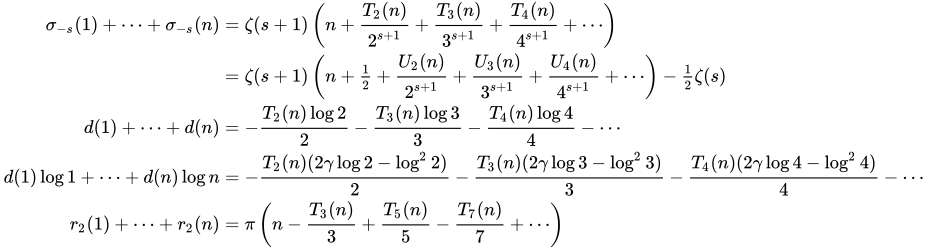
Sums
Let
-
T
q
(
n
)
=
c
q
(
1
)
+
c
q
(
2
)
+
⋯
+
c
q
(
n
)
U
q
(
n
)
=
T
q
(
n
)
+
1
2
ϕ
(
q
)
{\displaystyle {\begin{aligned}T_{q}(n)&=c_{q}(1)+c_{q}(2)+\cdots +c_{q}(n)\\U_{q}(n)&=T_{q}(n)+{\tfrac {1}{2}}\phi (q)\end{aligned}}}

Then for s > 1,
-
σ
−
s
(
1
)
+
⋯
+
σ
−
s
(
n
)
=
ζ
(
s
+
1
)
(
n
+
T
2
(
n
)
2
s
+
1
+
T
3
(
n
)
3
s
+
1
+
T
4
(
n
)
4
s
+
1
+
⋯
)
=
ζ
(
s
+
1
)
(
n
+
1
2
+
U
2
(
n
)
2
s
+
1
+
U
3
(
n
)
3
s
+
1
+
U
4
(
n
)
4
s
+
1
+
⋯
)
−
1
2
ζ
(
s
)
d
(
1
)
+
⋯
+
d
(
n
)
=
−
T
2
(
n
)
log
2
2
−
T
3
(
n
)
log
3
3
−
T
4
(
n
)
log
4
4
−
⋯
d
(
1
)
log
1
+
⋯
+
d
(
n
)
log
n
=
−
T
2
(
n
)
(
2
γ
log
2
−
log
2
2
)
2
−
T
3
(
n
)
(
2
γ
log
3
−
log
2
3
)
3
−
T
4
(
n
)
(
2
γ
log
4
−
log
2
4
)
4
−
⋯
r
2
(
1
)
+
⋯
+
r
2
(
n
)
=
π
(
n
−
T
3
(
n
)
3
+
T
5
(
n
)
5
−
T
7
(
n
)
7
+
⋯
)
{\displaystyle {\begin{aligned}\sigma _{-s}(1)+\cdots +\sigma _{-s}(n)&=\zeta (s+1)\left(n+{\frac {T_{2}(n)}{2^{s+1}}}+{\frac {T_{3}(n)}{3^{s+1}}}+{\frac {T_{4}(n)}{4^{s+1}}}+\cdots \right)\\&=\zeta (s+1)\left(n+{\tfrac {1}{2}}+{\frac {U_{2}(n)}{2^{s+1}}}+{\frac {U_{3}(n)}{3^{s+1}}}+{\frac {U_{4}(n)}{4^{s+1}}}+\cdots \right)-{\tfrac {1}{2}}\zeta (s)\\d(1)+\cdots +d(n)&=-{\frac {T_{2}(n)\log 2}{2}}-{\frac {T_{3}(n)\log 3}{3}}-{\frac {T_{4}(n)\log 4}{4}}-\cdots \\d(1)\log 1+\cdots +d(n)\log n&=-{\frac {T_{2}(n)(2\gamma \log 2-\log ^{2}2)}{2}}-{\frac {T_{3}(n)(2\gamma \log 3-\log ^{2}3)}{3}}-{\frac {T_{4}(n)(2\gamma \log 4-\log ^{2}4)}{4}}-\cdots \\r_{2}(1)+\cdots +r_{2}(n)&=\pi \left(n-{\frac {T_{3}(n)}{3}}+{\frac {T_{5}(n)}{5}}-{\frac {T_{7}(n)}{7}}+\cdots \right)\end{aligned}}}
See also
Notes
- Ramanujan, On Certain Trigonometric Sums ...
These sums are obviously of great interest, and a few of their properties have been discussed already. But, so far as I know, they have never been considered from the point of view which I adopt in this paper; and I believe that all the results which it contains are new.
(Papers, p. 179). In a footnote cites pp. 360–370 of the Dirichlet–Dedekind Vorlesungen über Zahlentheorie, 4th ed. - Nathanson, ch. 8.
- Hardy & Wright, Thms 65, 66
- G. H. Hardy, P. V. Seshu Aiyar, & B. M. Wilson, notes to On certain trigonometrical sums ..., Ramanujan, Papers, p. 343
- Schwarz & Spilken (1994) p.16
- B. Berndt, commentary to On certain trigonometrical sums..., Ramanujan, Papers, p. 371
- Knopfmacher, p. 196
- Hardy & Wright, p. 243
- Tóth, external links, eq. 6
- Tóth, external links, eq. 17.
- Tóth, external links, eq. 8.
- B. Berndt, commentary to On certain trigonometrical sums..., Ramanujan, Papers, pp. 369–371
- Ramanujan, On certain trigonometrical sums...
The majority of my formulae are "elementary" in the technical sense of the word — they can (that is to say) be proved by a combination of processes involving only finite algebra and simple general theorems concerning infinite series
(Papers, p. 179) - The theory of formal Dirichlet series is discussed in Hardy & Wright, § 17.6 and in Knopfmacher.
- Knopfmacher, ch. 7, discusses Ramanujan expansions as a type of Fourier expansion in an inner product space which has the cq as an orthogonal basis.
- Ramanujan, On Certain Arithmetical Functions
- Nicol, p. 1
- This is Jordan's totient function, Js(n).
- Cf. Hardy & Wright, Thm. 329, which states that
6
π
2
<
σ
(
n
)
ϕ
(
n
)
n
2
<
1.
{\displaystyle \;{\frac {6}{\pi ^{2}}}<{\frac {\sigma (n)\phi (n)}{n^{2}}}<1.}
- Hardy, Ramanujan, p. 141
- B. Berndt, commentary to On certain trigonometrical sums..., Ramanujan, Papers, p. 371
- Ramanujan, On Certain Arithmetical Functions

References
- Hardy, G. H. (1999). Ramanujan: Twelve Lectures on Subjects Suggested by his Life and Work. Providence RI: AMS / Chelsea. ISBN 978-0-8218-2023-0.
- Hardy, G. H.; Wright, E. M. (1979) [1938]. An Introduction to the Theory of Numbers (5th ed.). Oxford: Clarendon Press. ISBN 0-19-853171-0. MR 0568909. Zbl 0423.10001.
- Knopfmacher, John (1990) [1975]. Abstract Analytic Number Theory (2nd ed.). New York: Dover. ISBN 0-486-66344-2. Zbl 0743.11002.
- Nathanson, Melvyn B. (1996). Additive Number Theory: the Classical Bases. Graduate Texts in Mathematics. Vol. 164. Springer-Verlag. Section A.7. ISBN 0-387-94656-X. Zbl 0859.11002..
- Nicol, C. A. (1962). "Some formulas involving Ramanujan sums". Can. J. Math. 14: 284–286. doi:10.4153/CJM-1962-019-8.
- Ramanujan, Srinivasa (1918). "On Certain Trigonometric Sums and their Applications in the Theory of Numbers". Transactions of the Cambridge Philosophical Society. 22 (15): 259–276. (pp. 179–199 of his Collected Papers)
- Ramanujan, Srinivasa (1916). "On Certain Arithmetical Functions". Transactions of the Cambridge Philosophical Society. 22 (9): 159–184. (pp. 136–163 of his Collected Papers)
- Ramanujan, Srinivasa (2000). Collected Papers. Providence RI: AMS / Chelsea. ISBN 978-0-8218-2076-6.
- Schwarz, Wolfgang; Spilker, Jürgen (1994). Arithmetical Functions. An introduction to elementary and analytic properties of arithmetic functions and to some of their almost-periodic properties. London Mathematical Society Lecture Note Series. Vol. 184. Cambridge University Press. ISBN 0-521-42725-8. Zbl 0807.11001.