In functional analysis, a reflexive operator algebra A is an operator algebra that has enough invariant subspaces to characterize it. Formally, A is reflexive if it is equal to the algebra of bounded operators which leave invariant each subspace left invariant by every operator in A.
This should not be confused with a reflexive space.
Examples
Nest algebras are examples of reflexive operator algebras. In finite dimensions, these are simply algebras of all matrices of a given size whose nonzero entries lie in an upper-triangular pattern.
In fact if we fix any pattern of entries in an n by n matrix containing the diagonal, then the set of all n by n matrices whose nonzero entries lie in this pattern forms a reflexive algebra.
An example of an algebra which is not reflexive is the set of 2 × 2 matrices
-
{
(
a
b
0
a
)
:
a
,
b
∈
C
}
.
{\displaystyle \left\{{\begin{pmatrix}a&b\\0&a\end{pmatrix}}\ :\ a,b\in \mathbb {C} \right\}.}

This algebra is smaller than the Nest algebra
-
{
(
a
b
0
c
)
:
a
,
b
,
c
∈
C
}
{\displaystyle \left\{{\begin{pmatrix}a&b\\0&c\end{pmatrix}}\ :\ a,b,c\in \mathbb {C} \right\}}

but has the same invariant subspaces, so it is not reflexive.
If T is a fixed n by n matrix then the set of all polynomials in T and the identity operator forms a unital operator algebra. A theorem of Deddens and Fillmore states that this algebra is reflexive if and only if the largest two blocks in the Jordan normal form of T differ in size by at most one. For example, the algebra
-
{
(
a
b
0
0
a
0
0
0
a
)
:
a
,
b
∈
C
}
{\displaystyle \left\{{\begin{pmatrix}a&b&0\\0&a&0\\0&0&a\end{pmatrix}}\ :\ a,b\in \mathbb {C} \right\}}
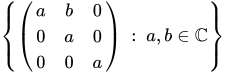
which is equal to the set of all polynomials in
-
T
=
(
0
1
0
0
0
0
0
0
0
)
{\displaystyle T={\begin{pmatrix}0&1&0\\0&0&0\\0&0&0\end{pmatrix}}}

and the identity is reflexive.
Hyper-reflexivity
Let
A
{\displaystyle {\mathcal {A}}}

-
β
(
T
,
A
)
=
sup
{
‖
P
⊥
T
P
‖
:
P
is a projection and
P
⊥
A
P
=
(
0
)
}
.
{\displaystyle \beta (T,{\mathcal {A}})=\sup \left\{\left\|P^{\perp }TP\right\|\ :\ P{\mbox{ is a projection and }}P^{\perp }{\mathcal {A}}P=(0)\right\}.}

Observe that P is a projection involved in this supremum precisely if the range of P is an invariant subspace of
A
{\displaystyle {\mathcal {A}}}
The algebra
A
{\displaystyle {\mathcal {A}}}
-
β
(
T
,
A
)
=
0
implies that
T
is in
A
.
{\displaystyle \beta (T,{\mathcal {A}})=0{\mbox{ implies that }}T{\mbox{ is in }}{\mathcal {A}}.}

We note that for any T in B(H) the following inequality is satisfied:
-
β
(
T
,
A
)
≤
dist
(
T
,
A
)
.
{\displaystyle \beta (T,{\mathcal {A}})\leq {\mbox{dist}}(T,{\mathcal {A}}).}

Here
dist
(
T
,
A
)
{\displaystyle {\mbox{dist}}(T,{\mathcal {A}})}

-
dist
(
T
,
A
)
≤
K
β
(
T
,
A
)
.
{\displaystyle {\mbox{dist}}(T,{\mathcal {A}})\leq K\beta (T,{\mathcal {A}}).}

The smallest such K is called the distance constant for
A
{\displaystyle {\mathcal {A}}}
In the case of a reflexive algebra of matrices with nonzero entries specified by a given pattern, the problem of finding the distance constant can be rephrased as a matrix-filling problem: if we fill the entries in the complement of the pattern with arbitrary entries, what choice of entries in the pattern gives the smallest operator norm?
Examples
- Every finite-dimensional reflexive algebra is hyper-reflexive. However, there are examples of infinite-dimensional reflexive operator algebras which are not hyper-reflexive.
- The distance constant for a one-dimensional algebra is 1.
- Nest algebras are hyper-reflexive with distance constant 1.
- Many von Neumann algebras are hyper-reflexive, but it is not known if they all are.
- A type I von Neumann algebra is hyper-reflexive with distance constant at most 2.
See also
References
- William Arveson, Ten lectures on operator algebras, ISBN 0-8218-0705-6
- H. Radjavi and P. Rosenthal, Invariant Subspaces, ISBN 0-486-42822-2