In mathematics, more specifically in homotopy theory, a simplicial presheaf is a presheaf on a site (e.g., the category of topological spaces) taking values in simplicial sets (i.e., a contravariant functor from the site to the category of simplicial sets). Equivalently, a simplicial presheaf is a simplicial object in the category of presheaves on a site. The notion was introduced by A. Joyal in the 1970s.[1] Similarly, a simplicial sheaf on a site is a simplicial object in the category of sheaves on the site.[2]
Examples
Example: Consider the étale site of a scheme S. Each U in the site represents the presheaf
Hom
(
−
,
U
)
{\displaystyle \operatorname {Hom} (-,U)}

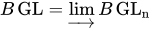
Example: Let G be a presheaf of groupoids. Then taking nerves section-wise, one obtains a simplicial presheaf
B
G
{\displaystyle BG}

If
f
:
X
→
Y
{\displaystyle f:X\to Y}


Homotopy sheaves of a simplicial presheaf
Let F be a simplicial presheaf on a site. The homotopy sheaves
π
∗
F
{\displaystyle \pi _{*}F}





Model structures
The category of simplicial presheaves on a site admits several different model structures.
Some of them are obtained by viewing simplicial presheaves as functors
-
S
o
p
→
Δ
o
p
S
e
t
s
{\displaystyle S^{op}\to \Delta ^{op}Sets}

The category of such functors is endowed with (at least) three model structures, namely the projective, the Reedy, and the injective model structure. The weak equivalences / fibrations in the first are maps
-
F
→
G
{\displaystyle {\mathcal {F}}\to {\mathcal {G}}}

such that
-
F
(
U
)
→
G
(
U
)
{\displaystyle {\mathcal {F}}(U)\to {\mathcal {G}}(U)}
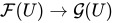
is a weak equivalence / fibration of simplicial sets, for all U in the site S. The injective model structure is similar, but with weak equivalences and cofibrations instead.
Stack
A simplicial presheaf F on a site is called a stack if, for any X and any hypercovering H →X, the canonical map
-
F
(
X
)
→
holim
F
(
H
n
)
{\displaystyle F(X)\to \operatorname {holim} F(H_{n})}

is a weak equivalence as simplicial sets, where the right is the homotopy limit of
-
[
n
]
=
{
0
,
1
,
…
,
n
}
↦
F
(
H
n
)
{\displaystyle [n]=\{0,1,\dots ,n\}\mapsto F(H_{n})}
.
Any sheaf F on the site can be considered as a stack by viewing
F
(
X
)
{\displaystyle F(X)}


If A is a sheaf of abelian group (on the same site), then we define
K
(
A
,
1
)
{\displaystyle K(A,1)}


-
H
i
(
X
;
A
)
=
[
X
,
K
(
A
,
i
)
]
{\displaystyle \operatorname {H} ^{i}(X;A)=[X,K(A,i)]}
![{\displaystyle \operatorname {H} ^{i}(X;A)=[X,K(A,i)]}](https://wikimedia.org/api/rest_v1/media/math/render/svg/5cfba39b0a4bf389a4afdae0f6f05994cbdd9f89)
where the left denotes a sheaf cohomology and the right the homotopy class of maps.
See also
Notes
- Toën, Bertrand (2002), "Stacks and Non-abelian cohomology" (PDF), Introductory Workshop on Algebraic Stacks, Intersection Theory, and Non-Abelian Hodge Theory, MSRI
- Jardine 2007, §1
Further reading
- Konrad Voelkel, Model structures on simplicial presheaves
References
- Jardine, J.F. (2004). "Generalised sheaf cohomology theories". In Greenlees, J. P. C. (ed.). Axiomatic, enriched and motivic homotopy theory. Proceedings of the NATO Advanced Study Institute, Cambridge, UK, 9--20 September 2002. NATO Science Series II: Mathematics, Physics and Chemistry. Vol. 131. Dordrecht: Kluwer Academic. pp. 29–68. ISBN 1-4020-1833-9. Zbl 1063.55004.
- Jardine, J.F. (2007). "Simplicial presheaves" (PDF).
- B. Toën, Simplicial presheaves and derived algebraic geometry