In linear algebra, a matrix unit is a matrix with only one nonzero entry with value 1.[1][2] The matrix unit with a 1 in the ith row and jth column is denoted as
E
i
j
{\displaystyle E_{ij}}

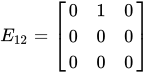
A single-entry matrix generalizes the matrix unit for matrices with only one nonzero entry of any value, not necessarily of value 1.
Properties
The set of m by n matrix units is a basis of the space of m by n matrices.[2]
The product of two matrix units of the same square shape
n
×
n
{\displaystyle n\times n}



The group of scalar n-by-n matrices over a ring R is the centralizer of the subset of n-by-n matrix units in the set of n-by-n matrices over R.[2]
The matrix norm (induced by the same two vector norms) of a matrix unit is equal to 1.
When multiplied by another matrix, it isolates a specific row or column in arbitrary position. For example, for any 3-by-3 matrix A:[3]
-
E
23
A
=
[
0
0
0
a
31
a
32
a
33
0
0
0
]
.
{\displaystyle E_{23}A=\left[{\begin{matrix}0&0&0\\a_{31}&a_{32}&a_{33}\\0&0&0\end{matrix}}\right].}
-
A
E
23
=
[
0
0
a
12
0
0
a
22
0
0
a
32
]
.
{\displaystyle AE_{23}=\left[{\begin{matrix}0&0&a_{12}\\0&0&a_{22}\\0&0&a_{32}\end{matrix}}\right].}
![{\displaystyle E_{23}A=\left[{\begin{matrix}0&0&0\\a_{31}&a_{32}&a_{33}\\0&0&0\end{matrix}}\right].}](https://wikimedia.org/api/rest_v1/media/math/render/svg/465cc21ae93f6bf1cb956685cd85c81850c98760)
![{\displaystyle AE_{23}=\left[{\begin{matrix}0&0&a_{12}\\0&0&a_{22}\\0&0&a_{32}\end{matrix}}\right].}](https://wikimedia.org/api/rest_v1/media/math/render/svg/a798c3f3f0e778a9847acfa5cc16eea6e1e69f7c)
References
- Artin, Michael. Algebra. Prentice Hall. p. 9.
- Lam, Tsit-Yuen (1999). "Chapter 17: Matrix Rings". Lectures on Modules and Rings. Graduate Texts in Mathematics. Vol. 189. Springer Science+Business Media. pp. 461–479.
- Marcel Blattner (2009). "B-Rank: A top N Recommendation Algorithm". arXiv:0908.2741 [physics.data-an].