Small snub icosicosidodecahedron

☆ Save On Wikipedia ↗
Small snub icosicosidodecahedron
TypeUniform star polyhedron
ElementsF = 112, E = 180
V = 60 (χ = 8)
Faces by sides(40+60){3}+12{5/2}
Coxeter diagram
Wythoff symbol| 5/2 3 3
Symmetry groupIh, [5,3], *532
Index referencesU32, C41, W110
Dual polyhedronSmall hexagonal hexecontahedron
Vertex figure
35.5/2
Bowers acronymSeside
3D model of a small snub icosicosidodecahedron

In geometry, the small snub icosicosidodecahedron or snub disicosidodecahedron is a uniform star polyhedron, indexed as U32. It has 112 faces (100 triangles and 12 pentagrams), 180 edges, and 60 vertices. Its stellation core is a truncated pentakis dodecahedron. It also called a holosnub icosahedron, ß{3,5}.

The 40 non-snub triangular faces form 20 coplanar pairs, forming star hexagons that are not quite regular. Unlike most snub polyhedra, it has reflection symmetries.

Convex hull

Its convex hull is a nonuniform truncated icosahedron.


Truncated icosahedron
(regular faces)

Convex hull
(isogonal hexagons)

Small snub icosicosidodecahedron

Cartesian coordinates

Let ξ = − 3 2 + 1 2 1 + 4 ϕ ≈ − 0.1332396008261379 {\displaystyle \xi =-{\frac {3}{2}}+{\frac {1}{2}}{\sqrt {1+4\phi }}\approx -0.1332396008261379} {\displaystyle \xi =-{\frac {3}{2}}+{\frac {1}{2}}{\sqrt {1+4\phi }}\approx -0.1332396008261379} be largest (least negative) zero of the polynomial P = x 2 + 3 x + ϕ − 2 {\displaystyle P=x^{2}+3x+\phi ^{-2}} {\displaystyle P=x^{2}+3x+\phi ^{-2}}, where ϕ {\displaystyle \phi } {\displaystyle \phi } is the golden ratio. Equivalently, ξ = − 2 + ϕ + ϕ + ϕ + ⋯ = − 2 + β {\displaystyle \xi =-2+{\sqrt {\phi +{\sqrt {\phi +{\sqrt {\phi +\cdots }}}}}}\,=-2+\beta } {\displaystyle \xi =-2+{\sqrt {\phi +{\sqrt {\phi +{\sqrt {\phi +\cdots }}}}}}\,=-2+\beta } where β ≈ 1.86676039 {\displaystyle \beta \approx 1.86676039} {\displaystyle \beta \approx 1.86676039} (OEIS: A275828) is a root of β 2 − β − ϕ = 0. {\displaystyle \beta ^{2}-\beta -\phi =0.} {\displaystyle \beta ^{2}-\beta -\phi =0.} Let the point p {\displaystyle p} {\displaystyle p} be given by

p = ( ϕ − 1 ξ + ϕ − 3 ξ ϕ − 2 ξ + ϕ − 2 ) {\displaystyle p={\begin{pmatrix}\phi ^{-1}\xi +\phi ^{-3}\\\xi \\\phi ^{-2}\xi +\phi ^{-2}\end{pmatrix}}} {\displaystyle p={\begin{pmatrix}\phi ^{-1}\xi +\phi ^{-3}\\\xi \\\phi ^{-2}\xi +\phi ^{-2}\end{pmatrix}}}.

Let the matrix M {\displaystyle M} {\displaystyle M} be given by

M = ( 1 / 2 − ϕ / 2 1 / ( 2 ϕ ) ϕ / 2 1 / ( 2 ϕ ) − 1 / 2 1 / ( 2 ϕ ) 1 / 2 ϕ / 2 ) {\displaystyle M={\begin{pmatrix}1/2&-\phi /2&1/(2\phi )\\\phi /2&1/(2\phi )&-1/2\\1/(2\phi )&1/2&\phi /2\end{pmatrix}}} {\displaystyle M={\begin{pmatrix}1/2&-\phi /2&1/(2\phi )\\\phi /2&1/(2\phi )&-1/2\\1/(2\phi )&1/2&\phi /2\end{pmatrix}}}.

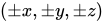
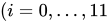
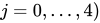
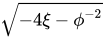
M {\displaystyle M} {\displaystyle M} is the rotation around the axis ( 1 , 0 , ϕ ) {\displaystyle (1,0,\phi )} {\displaystyle (1,0,\phi )} by an angle of 2 π / 5 {\displaystyle 2\pi /5} {\displaystyle 2\pi /5}, counterclockwise. Let the linear transformations T 0 , … , T 11 {\displaystyle T_{0},\ldots ,T_{11}} {\displaystyle T_{0},\ldots ,T_{11}} be the transformations which send a point ( x , y , z ) {\displaystyle (x,y,z)} {\displaystyle (x,y,z)} to the even permutations of ( ± x , ± y , ± z ) {\displaystyle (\pm x,\pm y,\pm z)} {\displaystyle (\pm x,\pm y,\pm z)} with an even number of minus signs. The transformations T i {\displaystyle T_{i}} {\displaystyle T_{i}} constitute the group of rotational symmetries of a regular tetrahedron. The transformations T i M j {\displaystyle T_{i}M^{j}} {\displaystyle T_{i}M^{j}} ( i = 0 , … , 11 {\displaystyle (i=0,\ldots ,11} {\displaystyle (i=0,\ldots ,11}, j = 0 , … , 4 ) {\displaystyle j=0,\ldots ,4)} {\displaystyle j=0,\ldots ,4)} constitute the group of rotational symmetries of a regular icosahedron. Then the 60 points T i M j p {\displaystyle T_{i}M^{j}p} {\displaystyle T_{i}M^{j}p} are the vertices of a small snub icosicosidodecahedron. The edge length equals − 2 ξ {\displaystyle -2\xi } {\displaystyle -2\xi }, the circumradius equals − 4 ξ − ϕ − 2 {\displaystyle {\sqrt {-4\xi -\phi ^{-2}}}} {\displaystyle {\sqrt {-4\xi -\phi ^{-2}}}}, and the midradius equals − ξ {\displaystyle {\sqrt {-\xi }}} {\displaystyle {\sqrt {-\xi }}}.

For a small snub icosicosidodecahedron whose edge length is 1, the circumradius is

R = 1 2 ξ − 1 ξ ≈ 1.4581903307387025 {\displaystyle R={\frac {1}{2}}{\sqrt {\frac {\xi -1}{\xi }}}\approx 1.4581903307387025} {\displaystyle R={\frac {1}{2}}{\sqrt {\frac {\xi -1}{\xi }}}\approx 1.4581903307387025}

Its midradius is

r = 1 2 − 1 ξ ≈ 1.369787954633799 {\displaystyle r={\frac {1}{2}}{\sqrt {\frac {-1}{\xi }}}\approx 1.369787954633799} {\displaystyle r={\frac {1}{2}}{\sqrt {\frac {-1}{\xi }}}\approx 1.369787954633799}

The other zero of P {\displaystyle P} {\displaystyle P} plays a similar role in the description of the small retrosnub icosicosidodecahedron.

See also