In fluid dynamics, stream thrust averaging is a process used to convert three-dimensional flow through a duct into one-dimensional uniform flow. It makes the assumptions that the flow is mixed adiabatically and without friction. However, due to the mixing process, there is a net increase in the entropy of the system. Although there is an increase in entropy, the stream thrust averaged values are more representative of the flow than a simple average as a simple average would violate the second law of thermodynamics.
Equations for a perfect gas
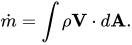
Stream thrust:
-
F
=
∫
(
ρ
V
⋅
d
A
)
V
⋅
f
+
∫
p
d
A
⋅
f
.
{\displaystyle F=\int \left(\rho \mathbf {V} \cdot d\mathbf {A} \right)\mathbf {V} \cdot \mathbf {f} +\int pd\mathbf {A} \cdot \mathbf {f} .}

-
m
˙
=
∫
ρ
V
⋅
d
A
.
{\displaystyle {\dot {m}}=\int \rho \mathbf {V} \cdot d\mathbf {A} .}
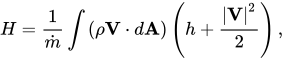
Stagnation enthalpy:
-
H
=
1
m
˙
∫
(
ρ
V
⋅
d
A
)
(
h
+
|
V
|
2
2
)
,
{\displaystyle H={1 \over {\dot {m}}}\int \left({\rho \mathbf {V} \cdot d\mathbf {A} }\right)\left(h+{|\mathbf {V} |^{2} \over 2}\right),}
-
U
¯
2
(
1
−
R
2
C
p
)
−
U
¯
F
m
˙
+
H
R
C
p
=
0.
{\displaystyle {\overline {U}}^{2}\left({1-{R \over 2C_{p}}}\right)-{\overline {U}}{F \over {\dot {m}}}+{HR \over C_{p}}=0.}

Solutions
Solving for
U
¯
{\displaystyle {\overline {U}}}

-
ρ
¯
=
m
˙
U
¯
A
,
{\displaystyle {\overline {\rho }}={{\dot {m}} \over {\overline {U}}A},}

-
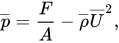
p
¯
=
F
A
−
ρ
¯
U
¯
2
,
{\displaystyle {\overline {p}}={F \over A}-{{\overline {\rho }}{\overline {U}}^{2}},}
-
h
¯
=
p
¯
C
p
ρ
¯
R
.
{\displaystyle {\overline {h}}={{\overline {p}}C_{p} \over {\overline {\rho }}R}.}

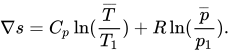
Second law of thermodynamics:
-
∇
s
=
C
p
ln
(
T
¯
T
1
)
+
R
ln
(
p
¯
p
1
)
.
{\displaystyle \nabla s=C_{p}\ln({{\overline {T}} \over T_{1}})+R\ln({{\overline {p}} \over p_{1}}).}
The values
T
1
{\displaystyle T_{1}}


-
∇
s
=
C
p
ln
(
T
¯
)
+
R
ln
(
p
¯
)
.
{\displaystyle \nabla s=C_{p}\ln({\overline {T}})+R\ln({\overline {p}}).}

One possible unreal solution for the stream thrust averaged velocity yields a negative entropy. Another method of determining the proper solution is to take a simple average of the velocity and determining which value is closer to the stream thrust averaged velocity.
References
- DeBonis, J.R.; Trefny, C.J.; Steffen, Jr., C.J. (1999). "Inlet Development for a Rocket Based Combined Cycle, Single Stage to Orbit Vehicle Using Computational Fluid Dynamics" (PDF). NASA/TM—1999-209279. NASA. Retrieved 18 February 2013.