In algebraic geometry, given a morphism f: X → S of schemes, the cotangent sheaf on X is the sheaf of
O
X
{\displaystyle {\mathcal {O}}_{X}}


-
Hom
O
X
(
Ω
X
/
S
,
F
)
=
Der
S
(
O
X
,
F
)
{\displaystyle \operatorname {Hom} _{{\mathcal {O}}_{X}}(\Omega _{X/S},F)=\operatorname {Der} _{S}({\mathcal {O}}_{X},F)}

that depends naturally on F. In other words, the cotangent sheaf is characterized by the universal property: there is the differential
d
:
O
X
→
Ω
X
/
S
{\displaystyle d:{\mathcal {O}}_{X}\to \Omega _{X/S}}



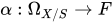
In the case X and S are affine schemes, the above definition means that
Ω
X
/
S
{\displaystyle \Omega _{X/S}}

There are two important exact sequences:
- If S →T is a morphism of schemes, then
-
f
∗
Ω
S
/
T
→
Ω
X
/
T
→
Ω
X
/
S
→
0.
{\displaystyle f^{*}\Omega _{S/T}\to \Omega _{X/T}\to \Omega _{X/S}\to 0.}
-
f
∗
Ω
S
/
T
→
Ω
X
/
T
→
Ω
X
/
S
→
0.
{\displaystyle f^{*}\Omega _{S/T}\to \Omega _{X/T}\to \Omega _{X/S}\to 0.}
- If Z is a closed subscheme of X with ideal sheaf I, then


The cotangent sheaf is closely related to smoothness of a variety or scheme. For example, an algebraic variety is smooth of dimension n if and only if ΩX is a locally free sheaf of rank n.[5]
Construction through a diagonal morphism
Let
f
:
X
→
S
{\displaystyle f:X\to S}

-
Ω
X
/
S
=
Δ
∗
(
I
/
I
2
)
{\displaystyle \Omega _{X/S}=\Delta ^{*}(I/I^{2})}

and checks this sheaf of modules satisfies the required universal property of a cotangent sheaf (Hartshorne, Ch II. Remark 8.9.2). The construction shows in particular that the cotangent sheaf is quasi-coherent. It is coherent if S is Noetherian and f is of finite type.
The above definition means that the cotangent sheaf on X is the restriction to X of the conormal sheaf to the diagonal embedding of X over S.
Relation to a tautological line bundle
The cotangent sheaf on a projective space is related to the tautological line bundle O(-1) by the following exact sequence: writing
P
R
n
{\displaystyle \mathbf {P} _{R}^{n}}

-
0
→
Ω
P
R
n
/
R
→
O
P
R
n
(
−
1
)
⊕
(
n
+
1
)
→
O
P
R
n
→
0.
{\displaystyle 0\to \Omega _{\mathbf {P} _{R}^{n}/R}\to {\mathcal {O}}_{\mathbf {P} _{R}^{n}}(-1)^{\oplus (n+1)}\to {\mathcal {O}}_{\mathbf {P} _{R}^{n}}\to 0.}

(See also Chern class#Complex projective space.)
Cotangent stack
For this notion, see § 1 of
- A. Beilinson and V. Drinfeld, Quantization of Hitchin’s integrable system and Hecke eigensheaves Archived 2015-01-05 at the Wayback Machine[6]
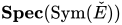
There, the cotangent stack on an algebraic stack X is defined as the relative Spec of the symmetric algebra of the tangent sheaf on X. (Note: in general, if E is a locally free sheaf of finite rank,
S
p
e
c
(
Sym
(
E
ˇ
)
)
{\displaystyle \mathbf {Spec} (\operatorname {Sym} ({\check {E}}))}
See also: Hitchin fibration (the cotangent stack of
Bun
G
(
X
)
{\displaystyle \operatorname {Bun} _{G}(X)}

Notes
- "Section 17.27 (08RL): Modules of differentials". The Stacks project.
- In concise terms, this means:
-
Θ
X
=
d
e
f
H
o
m
O
X
(
Ω
X
,
O
X
)
=
D
e
r
(
O
X
)
.
{\displaystyle \Theta _{X}{\overset {\mathrm {def} }{=}}{\mathcal {H}}om_{{\mathcal {O}}_{X}}(\Omega _{X},{\mathcal {O}}_{X})={\mathcal {D}}er({\mathcal {O}}_{X}).}
-
Θ
X
=
d
e
f
H
o
m
O
X
(
Ω
X
,
O
X
)
=
D
e
r
(
O
X
)
.
{\displaystyle \Theta _{X}{\overset {\mathrm {def} }{=}}{\mathcal {H}}om_{{\mathcal {O}}_{X}}(\Omega _{X},{\mathcal {O}}_{X})={\mathcal {D}}er({\mathcal {O}}_{X}).}
- Hartshorne 1977, Ch. II, Proposition 8.12.
- https://mathoverflow.net/q/79956 as well as (Hartshorne 1977, Ch. II, Theorem 8.17.)
- Hartshorne 1977, Ch. II, Theorem 8.15.
- see also: § 3 of http://www.math.harvard.edu/~gaitsgde/grad_2009/SeminarNotes/Sept22(Dmodstack1).pdf

See also
References
- "Sheaf of differentials of a morphism".
- Hartshorne, Robin (1977), Algebraic Geometry, Graduate Texts in Mathematics, vol. 52, New York: Springer-Verlag, ISBN 978-0-387-90244-9, MR 0463157
External links
- "Questions about tangent and cotangent bundle on schemes". Stack Exchange. November 2, 2014.