In mathematics, the tensor-hom adjunction is the statement that the tensor product
−
⊗
X
{\displaystyle -\otimes X}


-
Hom
(
Y
⊗
X
,
Z
)
≅
Hom
(
Y
,
Hom
(
X
,
Z
)
)
.
{\displaystyle \operatorname {Hom} (Y\otimes X,Z)\cong \operatorname {Hom} (Y,\operatorname {Hom} (X,Z)).}

This is made more precise below. The order of terms in the phrase "tensor-hom adjunction" reflects their relationship: tensor is the left adjoint, while hom is the right adjoint.
General statement for modules
Say R and S are (possibly noncommutative) rings, and consider the right module categories (an analogous statement holds for left modules):
-
C
=
M
o
d
S
and
D
=
M
o
d
R
.
{\displaystyle {\mathcal {C}}=\mathrm {Mod} _{S}\quad {\text{and}}\quad {\mathcal {D}}=\mathrm {Mod} _{R}.}

Fix an
(
R
,
S
)
{\displaystyle (R,S)}


-
F
(
Y
)
=
Y
⊗
R
X
for
Y
∈
D
{\displaystyle F(Y)=Y\otimes _{R}X\quad {\text{for }}Y\in {\mathcal {D}}}

-
G
(
Z
)
=
Hom
S
(
X
,
Z
)
for
Z
∈
C
{\displaystyle G(Z)=\operatorname {Hom} _{S}(X,Z)\quad {\text{for }}Z\in {\mathcal {C}}}

Then
F
{\displaystyle F}


-
Hom
S
(
Y
⊗
R
X
,
Z
)
≅
Hom
R
(
Y
,
Hom
S
(
X
,
Z
)
)
.
{\displaystyle \operatorname {Hom} _{S}(Y\otimes _{R}X,Z)\cong \operatorname {Hom} _{R}(Y,\operatorname {Hom} _{S}(X,Z)).}

This is actually an isomorphism of abelian groups. More precisely, if
Y
{\displaystyle Y}


Counit and unit
Like all adjunctions, the tensor-hom adjunction can be described by its counit and unit natural transformations. Using the notation from the previous section, the counit
-
ε
:
F
G
→
1
C
{\displaystyle \varepsilon :FG\to 1_{\mathcal {C}}}
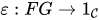
has components
-
ε
Z
:
Hom
S
(
X
,
Z
)
⊗
R
X
→
Z
{\displaystyle \varepsilon _{Z}:\operatorname {Hom} _{S}(X,Z)\otimes _{R}X\to Z}

given by evaluation: For
-
ϕ
∈
Hom
S
(
X
,
Z
)
and
x
∈
X
,
{\displaystyle \phi \in \operatorname {Hom} _{S}(X,Z)\quad {\text{and}}\quad x\in X,}

-
ε
(
ϕ
⊗
x
)
=
ϕ
(
x
)
.
{\displaystyle \varepsilon (\phi \otimes x)=\phi (x).}

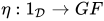
The components of the unit
-
η
:
1
D
→
G
F
{\displaystyle \eta :1_{\mathcal {D}}\to GF}
-
η
Y
:
Y
→
Hom
S
(
X
,
Y
⊗
R
X
)
{\displaystyle \eta _{Y}:Y\to \operatorname {Hom} _{S}(X,Y\otimes _{R}X)}

are defined as follows: For
y
{\displaystyle y}

-
η
Y
(
y
)
∈
Hom
S
(
X
,
Y
⊗
R
X
)
{\displaystyle \eta _{Y}(y)\in \operatorname {Hom} _{S}(X,Y\otimes _{R}X)}

is a right
S
{\displaystyle S}

-
η
Y
(
y
)
(
t
)
=
y
⊗
t
for
t
∈
X
.
{\displaystyle \eta _{Y}(y)(t)=y\otimes t\quad {\text{for }}t\in X.}

The counit and unit equations can now be explicitly verified. For
Y
{\displaystyle Y}

-
ε
F
Y
∘
F
(
η
Y
)
:
Y
⊗
R
X
→
Hom
S
(
X
,
Y
⊗
R
X
)
⊗
R
X
→
Y
⊗
R
X
{\displaystyle \varepsilon _{FY}\circ F(\eta _{Y}):Y\otimes _{R}X\to \operatorname {Hom} _{S}(X,Y\otimes _{R}X)\otimes _{R}X\to Y\otimes _{R}X}

is given on simple tensors of
Y
⊗
X
{\displaystyle Y\otimes X}

-
ε
F
Y
∘
F
(
η
Y
)
(
y
⊗
x
)
=
η
Y
(
y
)
(
x
)
=
y
⊗
x
.
{\displaystyle \varepsilon _{FY}\circ F(\eta _{Y})(y\otimes x)=\eta _{Y}(y)(x)=y\otimes x.}

Likewise,
-
G
(
ε
Z
)
∘
η
G
Z
:
Hom
S
(
X
,
Z
)
→
Hom
S
(
X
,
Hom
S
(
X
,
Z
)
⊗
R
X
)
→
Hom
S
(
X
,
Z
)
.
{\displaystyle G(\varepsilon _{Z})\circ \eta _{GZ}:\operatorname {Hom} _{S}(X,Z)\to \operatorname {Hom} _{S}(X,\operatorname {Hom} _{S}(X,Z)\otimes _{R}X)\to \operatorname {Hom} _{S}(X,Z).}

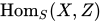
For
ϕ
{\displaystyle \phi }

-
G
(
ε
Z
)
∘
η
G
Z
(
ϕ
)
{\displaystyle G(\varepsilon _{Z})\circ \eta _{GZ}(\phi )}

is a right
S
{\displaystyle S}
-
G
(
ε
Z
)
∘
η
G
Z
(
ϕ
)
(
x
)
=
ε
Z
(
ϕ
⊗
x
)
=
ϕ
(
x
)
{\displaystyle G(\varepsilon _{Z})\circ \eta _{GZ}(\phi )(x)=\varepsilon _{Z}(\phi \otimes x)=\phi (x)}

and therefore
-
G
(
ε
Z
)
∘
η
G
Z
(
ϕ
)
=
ϕ
.
{\displaystyle G(\varepsilon _{Z})\circ \eta _{GZ}(\phi )=\phi .}

The Ext and Tor functors
The Hom functor
hom
(
X
,
−
)
{\displaystyle \hom(X,-)}

In arithmetic
We can illustrate the tensor-hom adjunction in the category of functions of finite sets. Given a set
N
{\displaystyle N}


This allows us to interpret the isomorphism of hom-sets
-
Hom
(
Y
⊗
X
,
Z
)
≅
Hom
(
Y
,
Hom
(
X
,
Z
)
)
.
{\displaystyle \operatorname {Hom} (Y\otimes X,Z)\cong \operatorname {Hom} (Y,\operatorname {Hom} (X,Z)).}
that universally characterizes the tensor-hom adjunction, as the categorification of the remarkably basic law of exponents
-
Z
Y
X
=
(
Z
X
)
Y
.
{\displaystyle Z^{YX}=(Z^{X})^{Y}.}

See also
References
- May, J.P.; Sigurdsson, J. (2006). Parametrized Homotopy Theory. A.M.S. p. 253. ISBN 0-8218-3922-5.
- Bourbaki, Nicolas (1989), Elements of mathematics, Algebra I, Springer-Verlag, ISBN 3-540-64243-9