In topology and related branches of mathematics, a totally disconnected space is a topological space that has only singletons as connected subsets. In every topological space, the singletons (and, when it is considered connected, the empty set) are connected; in a totally disconnected space, these are the only connected subsets.
An important example of a totally disconnected space is the Cantor set, which is homeomorphic to the set of p-adic integers. Another example, playing a key role in algebraic number theory, is the field Qp of p-adic numbers.
Definition
A topological space
X
{\displaystyle X}

Another closely related notion is that of a totally separated space, i.e. a space where quasicomponents are singletons. That is, a topological space
X
{\displaystyle X}


Every totally separated space is evidently totally disconnected but the converse is false even for metric spaces. For instance, take
X
{\displaystyle X}
Confusingly, in the literature[3] totally disconnected spaces are sometimes called hereditarily disconnected,[4] while the terminology totally disconnected is used for totally separated spaces.[4]
Examples
The following are examples of totally disconnected spaces:
- Discrete spaces
- The rational numbers
- The irrational numbers
- The p-adic numbers; more generally, all profinite groups are totally disconnected.
- The Cantor set and the Cantor space
- The Baire space
- The Sorgenfrey line
- Every Hausdorff space of small inductive dimension 0 is totally disconnected
- The Erdős space ℓ2
∩
Q
ω
{\displaystyle \,\cap \,\mathbb {Q} ^{\omega }}
is a totally disconnected Hausdorff space that does not have small inductive dimension 0.
- Extremally disconnected Hausdorff spaces
- Stone spaces
- The Knaster–Kuratowski fan provides an example of a connected space, such that the removal of a single point produces a totally disconnected space.
Properties
- Subspaces, products, and coproducts of totally disconnected spaces are totally disconnected.
- Totally disconnected spaces are T1 spaces, since connected components are closed.
- Continuous images of totally disconnected spaces are not necessarily totally disconnected, in fact, every compact metric space is a continuous image of the Cantor set.
- A locally compact Hausdorff space has small inductive dimension 0 if and only if it is totally disconnected.
- Every totally disconnected compact metric space is homeomorphic to a subset of a countable product of discrete spaces.
- It is in general not true that every open set in a totally disconnected space is also closed.
- It is in general not true that the closure of every open set in a totally disconnected space is open, i.e. not every totally disconnected Hausdorff space is extremally disconnected.
Constructing a totally disconnected quotient space of any given space
Let
X
{\displaystyle X}



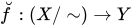
In fact this space is not only some totally disconnected quotient but in a certain sense the biggest: The following universal property holds: For any totally disconnected space
Y
{\displaystyle Y}



See also
Citations
- Rudin 1991, p. 395 Appendix A7.
- Munkres 2000, pp. 152.
- Engelking, Ryszard (1989). General Topology. Heldermann Verlag, Sigma Series in Pure Mathematics. ISBN 3-88538-006-4.
- Kuratowski 1968, pp. 151.
References
- Munkres, James R. (2000). Topology (2nd ed.). Upper Saddle River, NJ: Prentice Hall, Inc. ISBN 978-0-13-181629-9. OCLC 42683260. (accessible to patrons with print disabilities)
- Rudin, Walter (1991). Functional Analysis. International Series in Pure and Applied Mathematics. Vol. 8 (Second ed.). New York, NY: McGraw-Hill Science/Engineering/Math. ISBN 978-0-07-054236-5. OCLC 21163277.
- Willard, Stephen (2004), General topology, Dover Publications, ISBN 978-0-486-43479-7, MR 2048350 (reprint of the 1970 original, MR 0264581)
- Kuratowski, Kazimierz (1968), Topology II: Transl. from French (Revised ed.), New York: Academic Press [u.a.], ISBN 9780124292024