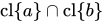
In mathematics, a topological space is said to be ultraconnected if no two nonempty closed sets are disjoint.[1] Equivalently, a space is ultraconnected if and only if the closures of two distinct points always have non trivial intersection. Hence, no T1 space with more than one point is ultraconnected.[2]
Properties
Every ultraconnected space
X
{\displaystyle X}


![{\displaystyle f:[0,1]\to X}](https://wikimedia.org/api/rest_v1/media/math/render/svg/ebe010ee7ddd6d0aeff0b2b0fc720cb06cdb7c99)


Every ultraconnected space is normal, limit point compact, and pseudocompact.[1]
Examples
The following are examples of ultraconnected topological spaces.
- A set with the indiscrete topology.
- The Sierpiński space.
- A set with the excluded point topology.
- The right order topology on the real line.[3]
See also
Notes
- PlanetMath
- Steen & Seebach, Sect. 4, pp. 29-30
- Steen & Seebach, example #50, p. 74
References
- This article incorporates material from Ultraconnected space on PlanetMath, which is licensed under the Creative Commons Attribution/Share-Alike License.
- Lynn Arthur Steen and J. Arthur Seebach, Jr., Counterexamples in Topology. Springer-Verlag, New York, 1978. Reprinted by Dover Publications, New York, 1995. ISBN 0-486-68735-X (Dover edition).