| Umm El Qa'ab | |
|---|---|
| أم القعاب (Arabic) | |
 General view of area, showing littering of pots | |
  Location of Umm El Qa'ab in Egypt | |
| 26°10.5′N 31°54.5′E / 26.1750°N 31.9083°E / 26.1750; 31.9083 | |
| Location | Egypt |
| Region | New Valley Governorate |
| Site notes | |
| Excavation dates | 1895-1898, 1900-1901, 1908-1912, 1977-present |
| Archaeologists | Émile Amélineau, Flinders Petrie, Édouard Naville, T. Eric Peet, W. Kaiser, G. Dreyer |
Umm El Qaʻāb (also Umm el-Qaab, Umm al-Qaab, or Umm El Gaʻab), Arabic: أم القعاب) is an archaeological site located at Abydos, Egypt.[1] Its modern name, meaning "Mother of Pots", refers to the mound made of millions of broken pieces of pots which defines the landscape. Umm el Qa'ab contains evidence that the site is the cemetery for Egypt's predynastic proto-kings along with rulers of the 1st and 2nd dynasties. In addition to early royal tombs, evidence also suggests a link between the site, the cult of Osiris, and Osiris' annual festival. It is located 1,5 kilometers to the west of Temple of Seti I at Abydos. The main temple to the god Khenti-Amentiu lies one mile to the south.[2]
The cemetery was likely founded during the Naqada I period (4,000 BCE) as evident from the tomb structures, pottery, and seal impressions excavated from the site. The location continued as a royal cemetery through the First Dynasty (2,950-2,775 BCE) and ended with the burial of only the last two kings of the Second Dynasty, Peribsen and Khasekhemy (2,650 BCE).[3]
Development of Umm el-Qaab necropolis occurred in three stages, moving from north to south:[4]
- Cemetery U - Pre-Dynastic
- Cemetery B - royal tombs of Dynasty 0 and early Dynasty I
- Tomb complexes - six kings and one queen of Dynasty I, and two kings of Dynasty II
The Pre and Early dynastic royal cemetery at Umm el-Qa'ab became a site of veneration and cultic practice beginning in the Middle Kingdom (1,938 BCE) and stayed in use for 1,500 years until the Ptolemaic Dynasty (305-30 BCE).[5]
Archaeology
The tombs of this area were first excavated by Émile Amélineau between 1895 and 1898.[6][7][8][9]
The site was then excavated by Flinders Petrie in 1900 and 1901 under the auspices of the Egypt Exploration Society.[10][11] His work was continued on a small scale by T. Eric Peet and Édouard Naville between 1908 and 1912.[12][13][14]
In 1977 a German Archaeological Institute team led by W. Kaiser and G. Dreyer resumed work at the site.[15][16]
In 1990s 16 wood samples (from wooden roofs, coffins, and mattings) were radiocarbon dated. The relative chronology of the radiocarbon dates was in line with the standard view of period and ruler order but the absolute date was more than 100 years older than the currentlu held historical chronology. Example results were Naqada IId - middle 35th century BC, Naqada IIIa2 - middle 34th century BC, and 2920-2910 BC for Qa'a, the last ruler of the 1st Dynasty.[4]
Pre-dynastic and Dynasty 0 tombs
Cemetery U

Cemetery U is located at the northern edge of Umm el-Qa'ab and inscriptions found in the tombs has been interpreted by Günter Dreyer as evidence of it being the burial site of 17 Egyptian proto-kings of the Naqada III period.[5] Tomb U-j contains the bulk of evidence which supports the royal nature of the site. Use of the area as a necropolis began, in an undifferentiated manner, in late Naqada I-IIa/b period. Then, after a period of non-use in the Naqada IIc period in Naqada IId larger tombs began to appear. Beginning in Naqada IIIa tomb construction became mudbrick lined and multi-chambered tombs began to appear.[4]
Tomb U-j
Dated to Naqada IIIA2 (3,300 BCE), tomb U-j is the largest tomb found at Cemetery U and contains 12 separate chambers. In contrast to the earlier Predynastic pit tombs found at Cemetery U, tomb U-j's multichambered design was outlined by mud-brick walls and had a roof made from wooden beams.[17] Although the tomb had been subject to plundering, about 2000 ceramic vessels were recovered with nearly one third having been imported from Palestine. These ceramic vessels contained traces of tree-resin-infused wine, providing the first evidence of wine in Ancient Egypt.[17]

In addition to ceramic vessels, tomb U-j also contained bowls carved out of obsidian and chests made from imported cedar. The presence of these items suggests the existence of an extensive trade network during the time the tombs were being constructed.[17] Small ivory hole pierced tags with "proto-hieroglyphic" characters inscribed on them were also recovered from the tomb. These artifacts possibly provide the earliest evidence of writing in Egypt.[17][18] Very similar tags were with proto-cuneiform characters were found in Uruk III-IV period (c. 3300-3100 BC) context in Mesopotamia and these tags continued in use until at least the Ur III period (c. 2112-2004 BC). They were thought to be, in Mesopotamia, used to indicate the contents of baskets.[19]
Evidence for Social Stratification
Analysis of Tomb U-j has led some scholars to believe that the origins of social stratification within Ancient Egypt can be found among the artifacts and burial practices found at the site. The British archaeologist, Alice Stevenson believes the ivory tags found in the tomb provide evidence for the existence of advanced administrative and bureaucratic organization.[17] In addition to the evidence of writing found in the tomb, the burials themselves have been interpreted as providing evidence of a society which was becoming more stratified. Outside the cemeteries of Abydos, contemporary tombs found elsewhere in Egypt were becoming less complex when compared to burials excavated at Cemetery U. This has been interpreted as evidence of ritual specialization, an organized effort to restrict materials, and artisanship centered around the burials at Umm el-Qa'ab.[17]
First Dynasty tombs
Cemetery B
Cemetery B is located south of Cemetery U and contains the tombs of Egypt's First Dynasty king along with the last two kings of the Second Dynasty. Furthermore, inscriptional evidence found at isolated tombs also suggests the Dynasty 0 rulers, Qa'a, Iry-Hor, and Narmer, were buried at this site.[5] The royal tombs located at Cemetery B were significantly larger and more architecturally complex when compared to their predynastic predecessors at Cemetery U. For instance, the First Dynasty ruler, King Djer, had a burial chamber of nearly 96 sq. m, while the burial chamber at Tomb U-j was only 20 sq. m.[5][17]
- B17/B18: Narmer[23]
- B10/B15/B19: Aha[24]
- O: Djer[25]
- Z: Djet[26]
- Y: Merneith[27]
- T: Den[28]
- X: Anedjib[29]
- U: Semerkhet[30]
- Q: Qa'a[31][32][33]
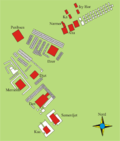 Tombs of the Egyptian 1st dynasty
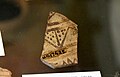 Pottery sherd, from stump base of a jug. 1st Dynasty. From the Royal Tomb of Semerkhet at Umm el-Qa'ab, Abydos, Egypt. Petrie Museum of Egyptian Archaeology, London


Human sacrifice and 1st Dynasty tombs
Human sacrifice was practiced as part of the funerary rituals associated with the First Dynasty.[34] The tomb of Djer is associated with the burials of 338 individuals thought to have been sacrificed.[34] The people and animals sacrificed, such as asses, were expected to assist the pharaoh in the afterlife. It appears that Djer's courtiers were strangled and their tombs all closed at the same time.[35][36] For unknown reasons, this practice ended with the conclusion of the dynasty, with shabtis taking the place of actual people to aid the pharaohs with the work expected of them in the afterlife.[34]
Tomb stelas
Many First and Second Dynasty pharaohs had tomb steles erected outside their tomb with their Serekh and their Horus name listed on it, which helps confirms the identity of the tomb owners. The following images shows the surviving tomb steles of pharaohs buried at Umm El Qa'ab.
 Djer
Djer Djet
Djet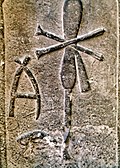 Merneith
 Den
Den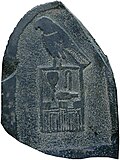 Semerkhet
 Qaa
Qaa


.JPG)
Second Dynasty tombs

At the beginning of the Second Dynasty (2,775 BCE), Egyptian kings were buried at Saqqara rather than Umm el-Qa'ab. However, this changed with the tombs of the dynasty's last two kings being located at Umm el-Qa'ab in Cemetery B.[5]
- P: Peribsen.[37] A seal found in this tomb contains the first full sentence written in hieroglyphs.[38]
- V: Khasekhemwy.[39] This tomb was on a massive scale, with several interconnecting mud-brick chambers, and the actual burial chamber being constructed of dressed limestone blocks. Its measurements were: 68.97 m long and 10.04-17.06 wide. When excavated by Petrie in 1901 it contained a scepter made from sard and banded with gold, limestone vases with golden covers, and a ewer and basin of bronze.

Tomb stelas
Note that Peribsen's stela is the only serekh to be topped with Seth instead of Horus (albeit the stele later had Seth erased), whereas Khasekhemwy's stela has both Horus and Seth on top of his serekh as a symbol of his reunification of Egypt.
 Peribsen
 Khasekhemwy

.jpg)
Activity during the Second and Third Dynasty
There is evidence that the tombs at Umm el-Qa'ab were looted and burned in the late Second Dynasty during the time period between Nynetjer and Khasekhemwy, when the country was split and ruled by two successors due to the overly complex state administration of the whole of Egypt.[40][41]
On the east side of the Pyramid of Djoser at Saqqara, eleven shafts 32 m deep were constructed and annexed to horizontal tunnels for royal family members. These were incorporated into the pre-existing substructure as it expanded eastward. In the storerooms along here over 40,000 stone vessels were found, many of which predate Djoser.[42] Shafts I–V were used for the burials of royal family members, but shafts VI–XI were used as symbolic tombs for the grave goods of royal ancestors from dynasties I–II. More than 40,000 vessels, bowls and vases made of various kinds of stone were found in these galleries. Royal names such as of kings Den, Semerkhet, Nynetjer and Sekhemib were incised on the pots, showing they came from both the tombs in Umm el-Qa'ab and in Saqqara. It is now thought that Djoser once restored the original tombs of the ancestors after Egypt's reunification, and then sealed the grave goods in the galleries in an attempt to save them from further destruction.[42] Not a lot of info is provided on Abydos during the rest of the Old Kingdom of Egypt.
Activity during the Tenth and Eleventh Dynasty
In the Teaching for King Merykara, the author, First Intermediate Period king of Egypt, Wahkare Khety address his son, the future king Merikare, advising him on how to be a good king, and how to avoid evil. In the text, the destruction of sacred territory at Abydos and Thinis is recorded; the king expresses remorse, as if accepting responsibility for the unthinkable that must have recurred throughout history – sacrilege in the name of the ruling king, subject to divine retribution during a judgment of the dead. This confirms that the tombs at Umm el-Qa'ab were looted again at the middle of the First Intermediate Period.[43]
In the 14th year of the reign of Mentuhotep II, the conquest of the Thinite region by the Herakleopolitan kings occurred. However, the armies of Merikare apparently looted and desecrated the sacred tombs at Umm el-Qa'ab in the process, confirming the third time the tombs were looted. As a result, the 14th year of Mentuhotep's reign is indeed named Year of the crime of Thinis in later Egyptian records.[44]
During the Kushute Twenty-fifth Dynasty of Egypt
Osiris Cult and Annual Festival

Osiris related cultic activity is thought o have began at the location in the Second Intermediate Period of Egypt based on pottery and the partially erased inscription on the statue of Osiris. Evidence of Osiris' affiliation with the site was highlighted after E. Amélineau discovered a basalt statue of Osiris in the refurbished tomb of king Djer.[45][46]

An annual festival dedicated to Osiris began during the Middle Kingdom and his temple became a site of pilgrimage. King Djer's tomb, now reinterpreted as Osiris' tomb, became inextricably linked to the temple as a result of the festival. The festival was held between July and September, coinciding with the annual inundation of the Nile. Priests associated with Osiris' cult would carry an image of the god out from his temple, travel along the processional valley, and bury the image at Umm el-Qa'ab. After burying the image, it would be ritualistically regenerated and returned to the temple along the same processional route.[5] The processional route between Umm el-Qa'ab and the Osiris temple played an integral role during the festival as his myth was ceremonially reenacted along the route.[5] The ritual significance of the causeway between Umm el-Qa'ab and Osiris' temple is further highlighted by Edouard Naville's discovery of six Osiris figures made of mud only 40 meters away from Djer's tomb.[47]
The annual festival along with various cultic activities continued at Umm el-Qa'ab for around 1,500 years after being formally established. Chapter 169 of the Book of the Dead, a text found among New Kingdom and later period burials, directly references the annual festival.[5] Aside from king Djer's tomb, tombs of other First Dynasty rulers such as Den and Qa'a were likely centers of cult practice. 18th Dynasty votive offerings were found near these early royal tombs in pits located 8 meters away from the burials.[5]
During the Kushute Twenty-fifth Dynasty of Egypt period burials were conducted there including royal ones. Osiris offering pottery from this period has also been found there.[48]
See also
References
- Toby Wilkinson, "Early Dynastic Egypt", Routledge, 1999
- O’Connor, David, et al., "Sacred Sands", Archaeology, vol. 54, no. 3, pp. 42–49, 2001
- Kemp, Barry J., "Abydos and the royal tombs of the First Dynasty", The Journal of Egyptian Archaeology 52.1, pp. 13-22, 1966
- Görsdorf, Jochen, Günter Dreyer, and Ulrich Hartung, "New 14C dating of the archaic royal necropolis Umm el-Qaab at Abydos (Egypt)", Radiocarbon 40.2, pp. 641-647, 1997
- O'Connor, David B. (2011). Abydos: Egypt's first pharaohs and the cult of Osiris. New aspects of antiquity (1. paperback ed.). London: Thames & Hudson. ISBN 978-0-500-28900-6.
- Amélineau, É., "Les nouvelles fouilles d'Abydos (1895-1896) : compte rendu in extenso des fouilles, description des monuments et objets découverts", Paris : E. Leroux, 1899
- Amélineau, É., "Les nouvelles fouilles d’Abydos 1896-1897", Paris, 1897
- Amélineau, É., "Les nouvelles fouilles d’Abydos 1897-1898", Paris, 1898
- Amélineau, É., "Le tombeau d’Osiris. Monographie de la découverte faite en 1897-1898", Paris, 1899
- Petrie, W.M.F., "The royal tombs of the First Dynasty. 1900. Part I. Egypt Exploration Fund 18. London, 1900
- Petrie, W.M.F., "The royal tombs of the earliest dynasties. 1901. Part II", Egypt Exploration Fund 21. London, 1901
- Naville, Edouard, and Kathleen Haddon, "The Cemeteries of Abydos: Part 1. 1909-1910. the Mixed Cemetery and Umm El-Ga'Ab", London ; Boston : Egypt Exploration Fund, 1914
- Peet, Thomas Eric, "The Cemeteries of Abydos: 1911-1912", Kegan Paul, Trench, Trübner & Company, 1914
- Peet, Thomas Eric, and William Leonard Stevenson Loat, "The Cemeteries of Abydos: Part III 1912-1913", Egypt Exploration Fund, 1913.
- Kaiser, Werner, and Peter Grossmann, "Umm el-Qaab. Nachuntersuchungen im frühzeitlichen Konigsfriedhof. 1. Vorbericht.(1rapport préliminaire sur la reprise des fouilles dans la nécropole royale de haute époque d'U. el Q.)", Mitteilungen des Deutschen Archäologischen Instituts, Abteilung Kairo Mainz 35, pp. 155-163, 1979
- Effland, Ute, and Andreas Effland, "Umm el-Qaab (Abydos), Ägypten. Untersuchungen zum Osiriskult in Abydos vom Alten Reich bis in die Spätantike. Die Arbeiten der Jahre 2018 und 2019", 2019
- Stevenson, Alice (December 2016). "The Egyptian Predynastic and State Formation". Journal of Archaeological Research. 24 (4): 421–468. doi:10.1007/s10814-016-9094-7. ISSN 1059-0161.
- Maiocchi, Massimo, "A Critical Examination of the Current Paradigms on the Origin of Writing in Mesopotamia", Enki & Ptah 1, pp. 85-100, 2025
- Stępień, Marek, "The New “pisan-dub-ba” Tablet from the Time of the Ur III Dynasty, in the Collection of the National Museum in Wrocław (Poland)", Anabasis. Studia Classica et Orientalia, pp. 7-21, 2025
- "The Earliest Known Egyptian Writing : History of Information".
- Günter Dreyer: Umm el-Qaab I .: the predynastic royal tomb U-j and its early documents (= Umm el-Qaab, 1st volume). von Zabern, Mainz 1998, ISBN 3-8053-2486-3., pp. 87 & 176.
- "Abydos Tomb of King Iry-Hor". www.ucl.ac.uk. Retrieved March 16, 2024.
- "Abydos tomb B 17/18 (tomb of Narmer ?)". www.ucl.ac.uk. Retrieved March 16, 2024.
- "Abydos Tomb of King Aha". /www.digitalegypt.ucl.ac.uk.
- "Abydos, Tomb O". /www.digitalegypt.ucl.ac.uk.
- "Abydos Tomb Z". www.ucl.ac.uk. Retrieved March 16, 2024.
- "Abydos Tomb Y". www.digitalegypt.ucl.ac.uk.
- "Abydos Tomb T". www.digitalegypt.ucl.ac.uk.
- "Abydos Tomb X". www.ucl.ac.uk. Retrieved March 16, 2024.
- "Abydos Tomb U". www.digitalegypt.ucl.ac.uk.
- "Abydos Tomb Q". www.digitalegypt.ucl.ac.uk.
- Engel, Eva-Maria, "Umm el-Qa'ab. Grab des Qa'a", Bulletin de Liaison du groupe international d'étude de la ceramique égyptienne 19, pp. 17-20, 1996
- Engel, Eva-Maria, "Abydos, Umm al-Qa'ab. Grab des Qa'a", Bulletin de Liaison du groupe international d'étude de la ceramique égyptienne 17, pp. 24-31, 1993
- Shaw, Ian. The Oxford History of Ancient Egypt. p. 68. Oxford University Press. 2000. ISBN 0-19-280458-8.
- Payne, Keith (20 October 2009). "Discovery of Abydos: Examining the Work of the Penn-Yale-IFA Joint Expedition" Archived 2010-02-05 at the Wayback Machine. Heritage Key.
- Payne, Keith "Exclusive Interview: Dr David O'Connor on the Abydos Expedition" Heritage Key 29 September 2009 Deprecated link archived 2012-07-08 at archive.today
- "Abydos Tomb P". www.ucl.ac.uk. Retrieved March 16, 2024.
- "Ash/Seth Peribsen". Francesco Raffaelle.com.
- "Abydos Tomb V". www.digitalegypt.ucl.ac.uk.
- Nicolas Grimal: A History of Ancient Egypt. Wiley-Blackwell, Weinheim 1994, ISBN 978-0-631-19396-8, p. 55.
- Baker, Darrell D. (2008). Encyclopedia of the Pharaohs Volume 1: Predynastic to the Twentieth Dynasty 3300-1069 BC. Egypt: The American University in Cairo Press. p. 95. ISBN 978-977-416-221-3.
- Kathryn A. Bard, "An Introduction to the Archaeology of Ancient Egypt", Oxford: Blackwell Publishing Ltd, pp. 128–133, 2008
- Morenz, Siegfried (1992). Egyptian Religion. Egypt: Cornell University Press. p. 128. ISBN 0-8014-8029-9.
- Callender, In: Ian Shaw (edit.), Oxford History of Ancient Egypt, p. 140.
- Leahy, Anthony, "The Osiris “Bed” Reconsidered", Orientalia 46.4, pp. 424-434, 1977
- Leahy, Anthony, "A protective measure at Abydos in the Thirteenth Dynasty", The Journal of Egyptian Archaeology 75.1, pp. 41-60, 1989
- Budka, Julia, "Re-awakening Osiris at Umm el-Qaab (Abydos). New Evidence for Votive Offerings and other Religious Practices", pp. 15-25, 2019
- Budka, Julia, "Kushites at Abydos: A view from Umm el-Qaab", in Claus Jurman, Bettina Bader, David A. Aston (Hg.), A True Scribe of Abydos. Essays on First Millennium Egypt in Honour of Anthony Leahy (Orientalia Lovaniensia Analecta 265), Leuven; Paris; Bristol, pp. 53-63, 2017
Further reading
- Amélineau, É., "Les nouvelles fouilles d’Abydos 1896-1897 comptes rendus in extenso des fouilles, description des monuments et objets découverts", Paris, 1902
- Amélineau, É., "Les nouvelles fouilles d’Abydos 1897-1898 compte rendu in extenso des fouilles, description des monuments et objets découverts". Paris, 1904
- Boehmer, R.M., "C14-Daten aus Uruk und Abydos - Ägyptisches (?) im frühen Nordsyrien, Sumer und Elam} , Baghdader Mitteilungen 22: 223-230, 1991
- Boehmer, R.M., Dreyer, G. and Kromer, B., "Einige frühzeitliche C14-Datierungen aus Abydos und Uruk, Mitteilungen des Deutschen Archaologischen Instituts", Abteilung Kairo 49, pp.63-68, 1991
- Breyer, F. A. K., "The examples of writing in the predynastic royal tomb Uj in Umm al-Qaab: Attempting a new interpretation", Journal of Egyptian Archaeology 88, pp. 53-65, 2002
- Budka, Julia, "Zîr vessels from the Tomb of Osiris at Umm el-Qaab", Bulletin de liaison de la céramique égyptienne 24, pp. 121-130, 2014
- Budka, Julia, "Marks on Egyptian festival pottery. The use of pot marks in the context of Osirian rituals at Umm el-Qaab, Abydos", in Julia Budka, Frank Kammerzell & Sławomir Rzepka (Hg.), Non-textual marking systems in Ancient Egypt (and elsewhere) (Lingua Aegyptia – Studia monographica 16), Hamburg, pp. 283-297, 2015
- Budka, Julia. "Votivgaben für Osiris. Neue Forschungen in Umm el-Qaab/Abydos", Sokar 15.29, pp. 56-65, 2014
- Budka, Julia, "Oases vessels from the tomb of Osiris at Umm el-Qaab/Abydos", Bulletin de liaison de la céramique égyptienne 34, pp.41-68, 2026
- Engel, Evamaria, "The royal tombs at Umm el-Qa’ab", Archéo-Nil 18.1, pp. 30-41, 2008
- Dreyer, G., Boessneck, H. J., von den Driesch, A. and Klug, S., "Umm el-Qaab - Nachuntersuchungen im fruhzeitlichen Konigshof - 3./4. Vorbericht", Mitteilungen des Deutschen Archaologischen Instituts Abteilung Kairo 46: 53-90, 1990
- Dreyer, G., "Umm el-Qaab - Nachuntersuchungen im fruhzeitlichen Konigshof - 5./6. Vorbericht", Mitteilungen des Deutschen Archaologischen Instituts Abteilung Kairo 46: 23-62, 1993
- Dreyer, G., Hartung, U., Hikade, T., Köhler, E. C., Müller, V., & Pumpenmeier, F., "Umm el-Qaab: Nachuntersuchungen im frühzeitlichen Königsfriedhof-9./10. Vorbericht", Mitteilungen des Deutschen Archäologischen Instituts. Abteilung Kairo, 54, pp. 77-167, 1998
- Dreyer, G., Engel, E.-M., Hartung, U., Hikade, Th., Kohler, E. Ch. and Pumpenmeier, F., "Umm el-Qaab - Nachuntersuchungen im friihzeitlichen Konigshof - 7/8. Vorbericht", Mitteilungen des Deutschen Archaologischen Instituts Abteilung Kairo 52, pp.11-81, 1996
- Dreyer, Günter et al., "Umm El-Qaab", Volumes I–VIII. Mainz/Wiesbaden: Zabern/Harrassowitz, 1998
- Dreyer, Günter, et al, "Umm el-Qaab Nachuntersuchungen im frühzeitlichen Königsfriedhof 11./12. Vorbericht", Mitteilungen des Deutschen Archäologischen Instituts. Abteilung Kairo 56, pp. 44-129, 2000
- Günter Dreyer, "Tomb U-j: A Royal Burial of Dynasty 0 at Abydos", in Emily Teeter (ed) Before the Pyramids: The Origins of Egyptian Civilization], Oriental Institute Museum Publications 33, Chicago: The Oriental Institute, pp.127-136, 2011 ISBN 978-1-885923-82-0
- Engel, Eva-Maria, "Abydos, Umm el-Qa'ab. Grab des Chasechemui", Bulletin de Liaison du groupe international d'étude de la ceramique égyptienne 20, pp. 25-28, 1997
- Hartung, Ulrich, "Prädynastische siegelabrollungen aus dem friedhof U in Abydos (Umm el-Qaab)", Mitteilungen des Deutschen Archäologischen Instituts, Abteilung Kairo 54, pp. 187-217, 1998
- Hartung, Ulrich, "Abydos, Umm el-Qaab: le cimetière prédynastique U", Archéo-Nil 12.1, pp. 87-94, 2002
- Kaiser, W. and Dreyer, G., "Umm el-Qaab - Nachuntersuchungen im friihzeitlichen Konigshof - 2. Vorbericht", Mitteilungen des Deutschen Archaologischen Instituts Abteilung Kairo 38: 211-269, 1982
- Kaiser, Werner, "Zum Siegel mit frühen Konigsnamen von Umm el-Qaab", Mitteilungen des Deutschen Archäologischen Instituts", Abteilung Kairo 43, pp. 115-119, 1987